






Spotlights
Farm Equipment Operator, Tractor Operator, Combine Operator, Harvester Operator, Agricultural Machinery Operator, Field Equipment Operator, Crop Harvester Operator, Agricultural Tractor Driver, Farm Machinery Technician, Agricultural Vehicle Operator, Agricultural Equipment Technician, Farm Machine Operator
Every field you see flourishing with crops, every bountiful harvest feeding communities, owes part of its success to the skill of Agriculture Equipment Operators. Their work powers the machinery that plants, nurtures, and gathers food essential to our daily lives.
Agriculture Equipment Operators drive and manage specialized machinery like tractors, combines, and harvesters to prepare soil, plant seeds, and harvest crops efficiently. They collaborate with farmers, agronomists, and maintenance teams to ensure equipment runs smoothly and fields are worked on schedule, aiming for healthy and abundant yields.
Using GPS-guided tractors, advanced monitors, and mechanical controls, these operators combine hands-on expertise with technology to maximize farm productivity. Their role is crucial in turning complex agricultural plans into reality, helping feed communities and support the global food chain.
- Playing a key role in producing the food that nourishes people every day
- Mastering the operation of powerful, high-tech farming machinery
- Working outdoors, connecting with nature and the changing seasons
- Contributing directly to farm success and local economies through efficient equipment use
Working Schedule
Agriculture Equipment Operators often work long hours during planting and harvesting seasons to meet tight deadlines dictated by weather and crop cycles. Their work environment is primarily outdoors, exposed to varying weather conditions. Many operators work as part of a farm team or for agricultural service companies, with schedules that can include early mornings, evenings, weekends, and overtime during peak periods.
Typical Duties
- Operate tractors, combines, planters, and other heavy farm machinery safely and efficiently
- Inspect and maintain equipment daily to ensure proper functioning
- Adjust machinery settings based on field conditions and crop requirements
- Monitor crops and soil conditions while operating equipment
- Load and unload farm inputs like seeds, fertilizers, and pesticides
- Collaborate with farmers and supervisors to plan fieldwork activities
- Record data on field operations and equipment performance
- Follow safety protocols to prevent accidents and equipment damage
- Transport equipment between fields and storage areas
- Assist mechanics with minor repairs and troubleshoot machinery issues
Additional Responsibilities
- Clean and lubricate machinery to prolong lifespan
- Report mechanical problems promptly to maintenance teams
- Stay updated on new agricultural machinery technologies
- Help train new operators on equipment use and safety
- Manage fuel and supply inventories for machinery
- Participate in farm safety meetings and training sessions
- Adapt to changing weather and crop conditions dynamically
- Support environmental sustainability practices during fieldwork
Mornings usually start early with a thorough equipment inspection and reviewing the day’s fieldwork plan with farm managers to prioritize tasks and check weather forecasts.
Midday focuses on actively operating machinery to till soil, plant seeds, or harvest crops, adjusting equipment settings as needed to respond to terrain and crop growth stages.
Afternoons often involve refueling and maintaining equipment, recording operational data, and coordinating with mechanics or other farm workers to prepare for the next day’s work, especially during peak seasons.
Soft Skills
- Attention to detail
- Problem-solving
- Strong hand-eye coordination
- Physical stamina
- Communication skills
- Time management
- Adaptability to weather and conditions
- Responsibility and safety awareness
- Teamwork
- Patience
- Mechanical aptitude
- Observational skills
Technical Skills
- Operating tractors and combines
- Basic mechanical maintenance
- GPS and precision farming technology
- Reading technical manuals and equipment gauges
- Adjusting machinery controls
- Understanding crop cycles and soil conditions
- Using communication devices in the field
- Data recording and reporting
- Safety equipment operation
- Basic troubleshooting of mechanical issues
- Crop Equipment Operator: Focuses on machinery for planting and harvesting grains, vegetables, and fruits
- Livestock Farm Equipment Operator: Operates equipment related to feeding, bedding, and manure management on animal farms
- Irrigation Equipment Operator: Manages machinery that controls water delivery systems for crops
- Forestry Equipment Operator: Uses heavy machinery for land clearing and timber harvesting in forested areas
- Specialty Crop Equipment Operator: Works with machinery
tailored for crops like vineyards, orchards, or greenhouses - Custom Service Equipment Operator: Operates farm machinery on contract for multiple farms, often managing diverse equipment types
- Maintenance-focused Operator: Specializes in the upkeep and repair of agricultural equipment alongside operation duties
- Family-owned farms
- Agricultural cooperatives
- Commercial crop farms
- Livestock farms and ranches
- Agricultural service companies
- Government agricultural agencies
- Agricultural equipment dealerships
- Farming contractors
- Agricultural research centers
- Food production companies
- Forestry operations
- Irrigation and water management firms
Agriculture Equipment Operators face seasonal pressure to meet critical planting and harvesting windows, requiring long days and sometimes rapid adjustments to changing weather or crop conditions. The role demands physical endurance and mental focus to operate heavy machinery safely for extended periods.
Work hours can be irregular, with early starts, late finishes, and occasional weekend work during peak seasons. Operators must be ready to adapt schedules based on crop maturity and weather forecasts, which can lead to unpredictable workdays.
Though the job offers outdoor work and independence, it can involve exposure to dust, noise, vibrations, and weather extremes. Operators must balance efficiency with strict safety protocols to avoid injuries and equipment damage, making attention and discipline essential.
- Increased use of GPS and precision agriculture technology for accurate planting and harvesting
- Integration of automation and self-driving tractors to boost efficiency
- Growing emphasis on sustainable farming practices influencing equipment choices
- Development of more fuel-efficient and electric agricultural machinery
- Use of data analytics from equipment sensors to optimize fieldwork
- Improved safety features on modern farm machinery
- Expansion of remote monitoring and diagnostics tools
- Rising demand for operators trained in multiple types of equipment
- Advancements in machine learning to predict equipment maintenance needs
- Increased focus on reducing environmental impact with smarter equipment
Many Agriculture Equipment Operators loved playing with tractors, trucks, and mechanical toys as kids, showing an early fascination with machines and how things work. Growing up around farms or rural areas often sparked their interest in farming and the outdoors.
They frequently enjoyed hands-on activities like fixing bikes, riding ATVs, or helping with garden chores, building skills in problem-solving, coordination, and responsibility that would serve them well in operating large agricultural machinery.
Most Agriculture Equipment Operators learn through a combination of on-the-job training and formal education in agriculture or machinery operation. While a high school diploma is typically required, vocational schools and community colleges offer specialized programs that teach equipment handling, safety, and maintenance.
Students can take courses in relevant subjects such as:
- Agricultural Mechanics
- Introduction to Agriculture
- Machine Operation and Safety
- Basic Engine Repair
- Soil Science
- Crop Science
- Environmental Science
- Precision Agriculture Technology
- Mathematics for Agriculture
- Mechanical Drawing and Blueprint Reading
Hands-on experience is crucial for mastering equipment operation, so internships, apprenticeships, or farm work provide valuable learning opportunities. Building a portfolio of skills and safety certifications enhances employability in this hands-on field.
- Join 4-H or FFA to gain early exposure to agricultural machinery and farming practices
- Take shop or mechanical classes to develop basic repair skills
- Enroll in agriculture science courses focusing on machinery and crop management
- Volunteer or work on local farms to gain hands-on experience
- Participate in summer internships at agricultural equipment dealers or farms
- Develop computer skills to handle GPS and farming software
- Attend agricultural fairs and machinery demonstrations
- Study math and science to understand technical aspects of machines
- Seek leadership roles in agricultural clubs to build teamwork and communication
- Explore certifications in equipment operation and safety
- Look for programs with strong hands-on training in equipment operation
- Choose schools offering precision agriculture and GPS technology courses
- Ensure safety training is a core part of the curriculum
- Find programs with internship or apprenticeship connections to local farms
- Check for up-to-date machinery and simulation equipment
- Consider schools with strong agricultural science departments
- Look for instructors with real-world farming and mechanical experience
- Programs that teach basic mechanical repair skills add value
- Seek opportunities to learn about environmental sustainability in agriculture
- Verify program accreditation and industry recognition
- Find schools offering career placement assistance
- Prioritize programs that include teamwork and communication skill development
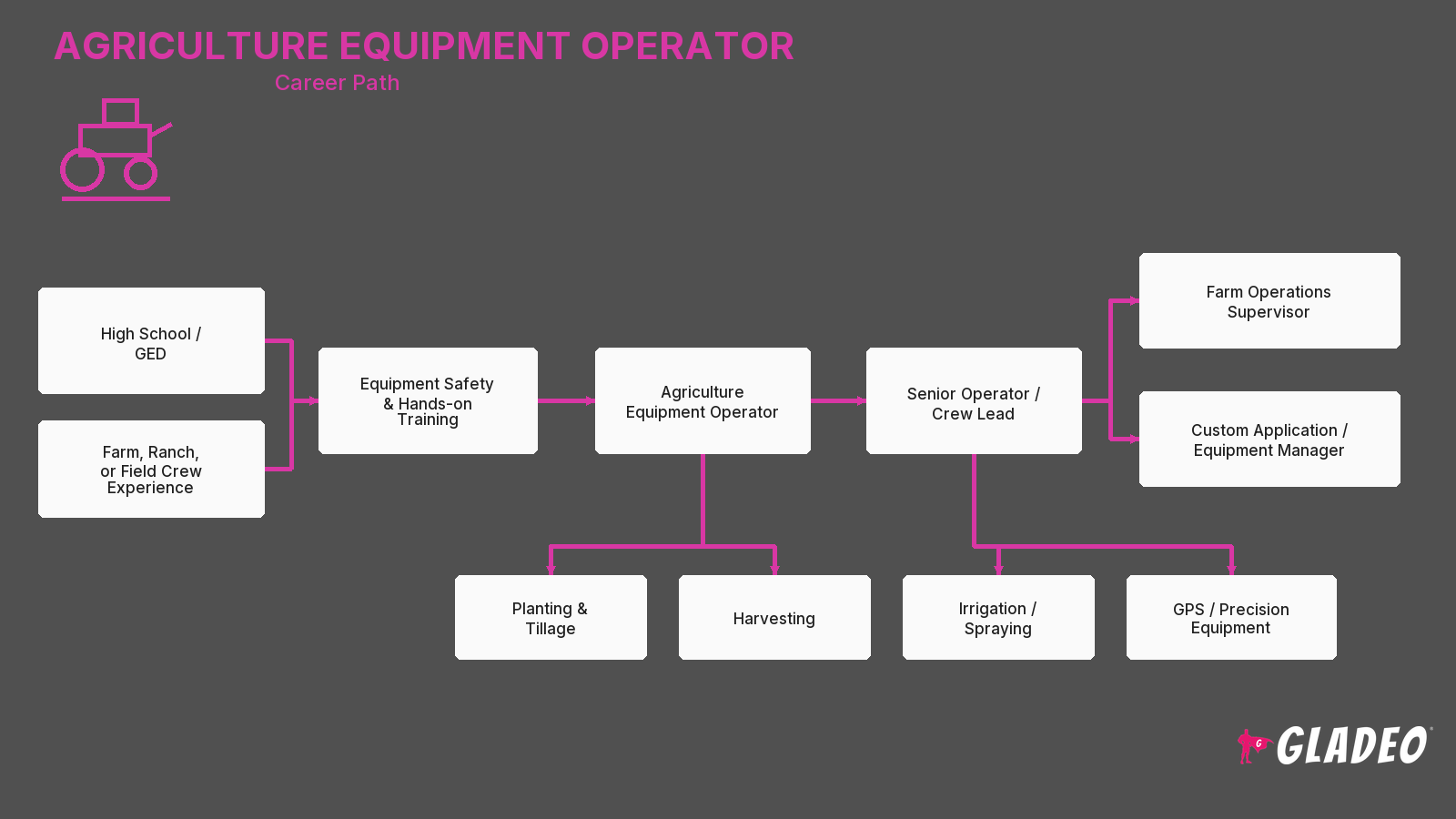
- Start as a farm laborer to understand basic farm operations and equipment
- Seek internships or apprenticeships with experienced operators
- Apply for entry-level roles like tractor driver assistant or machinery helper
- Build a safety certification portfolio, such as OSHA training
- Volunteer to learn equipment maintenance tasks
- Network with local farmers and agricultural businesses
- Create a resume highlighting mechanical skills and any hands-on experience
- Practice operating smaller or older equipment to build confidence
- Attend agricultural job fairs and machinery expos
- Join agricultural clubs to meet professionals and mentors
- Prepare for interviews by learning common equipment terminology
- Show willingness to work flexible hours and outdoors
- Gain certifications in advanced machinery operation and safety
- Learn to operate multiple types of agricultural equipment
- Develop mechanical repair and troubleshooting skills
- Build strong relationships with farm managers and mechanics
- Take leadership roles in farm teams or equipment crews
- Stay current with new agricultural technologies and software
- Pursue formal education in agricultural machinery or technology
- Consider specializing in precision agriculture or equipment maintenance
Websites:
- National FFA Organization (ffa.org)
- American Society of Agricultural and Biological Engineers (asae.org)
- Equipment World (equipmentworld.com)
- Farm Equipment Manufacturers Association (fema.org)
- PrecisionAg Alliance (precisionag.org)
- National Agricultural Safety Database (nasdonline.org)
- AgCareers.com (agcareers.com)
- TractorHouse (tractorhouse.com)
- National Institute for Farm Safety (farmingsafety.org)
- Agricultural Equipment Technology Foundation (aetf-farmsafety.org)
- Modern Farmer (modernfarmer.com)
- Farm Progress (farmprogress.com)
- AgWeb (agweb.com)
- The Progressive Farmer (dtnpf.com)
Books:
- Tractor and Machinery Management by John Deere Publishing
- Farm Machinery and Equipment by Frank R. Spellman
- Introduction to Agricultural Engineering Technology by Harry L. Field
- Agricultural Mechanics: Fundamentals & Applications by Ray V. Herren
- Precision Agriculture Technology for Crop Farming by Qin Zhang
If you enjoy working with machinery and agriculture but want to explore other options, there are several related careers that use similar skills and interests.
- Agricultural Technician
- Farm Manager
- Equipment Maintenance Technician
- Irrigation Specialist
- Landscape Equipment Operator
- Heavy Equipment Operator
- Agricultural Sales Representative
- Soil and Plant Scientist
- Construction Equipment Operator
- Environmental Technician
Newsfeed

Featured Jobs
Online Courses and Tools