






Spotlights
Research Scientist (AI), Machine Learning Research Scientist, AI Research Fellow, Postdoctoral Researcher in AI, Applied Research Scientist, Computer Science Researcher, Cognitive Computing Researcher, Artificial Intelligence Theorist, Research Professor in AI, Principal Research Scientist
The transformer architecture behind today's chatbots, the diffusion models behind AI image generators, and the reinforcement learning techniques behind computers that master complex games all began the same way: as an idea written down by a researcher who then spent months, sometimes years, testing whether it actually worked, failing hundreds of times along the way. Turning bold ideas about how intelligence might work into proven, published results is the job of the AI Research Scientist.
Unlike engineers who build products people use directly, AI Research Scientists work inside research labs, either at universities or inside the dedicated research divisions of technology companies, asking questions nobody has fully answered yet. They formulate original hypotheses about how a new algorithm or architecture might behave, design careful experiments to test those ideas, and write up their findings in papers that go through rigorous peer review before being shared with the world. Along the way they collaborate closely with fellow researchers, graduate students, and sometimes engineers who help scale a promising idea beyond a small experiment.
Using deep mathematical theory, programming in Python and frameworks like PyTorch or JAX, and access to research computing clusters, AI Research Scientists push the boundaries of what artificial intelligence can do. Their published work often becomes the foundation that engineers, product teams, and entire industries build on years later, meaning a paper that seems purely academic today can end up shaping technology everyone uses tomorrow.
- Being among the first people in the world to discover whether a new idea actually works
- Contributing research that can shape the future of an entire field, not just one product
- Having the intellectual freedom to pursue deep, open-ended questions
- Publishing work that other researchers build on for years to come
Working Schedule
Most AI Research Scientists work full-time, though the schedule is often more flexible and self-directed than in product-focused roles, with intense periods of focused work before major conference deadlines. The work happens mostly at a computer or whiteboard, split between reading papers, designing experiments, writing code, and discussing ideas with collaborators. Research Scientists are employed by universities as professors, by corporate research labs at large technology companies, by government research agencies, or by nonprofit research institutes.
Typical Duties
- Formulating original research questions and hypotheses
- Designing and running experiments to test new algorithms or architectures
- Reading and critically evaluating recently published research
- Writing papers for submission to peer-reviewed conferences and journals
- Presenting findings at academic and industry conferences
- Collaborating with other researchers and doctoral students on shared projects
- Mentoring junior researchers, students, or interns
- Applying for research funding or grants to support ongoing work
- Reviewing other researchers' papers as part of the peer review process
- Building prototype implementations of new theoretical ideas
- Maintaining detailed records of experiments and results
- Participating in research seminars and reading groups
Additional Responsibilities
- Serving on conference program committees that decide which papers get published
- Advising companies or startups on how emerging research applies to real products
- Teaching or guest lecturing on AI topics
- Contributing to open-source releases of research code
- Staying current across a broad and fast-growing body of literature
- Communicating complex findings to non-technical stakeholders or the public
- Managing a small team of researchers or students on larger projects
An AI Research Scientist's day often starts with reading, whether that is a newly published paper relevant to an ongoing project or notes from an experiment that finished running overnight. Understanding whether a result is meaningful or just noise often takes careful, unhurried thought.
Midday is usually spent designing or refining experiments, writing code to test a new idea, or working through the math behind why something might or might not work. Much of this time involves genuine uncertainty, since most experiments in cutting-edge research do not succeed on the first, second, or even tenth try. There are often discussions with collaborators or students, working through a stuck problem together or debating what a surprising result might mean.
Afternoons often involve writing, whether drafting a section of a paper, preparing a conference presentation, or reviewing a colleague's draft before submission. Research Scientists also spend time in seminars or reading groups, staying connected to a global community that is constantly publishing new ideas, and reflecting on which threads are worth pursuing further and which are dead ends.
Soft Skills
- Deep intellectual curiosity
- Comfort with uncertainty and repeated failure
- Rigorous, skeptical critical thinking
- Patience for long-term projects that may take months or years to pay off
- Strong written and verbal communication
- Creativity in framing entirely new research questions
- Collaboration across disciplines and institutions
- Resilience in the face of rejected papers and unfunded grant proposals
- Careful attention to methodological detail
- Independence and self-direction in choosing what to pursue
- Ability to explain complex, technical ideas in simple terms
Technical Skills
- Advanced mathematics, including linear algebra, probability, and optimization
- Deep understanding of machine learning theory
- Programming in Python and deep learning frameworks like PyTorch, JAX, or TensorFlow
- Experimental design and statistical analysis
- Scientific and technical writing for publication
- Literature review and research methodology
- Familiarity with high-performance and research computing environments
- Version control and reproducible research practices
- Deep expertise in a specific subfield, such as reinforcement learning or generative models
- Ability to read, critique, and build on dense academic papers
- Academic Research Scientist: Works as a professor, combining research with teaching and advising students
- Industry Research Scientist: Works inside a corporate AI lab pursuing long-term, fundamental research
- Applied Research Scientist: Bridges cutting-edge research with practical product applications
- Theoretical AI Researcher: Focuses on the mathematical foundations of how and why AI methods work
- Reinforcement Learning Researcher: Studies how systems learn through trial, error, and reward
- Generative AI Researcher: Studies models that create text, images, audio, or video
- AI Safety and Alignment Researcher: Studies how to make advanced AI systems safe, honest, and controllable
- Universities and academic research departments
- Corporate AI research labs at major technology companies
- Government research agencies and national laboratories
- Nonprofit AI research institutes
- Defense and national security research organizations
- Scientific research institutions in fields like biology or physics applying AI methods
- Medical research centers and hospitals conducting AI-driven research
- Think tanks focused on AI policy and societal impact
- Startups built around a specific research breakthrough
- Scientific computing centers and supercomputing facilities
- Professional research societies and academic publishers
- International research collaborations spanning multiple institutions
Becoming an AI Research Scientist typically requires years of graduate study, often five to seven years for a PhD, before landing a full-time research position, and the path can feel long compared to more direct routes into engineering roles. Along the way, most researchers face repeated rejection, whether from conferences that decline a submitted paper or grant committees that decline to fund a proposed project, and learning to keep going despite that rejection is part of the job.
Competition for the most sought-after research positions, especially at top labs and universities, is intense, and the pressure to keep publishing meaningful work, sometimes summarized as "publish or perish," can weigh heavily over an entire career. Many promising ideas simply do not work, and researchers must be comfortable spending months on a project that ultimately leads nowhere publishable.
The pace of literature is overwhelming, with thousands of new papers appearing every year across AI subfields. Staying genuinely current, rather than just skimming headlines, requires real ongoing effort, and researchers who fall behind can find it hard to keep contributing meaningfully to fast-moving areas.
- Research into scaling laws and the emergent abilities that appear in very large models
- Growing focus on interpretability, trying to understand what is actually happening inside neural networks
- Expansion of AI safety and alignment research as models become more capable
- Research into multimodal foundation models that combine text, images, audio, and video
- Growing interest in smaller, more efficient models alongside ever-larger ones
- Continued growth of open science and preprint culture through platforms like arXiv
- Increased attention to reproducibility and rigor amid concerns about overstated results
- Deepening collaboration between academic labs and industry research divisions
- Rising public and policy attention on AI research and its societal implications
- Growth of interdisciplinary research applying AI to biology, chemistry, and physics
Many AI Research Scientists grew up loving math competitions, science fairs, chess, or any activity that rewarded deep, patient thinking about a hard problem. They were often the kind of kid who kept asking "why" long after everyone else had moved on, and who genuinely enjoyed being stuck on a problem rather than being frustrated by it.
Others found their spark in reading about science and discovery, tinkering with coding or logic puzzles, or debating ideas just for the fun of testing them. A comfort with not knowing the answer yet, paired with genuine excitement about eventually finding out, often carried directly into a career built around original research.
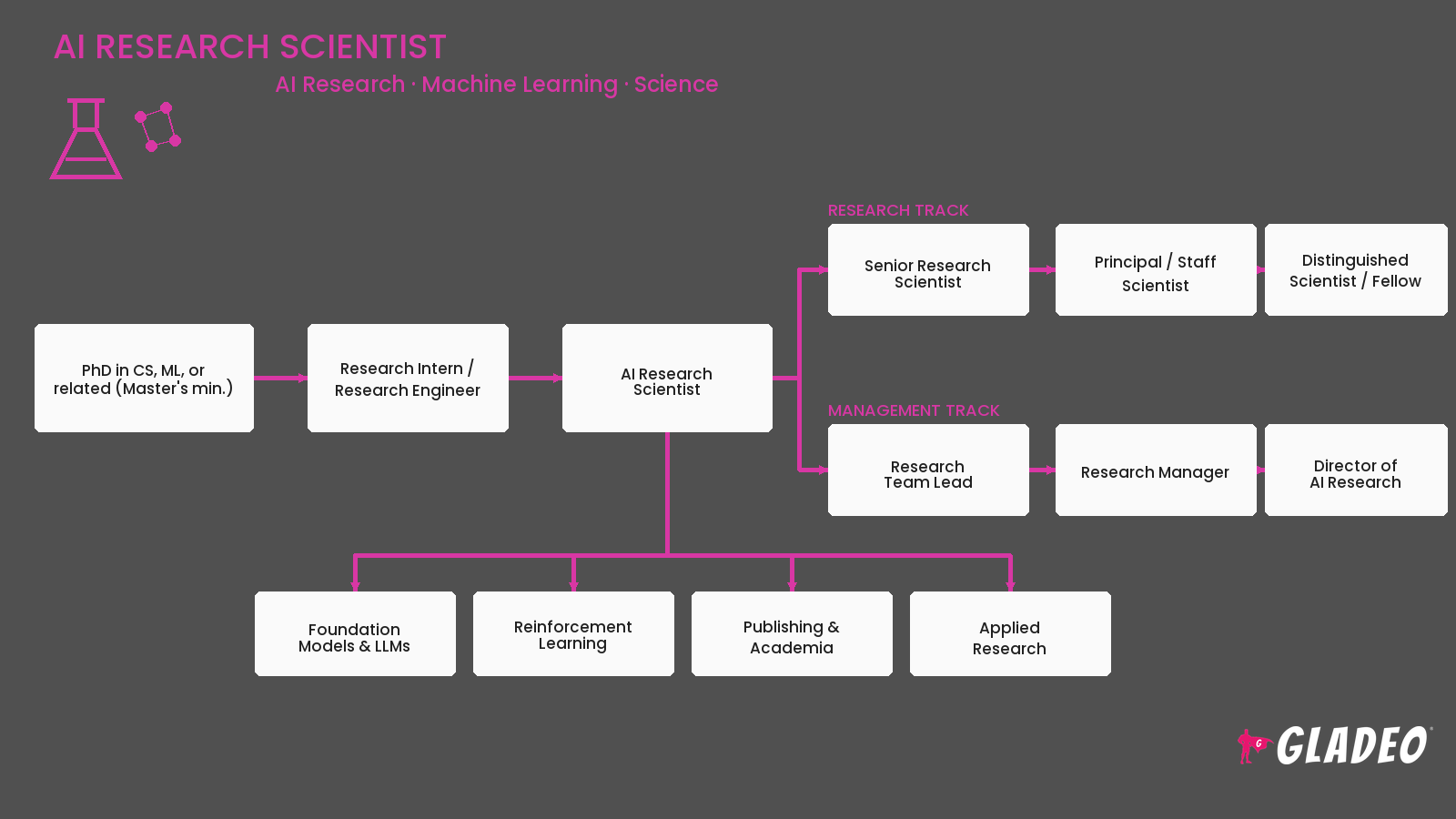
Becoming an AI Research Scientist usually requires a PhD in computer science, artificial intelligence, mathematics, or a closely related field, since most research positions expect candidates to have already led an original research project from question to publication. Some applied research roles accept candidates with a master's degree and strong, demonstrated research experience, but the most research-intensive positions, especially in academia, almost always require doctoral-level training.
Students can take courses in relevant subjects such as:
- Advanced Calculus and Linear Algebra
- Probability and Statistics
- Algorithms and Computational Theory
- Machine Learning
- Deep Learning
- Research Methods
- Discrete Mathematics
- Logic and Philosophy of Science
- Scientific and Technical Writing
- Optimization Theory
Because research careers are built on a track record of original work, hands-on research experience matters enormously, often more than coursework alone. Working on an undergraduate research project, publishing a paper as a student, or completing a substantial thesis gives students real proof they can do the kind of independent, rigorous thinking the field demands.
- Take the most advanced math and science courses available, including calculus and statistics
- Join a math team, science olympiad, or research-focused club
- Learn to code and start reading introductory AI and machine learning material
- Look for a research mentor, whether a teacher, professor, or online community
- Try to complete an independent research project, even a small one, from start to finish
- Enter science fairs or research competitions that reward original thinking
- Read research papers, even difficult ones, and try to summarize the main idea in your own words
- Practice writing clearly and precisely, since research depends on communicating ideas well
- Seek a research internship or lab position during college
- Attend talks or seminars by researchers, in person or online
- Consider pursuing an undergraduate thesis or capstone research project
- Talk to graduate students and professors about what the research path actually involves
- Strong research opportunities for undergraduates, not just coursework
- Faculty actively publishing in AI venues you recognize, like NeurIPS or ICML
- Access to computing resources sufficient for real machine learning experiments
- A track record of graduates who go on to strong PhD programs or research roles
- Small class sizes or seminars that allow close mentorship
- Support for attending or presenting at academic conferences
- A collaborative research culture rather than a purely competitive one
- Funding opportunities for graduate study, since PhD programs are typically funded
- Advisor fit, meaning a mentor whose research interests genuinely overlap with yours
- Strong coursework in both theoretical foundations and practical implementation
- Opportunities to co-author a paper before finishing your degree
- Alumni or career networks connected to major research labs and universities
- Publish or co-author a research paper as early as possible, even a modest one
- Complete a strong master's thesis or PhD dissertation showcasing original work
- Apply for research internships at major AI labs and universities during your studies
- Build a public presence by sharing code, blog posts, or talks about your research
- Attend and present at academic conferences to build a research network
- Seek a research advisor whose work genuinely excites you, not just a famous name
- Apply broadly to postdoctoral positions if you are coming from a PhD program
- Practice presenting your research clearly to both experts and non-experts
- Network with current researchers through conferences, seminars, and online communities
- Be prepared to relocate, since top research positions are concentrated in a handful of hubs
- Highlight your ability to work independently and push through failed experiments
- Consider applied research roles at companies if a pure academic path is not the right fit
- Build a consistent publication record at respected conferences and journals
- Take on a postdoctoral position to deepen expertise before a permanent role
- Develop a distinct research identity or specialty that other researchers recognize
- Mentor graduate students, junior researchers, or interns
- Secure research funding or grants to support larger, more ambitious projects
- Build a strong professional network through conferences and collaborations
- Take on leadership of a research team or lab as your track record grows
- Pursue tenure-track professorship, principal scientist, or research lab leadership roles
Websites:
- arXiv.org - arxiv.org
- NeurIPS - neurips.cc
- ICML - icml.cc
- ICLR - iclr.cc
- Papers with Code - paperswithcode.com
- Distill.pub - distill.pub
- Google DeepMind Research - deepmind.google/research
- Anthropic Research - anthropic.com/research
- Allen Institute for AI (AI2) - allenai.org
- MIT CSAIL - csail.mit.edu
- ACM Digital Library - dl.acm.org
- Association for the Advancement of Artificial Intelligence (AAAI) - aaai.org
- Hugging Face - huggingface.co
Books:
- Artificial Intelligence: A Modern Approach by Stuart Russell and Peter Norvig
- Deep Learning by Ian Goodfellow, Yoshua Bengio, and Aaron Courville
- Reinforcement Learning: An Introduction by Richard S. Sutton and Andrew G. Barto
- The Master Algorithm by Pedro Domingos
- Genius Makers by Cade Metz
If you find that being an AI Research Scientist isn't the right fit, your skills in rigorous thinking, math, and independent problem solving transfer well to many related careers.
- Deep Learning Engineer
- Machine Learning Engineer
- Data Scientist
- University Professor
- AI Policy Analyst
- Science Journalist or Writer
- Applied Mathematician
- Software Engineer
- Research Program Manager
Newsfeed

Featured Jobs
Online Courses and Tools