





Spotlights
Bioprocessing Technologist, Biomass Processing Specialist, Renewable Resources Technologist, Biofuel Technologist, Biomaterials Technician, Sustainable Energy Technologist, Bioenergy Engineer, Biomass Conversion Specialist, Green Technology Technologist, Industrial Biotechnology Technician, Environmental Bioprocess Engineer, Fermentation Technologist
Imagine turning plants, algae, and waste materials into clean energy, sustainable chemicals, and biodegradable products that help protect our planet’s future. Biorefining Technologists are the hidden heroes behind these green innovations, making it possible for consumers to use eco-friendly fuels and products every day.
Biorefining Technologists develop, test, and optimize processes that convert biomass—organic materials like crops, wood, and waste—into valuable products such as biofuels, bioplastics, and chemicals. They collaborate closely with engineers, chemists, environmental scientists, and production teams to scale these processes from the lab to industrial plants, ensuring efficiency, safety, and sustainability.
Using advanced analytical instruments, bioreactors, and computer modeling software, they monitor chemical reactions and biological processes to maximize output and reduce waste. Their work is vital to reducing reliance on fossil fuels, lowering greenhouse gas emissions, and advancing renewable energy technologies that impact industries and communities worldwide.
- Contributing to a greener, more sustainable future by turning waste into valuable resources.
- Seeing scientific research come to life in real-world applications that reduce pollution and protect ecosystems.
- Collaborating with a diverse team of experts to solve complex environmental challenges.
- Continuous learning and innovation in cutting-edge biotechnology and renewable energy fields.
Working Schedule
Biorefining Technologists typically work full-time in a laboratory, pilot plant, or industrial settings. Their schedule often follows regular daytime hours, but may include extended shifts or overtime when projects require meeting deadlines or during plant start-ups. Work environments can range from clean labs to industrial facilities, sometimes involving exposure to chemicals and machinery, demanding strict adherence to safety protocols.
Typical Duties
- Design and conduct experiments to develop biomass conversion processes.
- Operate and monitor bioreactors and other processing equipment.
- Analyze chemical and biological samples using spectroscopy, chromatography, and microscopy.
- Optimize process parameters like temperature, pH, and pressure for maximum yield.
- Collaborate with engineers to scale up lab processes to pilot and industrial scale.
- Prepare detailed reports and documentation of experimental results.
- Implement quality control measures to ensure product consistency.
- Troubleshoot process issues and recommend improvements.
- Ensure compliance with environmental and safety regulations.
- Participate in interdisciplinary project meetings and technology evaluations.
- Maintain laboratory and equipment cleanliness and calibration.
- Support technology transfer activities from R&D to manufacturing.
Additional Responsibilities
- Stay updated on emerging biorefining technologies and patents.
- Train junior technicians and interns in laboratory procedures.
- Assist in preparing grant proposals and research funding applications.
- Contribute to sustainability assessments and life cycle analyses.
- Engage with suppliers and vendors for sourcing raw materials and equipment.
- Participate in public outreach or educational events related to renewable resources.
- Develop standard operating procedures (SOPs) for new processes.
- Support environmental compliance audits and reporting.
Morning often starts with reviewing data from overnight experiments and preparing for new testing protocols. Technologists check equipment status and ensure safety measures are in place before beginning work.
Midday involves hands-on operation of bioprocessing equipment, collecting samples, and running analyses in the lab. They collaborate with engineers and scientists to discuss results and adjust process variables as needed.
Afternoons focus on documenting findings, meeting with project teams to plan next steps, and troubleshooting any issues that arose during the day. They may also attend training sessions or review scientific literature to stay informed on industry advances.
Soft Skills
- Problem-solving mindset
- Attention to detail
- Strong communication skills
- Team collaboration
- Adaptability to changing technologies
- Critical thinking
- Time management
- Patience and persistence
- Safety awareness
- Curiosity and eagerness to learn
- Organizational skills
- Analytical mindset
Technical Skills
- Knowledge of bioprocess engineering principles
- Experience with bioreactors and fermentation systems
- Analytical chemistry techniques (chromatography, spectroscopy)
- Data analysis and interpretation
- Process optimization
- Computer modeling and simulation software
- Laboratory safety protocols
- Quality control methods
- Familiarity with renewable energy technologies
- Technical documentation and reporting
- Biofuel Technologist: Focuses on converting biomass into fuels like ethanol and biodiesel.
- Biomaterials Technologist: Develops biodegradable materials from renewable resources.
- Fermentation Technologist: Specializes in microbial processes to produce chemicals and fuels.
- Waste-to-Energy Technologist: Converts organic waste into energy products.
- Industrial Biotechnology Technologist: Applies biotech in manufacturing processes beyond fuels.
- Algae Bioprocessing Technologist: Uses algae as a raw material for bio-products.
- Renewable Chemicals Technologist: Creates sustainable chemicals from biomass.
- Sustainability Analyst: Evaluates the environmental impact of biorefining processes.
- Renewable energy companies
- Biotechnology firms
- Agricultural processing plants
- Environmental consultancies
- Government research labs
- Universities and academic institutions
- Chemical manufacturing companies
- Waste management organizations
- Nonprofit environmental groups
- Biofuel production facilities
- Industrial biotech startups
- Energy policy organizations
Biorefining Technologists often work under pressure to meet project deadlines and production targets, especially when scaling up experimental processes to industrial levels. They must balance innovation with safety and regulatory compliance, which can require careful attention and problem-solving under stress.
Work hours are generally standard but can extend during critical phases like plant commissioning or troubleshooting. Some roles may involve shift work, especially in production facilities operating 24/7, requiring flexibility and stamina.
The role demands physical stamina for standing in labs and industrial settings, along with mental focus to analyze complex data and troubleshoot processes. Repeated trial-and-error experimentation can be challenging but is essential for breakthrough innovations.
- Increasing use of synthetic biology to engineer microorganisms for improved biomass conversion.
- Integration of artificial intelligence and machine learning in process optimization.
- Growing focus on circular economy principles to minimize waste and maximize resource use.
- Development of new feedstocks like algae and agricultural residues.
- Advancements in enzyme technology to speed up bioprocesses.
- Greater emphasis on carbon capture and utilization within biorefineries.
- Expansion of decentralized, smaller-scale biorefineries near raw material sources.
- Stronger environmental regulations driving cleaner production methods.
- Improved automation and real-time monitoring technologies.
- Collaboration between industry and academia for faster technology transfer.
Many Biorefining Technologists enjoyed tinkering with science kits, conducting experiments at home, or exploring nature to understand how plants and organisms work. They often showed curiosity about sustainability and how to protect the environment from a young age.
They gravitated toward science classes like biology and chemistry, and had interests in technology, problem solving, and innovation. Early participation in science fairs, environmental clubs, or agricultural projects often sparked their passion for bioprocessing and renewable energy.
Becoming a Biorefining Technologist usually involves earning a bachelor's degree in biotechnology, chemical engineering, environmental science, or a related field. Specialized training in bioprocessing, renewable energy, and industrial microbiology prepares students for this hands-on and technical role.
Students can take courses in relevant subjects such as:
- Biology and Microbiology
- Chemistry (General and Organic)
- Chemical Engineering Principles
- Bioprocess Engineering
- Environmental Science
- Renewable Energy Technologies
- Analytical Chemistry Techniques
- Industrial Microbiology
- Data Analysis and Statistics
- Safety and Regulatory Compliance
Hands-on laboratory experience, internships, and cooperative education programs are crucial for developing practical skills. Building a portfolio of projects and gaining familiarity with industrial equipment can set candidates apart. Many technologists continue learning on the job and pursue certifications to stay current in this evolving field.
- Take advanced science classes including biology, chemistry, and environmental science.
- Join science clubs or environmental groups to explore sustainability topics.
- Participate in science fairs with projects related to energy or biotechnology.
- Seek internships or volunteer opportunities in labs or industry settings.
- Develop strong math skills, especially in algebra and calculus.
- Explore college programs offering biotechnology, chemical engineering, or renewable energy majors.
- Attend college open houses and talk to professors about bioprocessing careers.
- Consider summer programs or camps focused on science and technology.
- Build computer skills, especially in data analysis software.
- Network with professionals through career days or online platforms.
- Choose programs with strong lab and pilot plant facilities for hands-on training.
- Look for curricula that include renewable energy and environmental sustainability courses.
- Check if internships or cooperative education opportunities are available.
- Consider programs with industry partnerships for job placement support.
- Verify faculty expertise in biorefining and related research areas.
- Seek programs offering training in process simulation and data analysis software.
- Ensure the program covers safety protocols and regulatory compliance.
- Find schools that encourage interdisciplinary learning with engineering and environmental science.
- Look for opportunities to participate in research projects.
- Consider certifications in bioprocessing or renewable energy technologies.
- Apply for internships at renewable energy or biotechnology companies during college.
- Build a strong resume highlighting lab skills and relevant coursework.
- Create a portfolio documenting projects, experiments, and process optimizations.
- Network with professors and industry professionals for job leads.
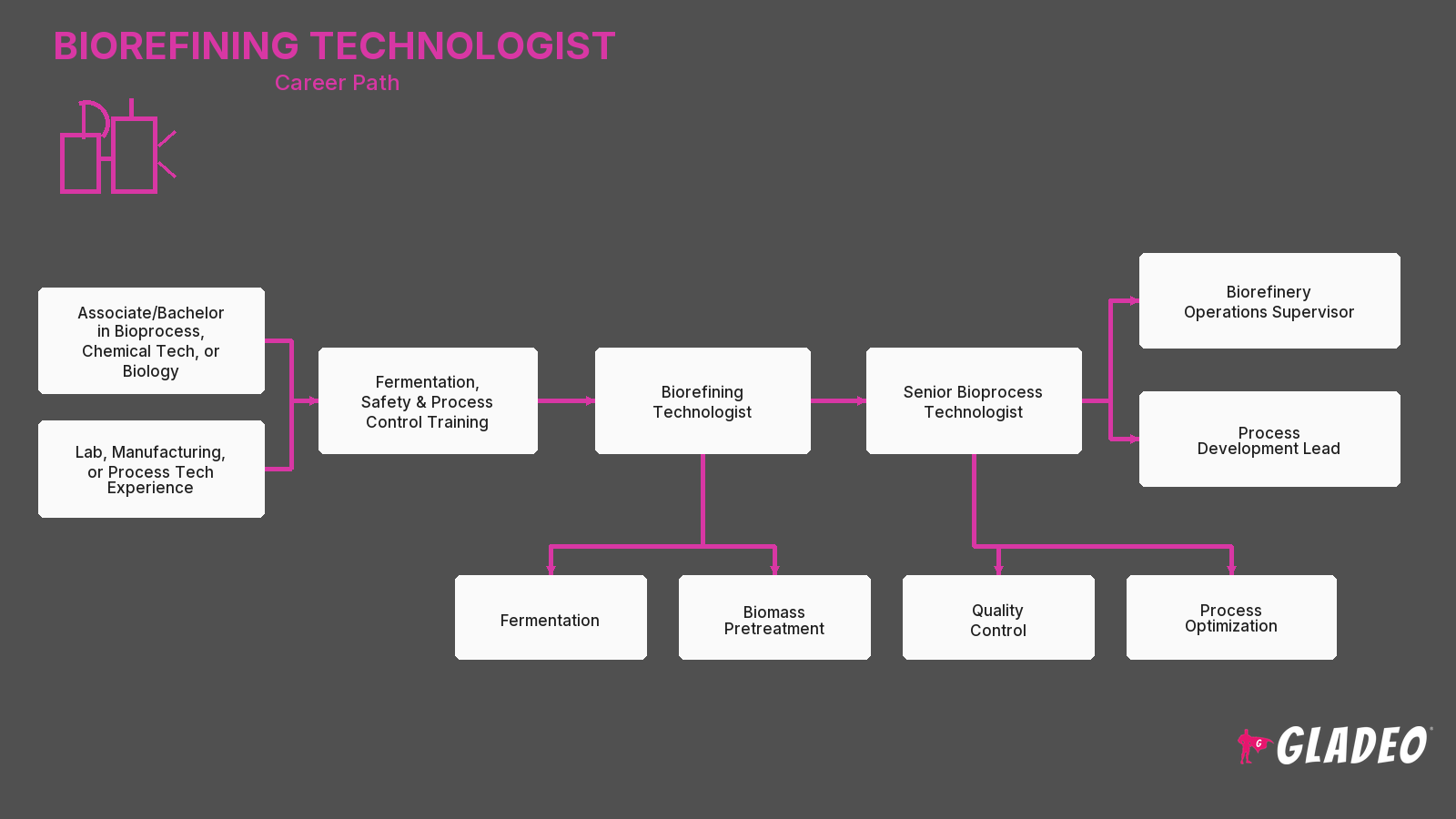
- Start in entry-level roles like lab technician or process assistant.
- Gain experience operating bioreactors and analytical instruments.
- Seek mentorship from experienced technologists or engineers.
- Attend industry conferences and workshops to learn and connect.
- Develop proficiency with process modeling and data analysis tools.
- Demonstrate safety awareness and teamwork in all tasks.
- Be prepared to work flexible hours during pilot plant operations.
- Stay curious and proactive in learning new bioprocessing techniques.
- Pursue advanced education such as a master's degree in biotechnology or chemical engineering.
- Gain certifications in process engineering or renewable energy.
- Develop leadership and project management skills.
- Build expertise in advanced bioprocessing technologies and data analytics.
- Network within professional associations and attend industry events.
- Seek roles with increasing responsibility, such as lead technologist or process engineer.
- Collaborate on research and development projects to innovate new methods.
- Consider transitioning to consulting or policy roles in sustainability and energy.
Websites:
- Biotechnology Innovation Organization (bio.org)
- Renewable Fuels Association (ethanolrfa.org)
- American Chemical Society (acs.org)
- International Society for Industrial Ecology (is4ie.org)
- Society for Industrial Microbiology and Biotechnology (simbhq.org)
- National Renewable Energy Laboratory (nrel.gov)
- American Society of Agricultural and Biological Engineers (asabeforum.org)
- Clean Energy States Alliance (cleanenergystates.org)
- Green Chemistry Initiative (greenchemistry.net)
- Bioprocess International (bioprocessintl.com)
- Environmental Protection Agency - Renewable Energy (epa.gov/renewable-energy)
- European Biorefinery Industries Consortium (ebic.bio)
- Biomass Magazine (biomassmagazine.com)
- Energy.gov - Bioenergy Technologies Office (energy.gov/eere/bioenergy)
Books:
- Biorefineries: Industrial Processes and Products by Sunita Varjani and Ajay Kumar Mishra
- Introduction to Biochemical Engineering by Douglas S. Clark and Frank J. V. Hoekstra
- Renewable Energy: Power for a Sustainable Future by Godfrey Boyle
- Bioprocess Engineering Principles by Pauline M. Doran
- Green Chemistry and Engineering by Anne E. Marteel-Parrish and Martin A. Abrahamson
If biorefining isn’t the perfect fit, your skills and interests can lead you to other exciting careers that blend science, technology, and sustainability.
- Chemical Technician
- Environmental Scientist
- Process Engineer
- Quality Control Analyst
- Agricultural Scientist
- Renewable Energy Consultant
- Microbiologist
- Laboratory Technician
- Sustainability Coordinator
- Waste Management Specialist
Newsfeed

Featured Jobs
Online Courses and Tools