







Spotlights
Computer Vision Scientist, Image Processing Engineer, Visual AI Engineer, Perception Engineer, Machine Vision Engineer, Computer Vision Researcher, Video Analytics Engineer, Robotics Vision Engineer, Autonomous Systems Perception Engineer, Deep Learning Vision Engineer
Your phone unlocking the instant it sees your face, a self-driving car spotting a pedestrian stepping off a curb, a factory camera catching a hairline crack in a part before it ships, or a doctor's scan getting flagged the moment it shows something worth a second look, all of it depends on machines learning to "see" the way humans do, and often catching things humans miss. Building that sight is the job of the Computer Vision Engineer.
Computer Vision Engineers design and train systems that interpret images and video, detecting objects, recognizing faces, segmenting scenes into meaningful parts, or spotting defects invisible to a quick glance. They work closely with robotics engineers, hardware engineers, data annotators, and product teams to make sure a system that performs well in a lab also performs well in the messy, unpredictable real world, whether that is a factory floor, a busy street, or a hospital.
Using tools like OpenCV, PyTorch or TensorFlow, convolutional neural networks and vision transformers, along with cameras, sensors, and sometimes LiDAR, Computer Vision Engineers turn raw pixels into decisions a machine can act on. Their work keeps self-driving cars safer, factories running with fewer defective products slipping through, security systems more reliable, and medical imaging tools more accurate, turning "seeing" into one of the most powerful tools in modern technology.
- Watching a system you built correctly identify something in the real world for the first time
- Working on technology with real safety stakes, like autonomous vehicles and medical imaging
- Solving visually intuitive problems that combine math, engineering, and creativity
- Seeing your work used in exciting, cutting-edge fields like robotics and manufacturing
Working Schedule
Most Computer Vision Engineers work full-time, typically standard business hours, though testing in real-world conditions, such as on a factory floor or during a vehicle test drive, can require early mornings or irregular hours. The work splits between coding at a desk, reviewing model performance on test data, and time in a lab or field setting testing with real cameras and hardware. Most are employed by technology companies, automotive and robotics manufacturers, or the tech divisions of manufacturing and healthcare companies, while some work as contractors on specific projects.
Typical Duties
- Collecting and annotating image and video datasets for training
- Training and fine-tuning object detection and segmentation models
- Evaluating model accuracy against real-world test sets, not just clean lab data
- Optimizing models to run in real time on cameras, phones, or embedded hardware
- Integrating vision models with cameras, sensors, and robotic systems
- Debugging failure cases caused by lighting, occlusion, angle, or motion blur
- Building data pipelines that support continual retraining as new footage comes in
- Collaborating with hardware, robotics, and product teams on system integration
- Testing systems under real field conditions, not just simulated environments
- Writing technical documentation and benchmarking reports
- Benchmarking models against strict latency and accuracy targets
Additional Responsibilities
- Staying current on new computer vision architectures and research
- Contributing to safety and compliance reviews for regulated applications
- Managing datasets and coordinating with labeling vendors or annotation teams
- Mentoring junior engineers on vision-specific debugging techniques
- Presenting live demos of vision systems to stakeholders and customers
- Contributing improvements back to open-source computer vision tools
A Computer Vision Engineer's day often starts with reviewing overnight training results and checking whether a model's accuracy improved on the latest test set. If a model is underperforming on certain kinds of images, the first task is often digging through examples to understand exactly where and why it fails.
Midday is usually spent building and testing, whether that means fine-tuning a detection model, writing code to optimize it for faster inference on a device, or setting up a new test with a camera in the lab. If a robotics or hardware team needs the vision system integrated into a physical product, there is often hands-on time connecting code to real cameras and sensors and watching how it performs live.
Afternoons often involve reviewing tricky failure cases together with teammates, such as a model that struggles with glare, shadows, or unusual angles, and brainstorming fixes like better data augmentation or a different model architecture. Before wrapping up, engineers often document findings and update the annotation guidelines so the next batch of training data addresses the gaps they found.
Soft Skills
- Strong visual and spatial thinking
- Patience with long, iterative debugging cycles
- Attention to detail when reviewing test results and failure cases
- Curiosity about how humans and machines perceive the world differently
- Problem-solving under real-world constraints like lighting and hardware limits
- Clear communication with hardware, robotics, and product teams
- Adaptability as new model architectures and tools emerge
- Persistence through long model training and testing cycles
- Teamwork across engineering, hardware, and business functions
- Safety-mindedness, especially for high-stakes applications
- Creativity in designing data augmentation and testing strategies
Technical Skills
- Python programming for model development and data pipelines
- OpenCV for classic image processing and computer vision tasks
- PyTorch or TensorFlow for deep learning model development
- Convolutional neural networks and vision transformer architectures
- Object detection frameworks such as YOLO and Detectron2
- Image and video annotation tools like CVAT or Labelbox
- Camera and sensor calibration techniques
- GPU programming and CUDA for performance-critical code
- Model optimization techniques like quantization, pruning, and TensorRT
- Basic 3D geometry and camera math for depth and spatial reasoning
- Object Detection Engineer: Builds systems that find and classify objects within images
- Image Segmentation Specialist: Builds models that divide an image into precise regions or objects
- Facial Recognition Engineer: Builds systems that identify or verify people from images
- Autonomous Vehicle Perception Engineer: Builds vision systems that help self-driving cars understand the road
- Manufacturing Defect Detection Engineer: Builds systems that spot flaws in products on a production line
- Medical Imaging Vision Engineer: Builds models that help analyze x-rays, scans, and other medical images
- Video Analytics and Surveillance Engineer: Builds systems that analyze video streams for security or business insight
- Automotive and autonomous vehicle companies
- Robotics and automation companies
- Manufacturing and industrial quality control companies
- Healthcare and medical imaging companies
- Security and surveillance technology companies
- Agriculture technology companies using drone and field imagery
- Retail and e-commerce companies using visual search and inventory tracking
- Aerospace and defense contractors
- Social media and photo-sharing platforms
- Consumer electronics companies building cameras and smart devices
- Government agencies and research labs
- Sports and media companies using video analytics
Computer Vision Engineers often work on systems where mistakes carry real consequences, whether that is a self-driving car misidentifying an obstacle or a medical imaging tool missing something important. That responsibility means extra care in testing and a healthy respect for how much can go wrong when a system meets the messy real world instead of a clean lab dataset.
Training and testing cycles can be long, sometimes taking days to train a model and additional days to properly evaluate it against enough real-world scenarios. Waiting for results, only to discover a subtle flaw and start over, is a normal and sometimes frustrating part of the job.
The field also raises real ethical questions, particularly around facial recognition and surveillance technology, and engineers are often expected to think carefully about privacy, consent, and fairness, not just accuracy. Balancing technical ambition with responsible use of the technology is an ongoing part of the work.
- Rise of vision transformers as an alternative to traditional convolutional networks
- Growth of multimodal models that combine vision with language understanding
- Expansion of edge AI, running vision models directly on cameras and devices
- Increasing use of synthetic data to train models when real data is scarce or expensive
- Advances in 3D scene understanding for robotics and autonomous vehicles
- Growth of self-supervised pretraining, reducing the need for massive labeled datasets
- Expansion of real-time video analytics for retail, security, and sports
- Rapid growth of autonomous vehicle and robotics perception systems
- Increasing regulation and public scrutiny of facial recognition and surveillance technology
- Wider use of vision AI in agriculture, construction, and industrial inspection
Many Computer Vision Engineers grew up loving photography, video games, or building and taking apart cameras and gadgets. They enjoyed puzzles that involved noticing patterns or spotting the difference between two nearly identical images.
Others were drawn to robotics kits, drones, or building things that could sense and react to the world around them. A fascination with how eyes and brains process images, paired with an interest in coding or engineering, often carried directly into a career spent teaching machines to see.
Most Computer Vision Engineers hold a bachelor's degree in computer science, electrical engineering, or a related field, and many pursue a master's degree for research-focused or advanced roles. A strong foundation in math, particularly linear algebra and calculus, is essential, since computer vision relies heavily on geometry and matrix operations.
Students can take courses in relevant subjects such as:
- Linear Algebra
- Computer Vision
- Machine Learning
- Signal and Image Processing
- Data Structures and Algorithms
- Robotics
- Multivariable Calculus
- Deep Learning
- Computer Architecture
- Probability and Statistics
Hands-on experience with real cameras and real-world image data is essential, since textbook datasets rarely capture the messiness of actual lighting, angles, and motion. Building and testing personal projects, whether a hobby robot, a security camera system, or an image classifier, gives students a real edge when applying for jobs.
- Take math courses through calculus and linear algebra, since vision relies heavily on geometry
- Learn to code in Python and experiment with basic image processing libraries
- Join a robotics team or club that works with cameras and sensors
- Build a personal project, like a simple object detector or a photo classifier
- Take a physics class to understand how light, lenses, and cameras work
- Enter science fairs or competitions involving robotics or computer vision
- Learn the basics of a computer vision library like OpenCV on your own
- Practice photography to build intuition for lighting, angles, and composition
- Study statistics and probability, which underpin most vision models
- Visit a local robotics, automotive, or manufacturing company for a tour or job shadow
- Seek internships or part-time projects involving cameras, sensors, or image data
- Talk to computer vision engineers about what their work actually looks like day to day
- Strong coursework in linear algebra, calculus, and applied math
- Dedicated computer vision or image processing courses, not just general AI
- Access to modern GPU hardware and cameras for hands-on projects
- Faculty with research or industry experience in vision or robotics
- A capstone or lab project involving a real vision system
- Coverage of both classical computer vision and modern deep learning approaches
- Strong ties to internships with robotics, automotive, or manufacturing companies
- Exposure to real-world, messy datasets, not only clean benchmark data
- Career services with connections to computer vision employers
- Opportunities to work with robotics, drones, or embedded hardware
- A community of peers working on vision or robotics projects
- Up-to-date curriculum that keeps pace with fast-moving research
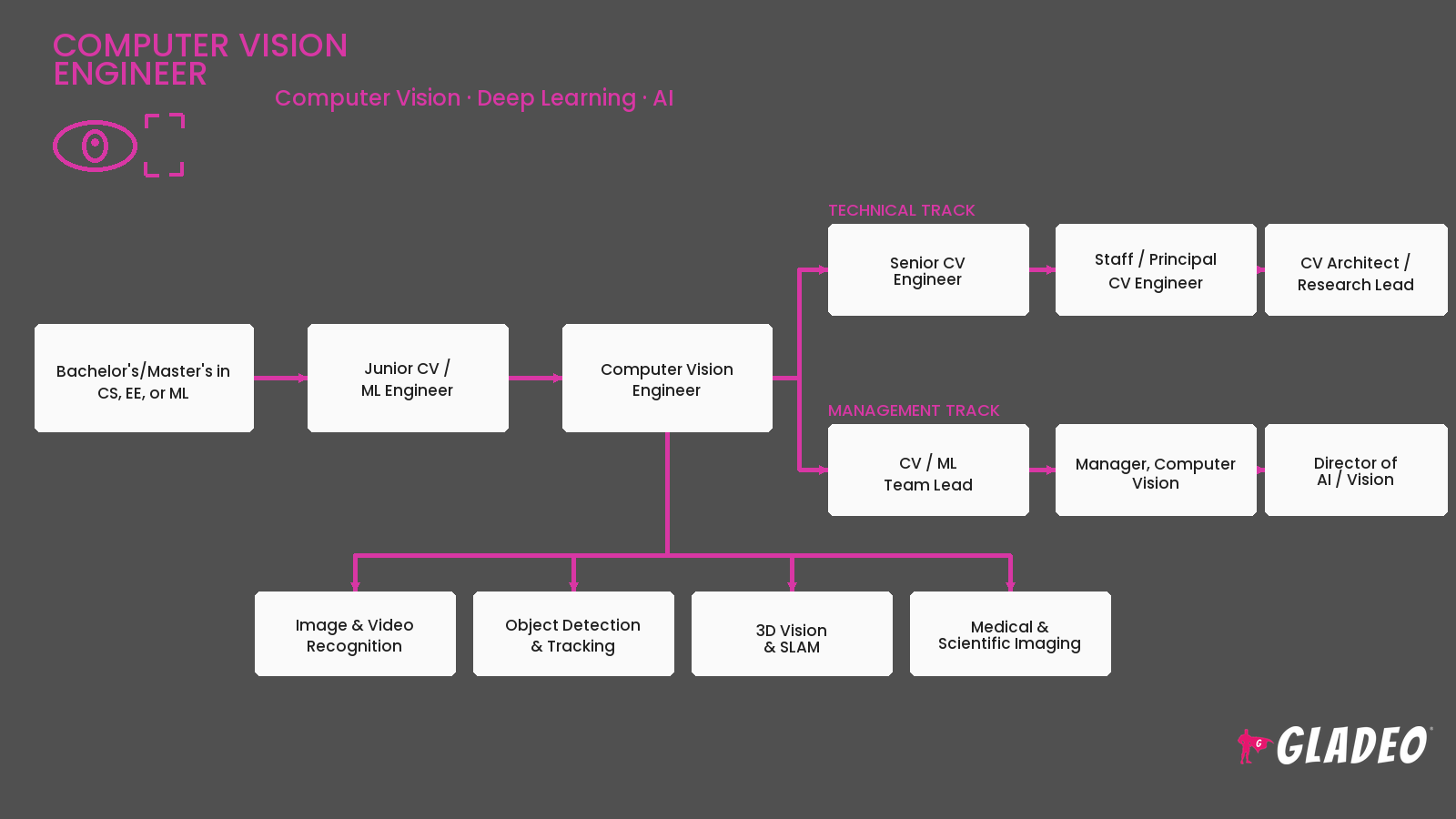
- Build a portfolio of vision projects, including code, demos, and short videos of them working
- Apply for entry-level titles such as Junior Computer Vision Engineer, Perception Engineer, or ML Engineer
- Compete in vision-focused Kaggle competitions and document your approach
- Contribute to open-source computer vision projects to build a public track record
- Practice explaining your projects clearly, including failure cases and how you fixed them
- Network with engineers at robotics, automotive, and AI meetups or conferences
- Search job boards for both "computer vision" and broader "machine learning" titles
- Consider internships or co-ops with robotics, automotive, or manufacturing companies
- Learn to deploy a vision model on real hardware before your first interview
- Prepare for technical interviews covering both coding and vision-specific concepts like geometry
- Highlight any experience working with real cameras, sensors, or embedded systems
- Be open to starting in a broader machine learning or robotics role to build experience
- Take ownership of increasingly complex or safety-critical vision systems
- Build a track record of models that perform reliably in real-world conditions
- Develop expertise in a specialized area like autonomous vehicles, medical imaging, or manufacturing
- Mentor newer engineers on debugging and testing vision systems
- Contribute to research, patents, or conference presentations in computer vision
- Build strong relationships with hardware and robotics teams
- Stay current with new architectures and techniques as the field evolves quickly
- Move into senior engineer, technical lead, or research scientist roles
Websites:
- OpenCV - opencv.org
- Papers with Code (Computer Vision) - paperswithcode.com/area/computer-vision
- CVPR - cvpr.thecvf.com
- Hugging Face - huggingface.co
- PyImageSearch - pyimagesearch.com
- Roboflow Blog - roboflow.com/blog
- Kaggle - kaggle.com
- NVIDIA Developer - developer.nvidia.com
- Two Minute Papers - twominutepapers.com
- IEEE Computer Society - computer.org
- Google AI Vision Blog - ai.googleblog.com
- Towards Data Science - towardsdatascience.com
Books:
- Computer Vision: Algorithms and Applications by Richard Szeliski
- Deep Learning for Vision Systems by Mohamed Elgendy
- Learning OpenCV by Adrian Kaehler and Gary Bradski
- Multiple View Geometry in Computer Vision by Richard Hartley and Andrew Zisserman
- Programming Computer Vision with Python by Jan Erik Solem
If you find that being a Computer Vision Engineer isn't the right fit, your skills in coding, math, and hands-on problem solving transfer well to many related careers.
- Machine Learning Engineer
- Robotics Engineer
- Embedded Systems Engineer
- Data Scientist
- Quality Control Engineer
- Software Engineer
- Photogrammetry Specialist
- AR/VR Engineer
- Autonomous Systems Technician
Click here to download the infographic
Newsfeed

Featured Jobs
Online Courses and Tools