







Spotlights
Chatbot Designer, Voice User Interface Designer, VUI Designer, Conversation Designer, Dialogue Designer, Voice Experience Designer, Chatbot UX Writer, Conversational UX Designer, AI Dialogue Writer, Voice Assistant Designer, Conversational Content Designer, Bot Persona Designer
Every time a chatbot actually understands what you meant, cracks a well-timed joke, or gracefully admits "I didn't catch that, could you try again?" instead of spitting out a confusing error, a Conversational AI Designer wrote that moment into existence. They are the scriptwriters and character builders behind the chatbots and voice assistants millions of people talk to every day, deciding not just what the AI says, but how it sounds, feels, and handles the unexpected.
Conversational AI Designers map out entire conversations before a single line of code runs: greeting a user, understanding their intent, handling confusion, recovering from mistakes, and wrapping things up smoothly. They build the AI's personality and tone, write and test sample dialogue, and design flowcharts that show every path a conversation could take. Along the way, they work closely with NLP engineers and prompt engineers who make the AI actually understand language, along with product managers, brand teams, and customer support leads who care deeply about how the AI represents the company.
Using conversation design tools, prototyping platforms, natural language understanding (NLU) frameworks, and constant user testing, Conversational AI Designers turn cold, robotic scripts into dialogue that feels natural and helpful. Their work determines whether a customer trusts a chatbot enough to actually use it, or gives up in frustration after the second confusing response, making them essential to how companies build AI that people genuinely want to talk to.
- Giving a piece of software an actual personality that people enjoy interacting with
- Solving the puzzle of guiding millions of different conversations down a smooth, helpful path
- Watching a chatbot you scripted successfully help a frustrated user instead of confusing them further
- Blending creative writing, psychology, and technology into a single, constantly evolving craft
Working Schedule
Conversational AI Designers typically work full-time, standard business hours, often as part of a product or design team inside a tech company. The work is a mix of solo writing and diagramming time, spent scripting dialogue and mapping conversation flows, and collaborative time spent in reviews with engineers, writers, and researchers. Most are employed directly by technology companies, though a growing number work at design agencies or as freelance consultants building chatbots and voice assistants for multiple clients.
Typical Duties
- Designing conversation flows that map every path a user interaction could take
- Writing sample dialogue, prompts, and responses for chatbots and voice assistants
- Developing the AI's persona, tone of voice, and personality guidelines
- Designing error handling and fallback responses for when the AI misunderstands a user
- Collaborating with NLP and prompt engineers to align scripted dialogue with what the AI can actually understand
- Running usability tests to see how real users respond to conversation drafts
- Revising scripts based on user testing feedback and real conversation transcripts
- Creating and maintaining a style guide for consistent voice across all AI interactions
- Reviewing analytics on where conversations break down or confuse users
- Presenting conversation designs and prototypes to stakeholders for approval
- Coordinating with brand and marketing teams to keep the AI's voice on-brand
- Testing conversations across different channels like chat, voice assistants, and smart speakers
Additional Responsibilities
- Training customer support or content teams on how to maintain the chatbot's voice
- Documenting conversation design decisions and rationale for future designers
- Researching competitor chatbots and voice assistants to benchmark quality
- Advocating for accessibility and inclusive language in AI conversations
- Auditing existing bots for outdated or inconsistent dialogue
- Contributing to design system guidelines for conversational interfaces
A Conversational AI Designer's morning often starts by reviewing recent conversation logs to see where real users got stuck, confused, or delighted by the chatbot. They might flag a handful of conversations where the bot misunderstood a common phrase, then start sketching a fix to the dialogue flow that handles that phrasing better.
Midday is often spent deep in scripting, writing out multiple versions of how the AI might respond to a tricky question, then testing them against the persona guide to make sure the tone stays consistent. They frequently meet with an NLP or prompt engineer to check whether a new line of dialogue is technically feasible, or with a product manager to align on what a new chatbot feature needs to accomplish.
Afternoons often include usability testing sessions, watching real users try out a new conversation flow and noting every moment of hesitation or confusion. The designer might revise a greeting message that felt too stiff, add a friendlier fallback response, or update the style guide after discovering a phrase that consistently confused testers. Before wrapping up, they typically document their changes and share updated flows with the wider product team.
Soft Skills
- Creative and narrative writing ability
- Empathy for how users think and feel during a conversation
- Attention to tone, word choice, and voice consistency
- Strong collaboration with engineers, writers, and researchers
- Patience during repetitive testing and revision cycles
- Active listening and openness to user feedback
- Problem-solving when conversations do not go as planned
- Adaptability across different platforms and use cases
- Clear communication when presenting design decisions
- Curiosity about how people naturally speak and phrase requests
- Comfort with ambiguity in early-stage design
- Attention to detail across long, branching scripts
Technical Skills
- Conversation design and prototyping tools such as Voiceflow or Botmock
- Understanding of natural language understanding (NLU) and intent recognition
- Familiarity with large language models and prompt design
- Flowcharting and diagramming for complex conversation paths
- Basic scripting or logic for chatbot platforms
- User research and usability testing methods
- Writing and editing for concise, natural-sounding dialogue
- Analytics tools for reviewing conversation performance data
- Familiarity with voice platforms such as Amazon Alexa or Google Assistant
- Accessibility best practices for text and voice interfaces
- Voice Interaction Designer: Focuses on dialogue for voice assistants and smart speakers
- Chatbot Designer: Focuses on text-based conversations for customer service or messaging apps
- Persona Designer: Specializes in developing the AI's character, tone, and personality
- Conversation Flow Architect: Focuses on mapping complex, branching conversation logic
- Enterprise Bot Designer: Designs conversational tools for internal company use, like HR or IT help bots
- Multilingual Conversation Designer: Adapts dialogue and tone across different languages and cultures
- Accessibility-Focused Designer: Specializes in making conversational interfaces usable for people with disabilities
- Technology and software companies
- E-commerce and retail companies
- Banking and financial services firms
- Healthcare and telehealth companies
- Customer experience and design agencies
- Telecommunications companies
- Travel and hospitality companies
- Voice assistant and smart device manufacturers
- Startups building AI-powered products
- Government digital services teams
- Nonprofit organizations offering AI-based support tools
- Gaming and entertainment companies
Conversational AI Designers are expected to anticipate nearly every way a real person might phrase a question, which means constant testing, revising, and rewriting even after a chatbot has launched. Perfection is never really finished, since users are endlessly creative in how they talk, and a script that works beautifully in testing can still confuse people in the real world.
The work involves a lot of repetition. Designers may rewrite the same greeting or fallback message dozens of times to get the tone exactly right, and they must stay patient through rounds of feedback from engineers, brand teams, and user researchers who each have different priorities. Deadlines tied to product launches can create pressure to finalize dialogue before every edge case has been fully tested.
There is also an emotional side to the job that can be easy to underestimate. Designers have to think carefully about how an AI should respond to frustrated, confused, or even distressed users, and get that tone right without ever having a real human moment to rely on. Balancing warmth with efficiency, and creativity with technical limitations, requires constant judgment calls.
- Rapid growth of large language models making conversations feel more natural and flexible
- Increasing use of generative AI to create dynamic responses rather than only scripted ones
- Greater focus on designing for multi-turn conversations that remember context
- Rising demand for multilingual and culturally adapted conversational experiences
- Growing attention to conversational accessibility for users with disabilities
- Expansion of voice assistants into cars, appliances, and wearable devices
- Increased use of user analytics and AI-assisted testing to refine dialogue faster
- More companies building custom AI personas to strengthen brand identity
- Rising concern around AI transparency, so users know when they are talking to a bot
- Growth of conversational design roles within traditional customer service teams
Many Conversational AI Designers grew up loving storytelling, whether through writing fiction, creating characters for tabletop games, or crafting dialogue in choose-your-own-adventure stories. They often enjoyed drama club, creative writing classes, or role-playing games where imagining how a character would respond in different situations came naturally.
Many were also the friends who noticed exactly the right thing to say to calm someone down or defuse an awkward moment, showing an early instinct for how word choice and tone shape how people feel. A mix of creative writing interests and curiosity about technology often pointed toward this unusual blend of a career.
Most Conversational AI Designers have a bachelor's degree in a field like communications, linguistics, English, human-computer interaction, or user experience design, though the field is new enough that many designers come from unconventional backgrounds, including creative writing, theater, or psychology. What matters most to employers is a strong portfolio showing conversation flows, sample dialogue, and evidence of user testing.
Students can take courses in relevant subjects such as:
- Linguistics and the Structure of Language
- Creative Writing and Dialogue Writing
- Human-Computer Interaction
- User Experience (UX) Design
- Psychology of Communication
- Introduction to Artificial Intelligence and Natural Language Processing
- User Research and Usability Testing
- Information Architecture
- Public Speaking and Persuasive Communication
- Introduction to Coding or Scripting Logic
Hands-on practice is essential in this field. Building sample chatbots using free conversation design tools, running informal user tests with friends or classmates, and studying real chatbot transcripts all help build the intuition needed for the job. Many designers also complete UX design bootcamps or certificate programs focused specifically on conversation and voice design, since traditional degree programs rarely cover this niche directly.
- Take creative writing, English, and drama classes to build dialogue-writing skills
- Study a foreign language to develop an ear for how phrasing and tone shift meaning
- Learn the basics of psychology to understand how people communicate and react
- Build a simple chatbot using a free tool like Voiceflow, Landbot, or Dialogflow
- Join a debate, speech, or theater program to practice thinking on your feet
- Take an introductory coding or computer science class to understand technical limitations
- Study user experience design through free online courses
- Practice writing short scripts for imagined customer service scenarios
- Interview friends or family about their worst chatbot experiences to learn what fails
- Read about how popular voice assistants and chatbots are designed
- Start a portfolio documenting any conversation or dialogue projects you create
- Seek internships or volunteer projects with startups building AI-powered products
- Programs or courses that specifically cover conversation design or voice user interface design
- Curriculum that blends writing, psychology, and basic technical literacy
- Opportunities to build and test real chatbot or voice assistant prototypes
- Instructors with real industry experience in UX or conversational design
- Access to conversation design tools like Voiceflow, Botmock, or Dialogflow
- Coursework in user research and usability testing methods
- Strong portfolio-building requirements as part of the program
- Career services familiar with UX and AI design job markets
- Opportunities to study accessibility and inclusive design practices
- Flexible or short-form certificate options for career changers
- Community or alumni network active in UX and conversational AI fields
- Programs that include feedback from real practicing designers
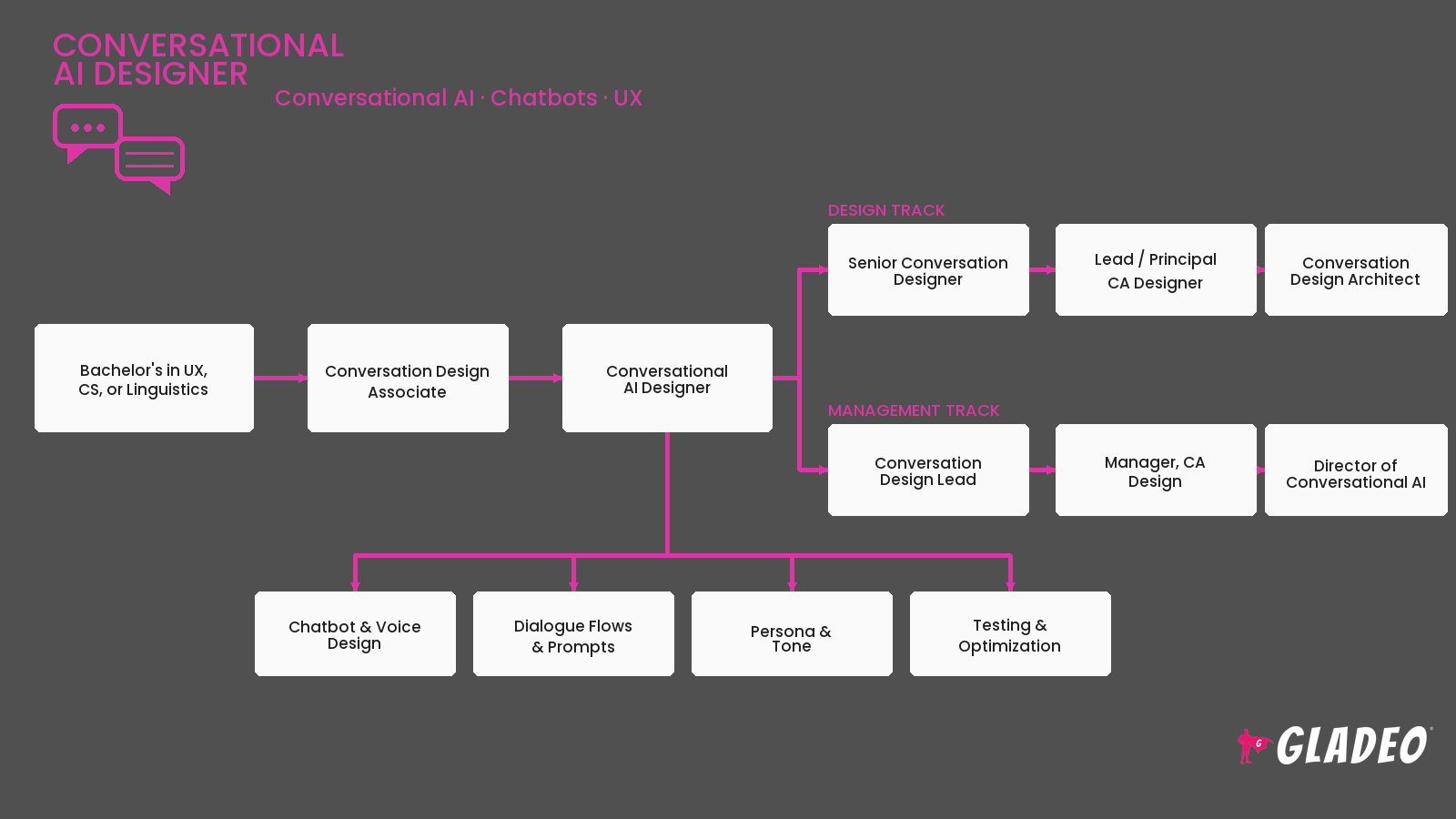
- Build a portfolio with two or three complete conversation flows, including error handling
- Create a simple working chatbot using a free tool to demonstrate practical skills
- Apply for entry-level titles like UX Writer, Junior Conversation Designer, or Content Designer
- Search job boards such as LinkedIn, Indeed, and UX-focused job boards for conversational design roles
- Join conversation design communities and share your work for feedback
- Practice explaining the reasoning behind your design choices, not just showing the final script
- Highlight any writing, psychology, or linguistics background prominently on your resume
- Attend UX or AI design meetups and conferences to build your network
- Offer to help a small business or nonprofit design a simple chatbot for real experience
- Study and critique chatbots you use in daily life to build a sharper design eye
- Be ready to demonstrate how you test and revise dialogue based on user feedback
- Stay current on new AI tools, since the field's tools change quickly
- Take ownership of more complex, multi-channel conversation projects
- Build a track record of chatbots or voice assistants that measurably improved user satisfaction
- Develop deeper technical fluency in NLP and prompt design to collaborate more effectively
- Mentor junior conversation designers and UX writers
- Specialize in a growing niche like voice design, accessibility, or multilingual design
- Build relationships with product and engineering leadership
- Present your design process at conferences or in industry publications
- Move into roles like Senior Conversation Designer, Voice UX Lead, or Head of Conversational Design
Websites:
- User Experience Professionals Association (UXPA) - uxpa.org
- Interaction Design Foundation (IxDF) - interaction-design.org
- Nielsen Norman Group (NN/g) - nngroup.com
- Interaction Design Association (IxDA) - ixda.org
- ACM SIGCHI - sigchi.org
- Voice Tech Global - voicetechglobal.com
- Rasa Community - rasa.com/community
- Voiceflow Learning Center - learn.voiceflow.com
- A List Apart - alistapart.com
- UX Collective - uxdesign.cc
- Smashing Magazine - smashingmagazine.com
- Conversational Interaction Conference - conversationalinteraction.com
- Google Assistant Conversation Design Guidelines - developers.google.com/assistant/conversation-design
- •mazon Alexa Design Guide - developer.amazon.com/en-US/alexa/design
Books:
- Designing Voice User Interfaces by Cathy Pearl
- Conversational Design by Erika Hall
- Voice User Interface Design by Michael H. Cohen, James P. Giangola, and Jennifer Balogh
- Designing Bots by Amir Shevat
- Voice Content and Usability by Preston So
If you find that being a Conversational AI Designer isn't the right fit, your skills in writing, psychology, and user-focused design transfer well to many related careers.
- UX Writer
- User Experience (UX) Designer
- Content Strategist
- Product Designer
- Customer Experience Designer
- Prompt Engineer
- Voice Actor or Script Writer
- Interaction Designer
- Social Media Content Creator
- Technical Writer
Click here to download the infographic
Newsfeed

Featured Jobs
Online Courses and Tools