







Spotlights
Labor Attorney, Employment Attorney, Workplace Rights Lawyer, Labor Relations Counsel, EEO Attorney, Employee Rights Attorney, Management-Side Employment Attorney, Union-Side Labor Attorney, Workplace Discrimination Attorney, Wage and Hour Attorney, Employment Litigation Associate, Human Resources Counsel
When someone is fired for reporting harassment, denied overtime pay they earned, or discriminated against because of their age, race, or disability, an Employment Lawyer is often the person who steps in to make things right. On the other side of the table, when a company needs to navigate a union negotiation or make sure its policies actually follow the law, an Employment Lawyer helps get it right before a problem ever starts. Either way, this career sits at the center of one of the most personal parts of everyday life: work.
Employment Lawyers, sometimes called Labor Lawyers, handle legal issues that arise in the workplace, including discrimination, wrongful termination, wage and hour disputes, workplace safety, family and medical leave, and union-related matters like collective bargaining and labor negotiations. Some represent individual employees who believe their rights were violated, filing complaints with government agencies or pursuing lawsuits against employers. Others represent companies, advising human resources teams on lawful policies, defending businesses against employee claims, or negotiating directly with labor unions on behalf of management. A single case might involve interviewing coworkers, reviewing years of emails and personnel files, or sitting across the table from a union negotiating committee.
Using employment law expertise, negotiation skills, and careful investigation, Employment Lawyers help make sure workplaces treat people fairly and legally, while also helping businesses understand their obligations before a small issue becomes a costly lawsuit. Their work matters because almost everyone works at some point in their life, and the rules Employment Lawyers help enforce shape whether that experience is fair, safe, and respectful.
- Helping workers who have been treated unfairly get real accountability and compensation
- Shaping workplace policies that protect employees before problems even happen
- Negotiating high-stakes agreements between employers and organized labor
- Working on issues that touch nearly everyone's daily life: their job
Working Schedule
Employment Lawyers generally work full-time, and the pace often depends on which side of the table they represent. Employee-side attorneys, especially those at smaller firms or nonprofits, may have somewhat more flexible schedules but often juggle many individual cases at once. Management-side attorneys at larger firms or in-house at a company tend to have busier periods tied to union negotiations, investigations, or litigation deadlines, sometimes requiring evening or weekend work. The job splits between office work drafting documents and reviewing evidence, and time spent in mediation sessions, administrative hearings, courtrooms, or at the bargaining table.
Typical Duties
- Advising employees or employers on workplace rights and legal obligations
- Investigating claims of discrimination, harassment, or retaliation
- Filing or defending against complaints with agencies like the EEOC or state labor boards
- Drafting and reviewing employment contracts, severance agreements, and workplace policies
- Representing clients in mediation, arbitration, or court for employment disputes
- Negotiating collective bargaining agreements between unions and employers
- Advising companies on wage and hour compliance, including overtime rules
- Handling family and medical leave, disability accommodation, and workplace safety issues
- Preparing witnesses and evidence for depositions and hearings
- Reviewing employee handbooks and policies for legal compliance
- Advising on layoffs, reductions in force, and reorganizations
- Representing clients in unfair labor practice proceedings before labor boards
Additional Responsibilities
- Training HR staff and managers on employment law compliance
- Staying current on changes to federal, state, and local labor laws
- Advising on workplace investigations conducted by internal HR teams
- Coordinating with union representatives during ongoing labor relations
- Assisting with employee classification questions, such as independent contractor status
- Reviewing social media and remote work policies for legal risk
An Employment Lawyer's morning often starts by reviewing new client intake calls or emails, which might include a worker describing a recent termination or an HR director asking about a tricky accommodation request. Early in the day, they might interview a witness or client about the details of a discrimination complaint, taking careful notes to build the factual record.
Midday is frequently filled with drafting: a demand letter to an employer, a response to a government agency complaint, or a new workplace policy for a business client. If a mediation or negotiation session is scheduled, much of the day goes toward preparing arguments, reviewing the other side's position, and anticipating where a compromise might be reached. Labor-side attorneys negotiating a union contract might spend hours at the bargaining table working through wage, benefit, and scheduling proposals line by line.
Afternoons often bring calls with opposing counsel to discuss settlement, meetings with HR teams walking through a new policy, or preparation for an upcoming hearing. Employment Lawyers regularly balance emotionally charged individual cases with the more procedural work of contracts and compliance, sometimes within the same afternoon.
Soft Skills
- Empathy for workers navigating difficult workplace situations
- Strong negotiation and mediation skills
- Clear written and verbal communication
- Attention to detail when reviewing documents and evidence
- Comfort with conflict and advocacy on behalf of one side
- Sound judgment when advising on sensitive personnel matters
- Discretion with confidential workplace information
- Organizational skills to manage multiple active cases
- Cultural competence and awareness of workplace diversity issues
- Patience during long negotiations or investigations
- Persuasive public speaking for hearings and mediations
- Ethical integrity when balancing competing interests
Technical Skills
- Federal and state employment and labor law
- Investigation techniques for workplace complaints
- Contract and policy drafting
- Negotiation and collective bargaining strategy
- Legal research using tools like Westlaw or Lexis
- Understanding of wage and hour, leave, and disability accommodation law
- Familiarity with EEOC and labor board procedures
- Mediation and alternative dispute resolution skills
- Data and document review for large-scale investigations
- Employee-Side Attorney: Represents individual workers in discrimination and wage disputes
- Management-Side Attorney: Represents companies defending against employee claims
- Labor Relations Attorney: Negotiates collective bargaining agreements with unions
- Wage and Hour Attorney: Focuses on overtime, minimum wage, and classification disputes
- Workplace Investigations Attorney: Conducts independent investigations into harassment or misconduct claims
- Employee Benefits Attorney: Advises on retirement, health, and benefits compliance
- In-House Employment Counsel: Works directly for one company on ongoing workplace legal matters
- Class Action Employment Attorney: Represents groups of employees in large-scale workplace disputes
- Plaintiff-side employment law firms representing workers
- Management-side employment and labor law firms
- Labor unions and union legal departments
- Corporate legal departments and human resources divisions
- Government agencies like the EEOC and state labor departments
- Nonprofit worker advocacy and legal aid organizations
- National Labor Relations Board offices
- Staffing and employment agencies
- Universities and school districts with employment legal needs
- Healthcare systems with large, complex workforces
- Manufacturing and logistics companies with union workforces
- Employment mediation and arbitration services
Employment Lawyers often work with clients who are going through a genuinely painful experience, whether that is losing a job, facing discrimination, or dealing with a hostile work environment, which means the job carries emotional weight beyond the legal work itself. Staying professional and effective while a client is upset or angry takes real skill and patience.
The work can also be adversarial by nature, since employment disputes usually involve two sides with directly conflicting interests. Attorneys need to be comfortable with confrontation, whether that means pushing back against a powerful employer or defending a company against a claim that has real financial and reputational stakes.
Labor negotiations and large investigations can demand long, unpredictable hours, especially when a union contract deadline approaches or a company faces a class action claim. The law in this field also changes frequently, with new regulations at the federal, state, and even city level, requiring constant attention to stay current and give clients accurate advice.
- Rising number of remote work and hybrid workplace policy disputes
- Increased attention to pay transparency and pay equity laws
- Growing use of artificial intelligence in hiring, raising new discrimination concerns
- Expansion of paid family and medical leave laws across states
- Renewed growth in labor union organizing and collective bargaining activity
- Increased scrutiny of non-compete agreements and their enforceability
- More claims involving gig economy worker classification
- Growing focus on workplace mental health and accommodation requests
- Rising use of mandatory arbitration clauses and legal challenges to them
- Expanded whistleblower protections across industries
Many Employment Lawyers were the students who stood up for a classmate being treated unfairly, organized a fundraiser, or took on a leadership role in a club or team where they had to balance different people's needs. They often had a strong sense of fairness and were drawn to situations where they could advocate for someone else.
Others gravitated toward psychology, sociology, or business classes, curious about how people and organizations work together. Many future Employment Lawyers also had an early part-time or summer job where they noticed, firsthand, how workplace rules and treatment could make or break someone's experience at work.
Becoming an Employment Lawyer requires a four-year bachelor's degree followed by three years of law school to earn a Juris Doctor (J.D.). No specific undergraduate major is required, though degrees in human resources, psychology, business, or labor studies can provide useful background. After law school, graduates must pass the bar exam in the state where they intend to practice, and many gain early experience through internships with the EEOC, a labor union, or an employment law firm.
Students can take courses in relevant subjects such as:
- Employment Law
- Labor Law and Collective Bargaining
- Employment Discrimination Law
- Alternative Dispute Resolution and Mediation
- Administrative Law
- Civil Procedure
- Trial Advocacy
- Workplace Investigations
- Employee Benefits Law
- Negotiation
Practical experience is essential in this field. Law students build real skills through employment law clinics, internships at government labor agencies, and summer positions at firms representing either employees or employers. Many future Employment Lawyers also benefit from prior work in human resources, union organizing, or workplace advocacy before law school.
- Take psychology, sociology, and business courses to understand workplace dynamics
- Join debate or student government to build negotiation and advocacy skills
- Volunteer with a worker advocacy or legal aid organization
- Read about labor history and major workplace rights court cases
- Take a part-time job and pay attention to workplace policies and treatment
- Take a pre-law track or major in political science, human resources, or labor studies in college
- Study for and take the LSAT with plenty of time before applying to law school
- Seek internships at law firms, government labor agencies, or labor unions
- Practice mediation and conflict resolution skills whenever possible
- Build strong writing skills through research-heavy composition courses
- Attend a workplace rights or labor law event if one is available in your area
- Network with employment lawyers, HR professionals, or union organizers
- Law schools with strong employment or labor law clinics
- Faculty with real experience practicing employee-side or management-side law
- Externship opportunities with government labor agencies or unions
- Strong bar passage rates in the state where you plan to practice
- Courses covering both employee-side and management-side perspectives
- Access to mediation and alternative dispute resolution training
- Career services with connections to employment law firms and corporate legal departments
- Opportunities to work on a labor and employment law journal
- Active alumni network in employment and labor law
- Reasonable tuition relative to expected starting salary in the field
- Programs offering coursework in employee benefits or workplace investigations
- Flexible scheduling if you plan to work while attending law school
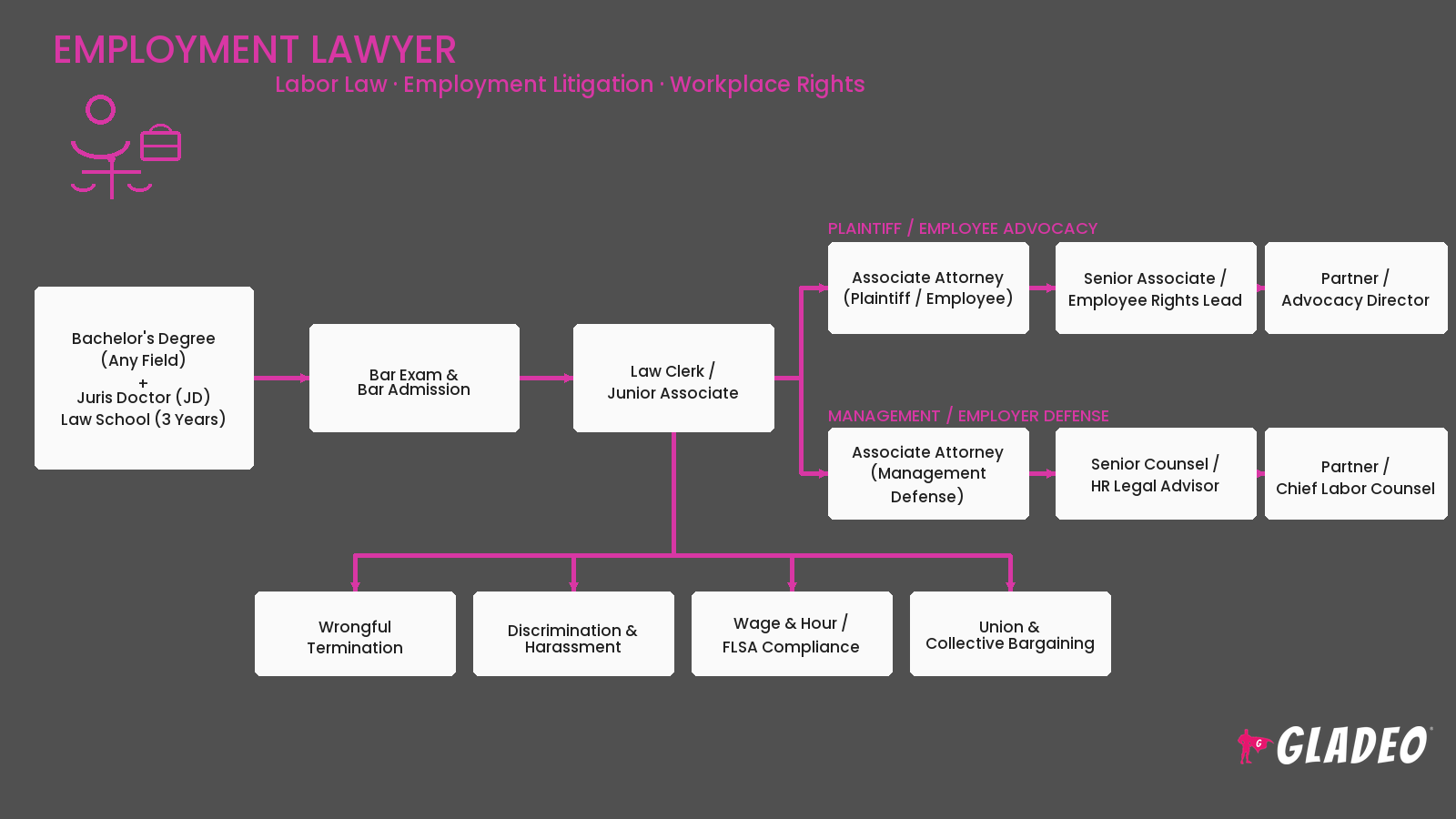
- Apply for associate positions at employee-side or management-side employment law firms
- Complete an internship with the EEOC, a state labor agency, or a labor union
- Search job boards through your state bar association and employment law sections
- Attend recruiting events hosted by firms with labor and employment practices
- Network with alumni and attorneys working in employment law
- Pass the bar exam and consider certifications in mediation or labor relations
- Highlight any HR, mediation, or workplace advocacy experience on your resume
- Consider starting at a smaller firm to get broader case experience early
- Practice explaining employment law concepts clearly, since clients are often stressed
- Be open to positions in both employee-side and management-side practices to build well-rounded experience
- Join student and early-career chapters of labor and employment bar associations
- Volunteer for pro bono workplace rights cases to build experience while job searching
- Build a reputation for thorough investigations and strong case outcomes
- Take on more complex cases, such as class actions or union negotiations
- Develop a specialty, such as wage and hour law, discrimination, or labor relations
- Build a referral network with HR professionals, unions, and other attorneys
- Publish articles or speak at continuing legal education events on employment law
- Move from associate to partner, or transition into an in-house employment counsel role
- Mentor junior attorneys entering employment and labor law
- Get involved in labor and employment bar association leadership roles
Websites:
- American Bar Association Labor and Employment Law Section - americanbar.org
- National Employment Lawyers Association - nela.org
- Society for Human Resource Management - shrm.org
- Labor and Employment Relations Association - leraweb.org
- American Employment Law Council - aelc.org
- National Labor Relations Board - nlrb.gov
- Equal Employment Advisory Council - eeac.org
- National Partnership for Women and Families - nationalpartnership.org
- Workplace Fairness - workplacefairness.org
- American Association for Justice - justice.org
- Institute for Workplace Equality - institute4workplaceequality.org
- AFL-CIO - aflcio.org
- National Labor College archives via George Meany Center resources - georgemeany.org
- American Bar Association Section of Labor and Employment Law Journal - americanbar.org
Books:
- Employment Law by Mark A. Rothstein and Lance Liebman
- The Employer's Legal Handbook by Sachi Barreiro
- Primer on Labor Relations Law by the American Bar Association Labor and Employment Law Section
- Working Scared by Nan Weiner
- Employment Discrimination Law by Barbara T. Lindemann and Paul Grossman
If you find that being an Employment Lawyer isn't the right fit, your skills in negotiation, investigation, and workplace advocacy transfer well to many related careers.
- Human Resources Director
- Labor Relations Specialist
- Mediator or Arbitrator
- Compliance Officer
- Union Organizer
- Employee Relations Manager
- Paralegal specializing in employment law
- Workplace Investigator
- Diversity, Equity, and Inclusion Officer
- Employee Benefits Consultant
Click here to download the infographic
Newsfeed

Featured Jobs
Online Courses and Tools