







Spotlights
Trusts and Estates Attorney, Wills and Trusts Lawyer, Probate Attorney, Elder Law Attorney, Estate Attorney, Wealth Planning Counsel, Trust Attorney, Succession Planning Lawyer, Estate and Gift Tax Attorney, Fiduciary Counsel, Legacy Planning Attorney, Estate Administration Lawyer
Long before anyone needs it, an Estate Planning Lawyer helps families make one of the most caring decisions they will ever make: a clear plan for what happens to the people and things they love. This career is about protecting families from confusion and conflict during their hardest moments, by making sure their wishes are written down clearly and legally long before those moments arrive.
Estate Planning Lawyers help individuals and families plan for the future by drafting wills, trusts, powers of attorney, and healthcare directives that spell out exactly how a person's assets should be handled and who should make decisions if they become unable to make them themselves. They meet with clients to understand their family situations, their goals, and their concerns, whether that means providing for young children, caring for a family member with special needs, minimizing estate taxes, or passing down a family business smoothly to the next generation. Much of the work happens at a desk and in a client's living room rather than a courtroom, since the goal of good estate planning is to prevent disputes and confusion, not fight about them after the fact.
Using careful drafting, tax planning knowledge, and a genuine understanding of family dynamics, Estate Planning Lawyers turn a person's wishes into documents that hold up legally and protect the people left behind. Their work matters because a clear estate plan can be the difference between a family that grieves together and a family torn apart by confusion, unnecessary taxes, or a fight over what a loved one "would have wanted."
- Helping families protect the people and causes they care about most
- Building long-term, trusted relationships that can span generations of a family
- Solving thoughtful puzzles that combine law, tax strategy, and family dynamics
- Giving clients real peace of mind instead of leaving loose ends for their loved ones
Working Schedule
Estate Planning Lawyers typically work full-time, standard business hours, making this one of the more predictable schedules within the legal profession. Most of the work happens in an office setting, meeting with clients, drafting documents, and coordinating with financial advisors and accountants. Occasional evening appointments accommodate clients who cannot meet during the workday, and travel is sometimes required to visit an elderly or homebound client. Court appearances are relatively rare compared to other legal specialties, since most estate planning work is designed to avoid disputes rather than litigate them.
Typical Duties
- Meeting with clients to understand their family situation, assets, and goals
- Drafting wills, trusts, powers of attorney, and healthcare directives
- Advising clients on strategies to minimize estate and gift taxes
- Structuring trusts to provide for minor children or family members with special needs
- Helping business owners plan for the transfer of a family business
- Reviewing and updating estate plans as family or financial circumstances change
- Advising on beneficiary designations for retirement accounts and life insurance
- Guiding clients through probate and trust administration after a death
- Coordinating with financial advisors, accountants, and insurance agents
- Explaining the differences between wills, revocable trusts, and irrevocable trusts
- Preparing documents for guardianship of minor children
- Advising elderly clients on long-term care and Medicaid planning
Additional Responsibilities
- Reviewing existing estate plans for outdated or conflicting provisions
- Explaining complex tax and legal concepts in plain, accessible language
- Managing trust accounts and fiduciary responsibilities when appointed as trustee
- Staying current on changes to state and federal estate tax law
- Coordinating with charitable organizations on planned giving arrangements
- Mediating family discussions about sensitive succession decisions
An Estate Planning Lawyer's morning often starts by reviewing notes from an intake call with a new client, a young couple with a new baby who want a will for the first time, and preparing questions about their family, assets, and wishes. Mid-morning might include a meeting with an existing client updating their plan after a divorce or the birth of a grandchild.
Midday is frequently spent drafting: writing or revising a trust document, preparing a power of attorney, or researching how a recent change in estate tax law affects a client's plan. The lawyer might also spend time on the phone with a client's financial advisor or accountant, making sure the legal plan lines up with the client's actual investment and retirement accounts.
Afternoons often bring client meetings where documents are reviewed and signed, sometimes with witnesses and a notary present, marking the completion of a plan the client has been thinking about for months. Estate Planning Lawyers might also spend time helping a family navigate probate after a loved one's death, guiding them calmly through paperwork during a difficult and emotional time.
Soft Skills
- Compassion and patience with clients discussing sensitive topics
- Clear, plain-language communication about complex legal concepts
- Strong attention to detail in legal documents
- Discretion and confidentiality with private family and financial information
- Active listening to understand a family's true goals and concerns
- Comfort discussing mortality, illness, and family conflict
- Trustworthiness, since clients share deeply personal information
- Organizational skills to manage many client files and deadlines
- Diplomacy when navigating disagreements within families
- Patience for detailed, methodical drafting work
- Relationship-building skills for long-term client trust
- Sound judgment on sensitive family and financial matters
Technical Skills
- Wills, trusts, and estate law
- Estate, gift, and generation-skipping tax planning
- Probate and trust administration procedures
- Document drafting software and estate planning practice tools
- Understanding of retirement accounts, life insurance, and beneficiary designations
- Elder law and Medicaid planning knowledge
- Business succession planning
- Legal research using tools like Westlaw or Lexis
- Basic accounting and financial statement literacy
- Trusts and Estates Attorney: Focuses on drafting wills, trusts, and core estate documents
- Elder Law Attorney: Specializes in long-term care planning and Medicaid eligibility
- Probate Attorney: Guides families through the court process of settling an estate
- Estate and Gift Tax Attorney: Focuses on minimizing taxes for high-net-worth clients
- Business Succession Attorney: Helps family businesses plan leadership and ownership transitions
- Special Needs Planning Attorney: Structures trusts to protect benefits for a disabled beneficiary
- Charitable Giving Attorney: Structures planned gifts and charitable trusts
- Fiduciary Litigation Attorney: Handles disputes over trusts, wills, or executor conduct
- Boutique trusts and estates law firms
- General practice law firms with an estate planning department
- Large law firms with dedicated wealth planning practices
- Bank and trust company legal and fiduciary departments
- Elder law and Medicaid planning practices
- Financial planning firms with in-house or affiliated legal counsel
- Nonprofit organizations with planned giving programs
- Family offices serving high-net-worth families
- Solo estate planning practices
- Probate courts and court-appointed fiduciary roles
- Legal aid organizations offering estate planning to underserved communities
- Insurance companies with estate planning advisory services
Estate Planning Lawyers regularly work with clients who are thinking about illness, aging, or death, topics many people avoid discussing at all, which requires patience, warmth, and genuine comfort sitting with difficult emotions. Helping a family plan for a loved one's incapacity or mortality is meaningful work, but it asks a lot of emotional presence from the attorney.
The work also demands exceptional precision. A poorly worded clause in a trust or a missed signature requirement can unravel an entire plan years later, sometimes after the client has passed away and can no longer fix the mistake, so the standard for accuracy is extremely high.
Because estate and tax laws change regularly at both the state and federal level, Estate Planning Lawyers must continuously update client plans and their own knowledge, which requires ongoing study throughout a career. Building a sustainable practice also often depends on years of relationship-building and referrals, which can mean a slower start compared to some other legal specialties.
- Rising use of digital estate planning platforms and online document tools
- Growing need for digital asset planning, including cryptocurrency and online accounts
- Increased demand for elder law and long-term care planning as the population ages
- Greater attention to blended family and non-traditional family estate planning
- Changes in federal estate tax exemption levels driving updated planning strategies
- Rising interest in charitable giving and legacy planning among younger clients
- Growth in special needs trusts as awareness of disability planning increases
- More families seeking business succession planning as owners retire
- Increased use of virtual client meetings and remote document signing
- Greater focus on incapacity planning, including healthcare directives and powers of attorney
Many Estate Planning Lawyers were the organized ones in their friend group or family, the person who kept track of details, planned events carefully, and liked helping people feel prepared and reassured. They often had a caring, steady presence that made others comfortable sharing personal concerns with them.
Others gravitated toward family history, genealogy, or stories about how families pass things down across generations, curious about legacy and how relationships shape decisions. Many future Estate Planning Lawyers also had an early experience helping an older family member navigate a confusing situation, which gave them a personal appreciation for how much a clear plan can help during a hard time.
Becoming an Estate Planning Lawyer requires a four-year bachelor's degree followed by three years of law school to earn a Juris Doctor (J.D.). No specific undergraduate major is required, though degrees in finance, accounting, or business provide useful background for the tax and financial aspects of the work. After law school, graduates must pass the bar exam in the state where they intend to practice, and many pursue an additional Master of Laws (LL.M.) in taxation or estate planning, along with credentials like becoming a Certified Trust and Financial Advisor or joining the American College of Trust and Estate Counsel.
Students can take courses in relevant subjects such as:
- Trusts and Estates
- Estate and Gift Taxation
- Wills and Probate Practice
- Elder Law
- Property Law
- Federal Income Tax
- Business Organizations
- Family Law
- Estate Planning Drafting
- Nonprofit and Charitable Giving Law
Practical experience is highly valuable in this field. Law students build real skills through trusts and estates legal clinics, internships at estate planning or elder law firms, and summer positions at banks or trust companies with fiduciary departments. Many future Estate Planning Lawyers also benefit from prior work in accounting, financial planning, or paralegal roles at an estate planning practice.
- Take accounting, economics, and personal finance courses
- Practice explaining financial or legal ideas clearly to family members
- Volunteer with a senior center, hospice, or elder services organization
- Read about how wills, trusts, and estate planning actually work
- Take a pre-law track or major in finance, accounting, or business in college
- Study for and take the LSAT with plenty of time before applying to law school
- Seek internships at law firms, banks, or financial planning companies during college
- Develop strong writing skills through detail-oriented, research-heavy coursework
- Practice patience and active listening in volunteer or customer-facing roles
- Learn the basics of how retirement accounts and life insurance work
- Talk to an estate planning attorney or financial advisor about their career path
- Build organizational habits, since precision and record-keeping matter enormously in this field
- Law schools with a strong trusts and estates or tax law curriculum
- Faculty who practice or have practiced estate planning or elder law
- Access to a trusts and estates legal clinic
- Strong bar passage rates in the state where you plan to practice
- Coursework in estate and gift taxation and business succession planning
- Externship opportunities with estate planning firms or bank trust departments
- Career services with connections to trusts and estates employers
- Opportunities to pursue a joint J.D./LL.M. in taxation
- Active alumni network in estate planning and wealth management
- Preparation for credentials like Certified Trust and Financial Advisor
- Reasonable tuition relative to expected starting salary in the field
- Flexible scheduling if you plan to work while attending law school
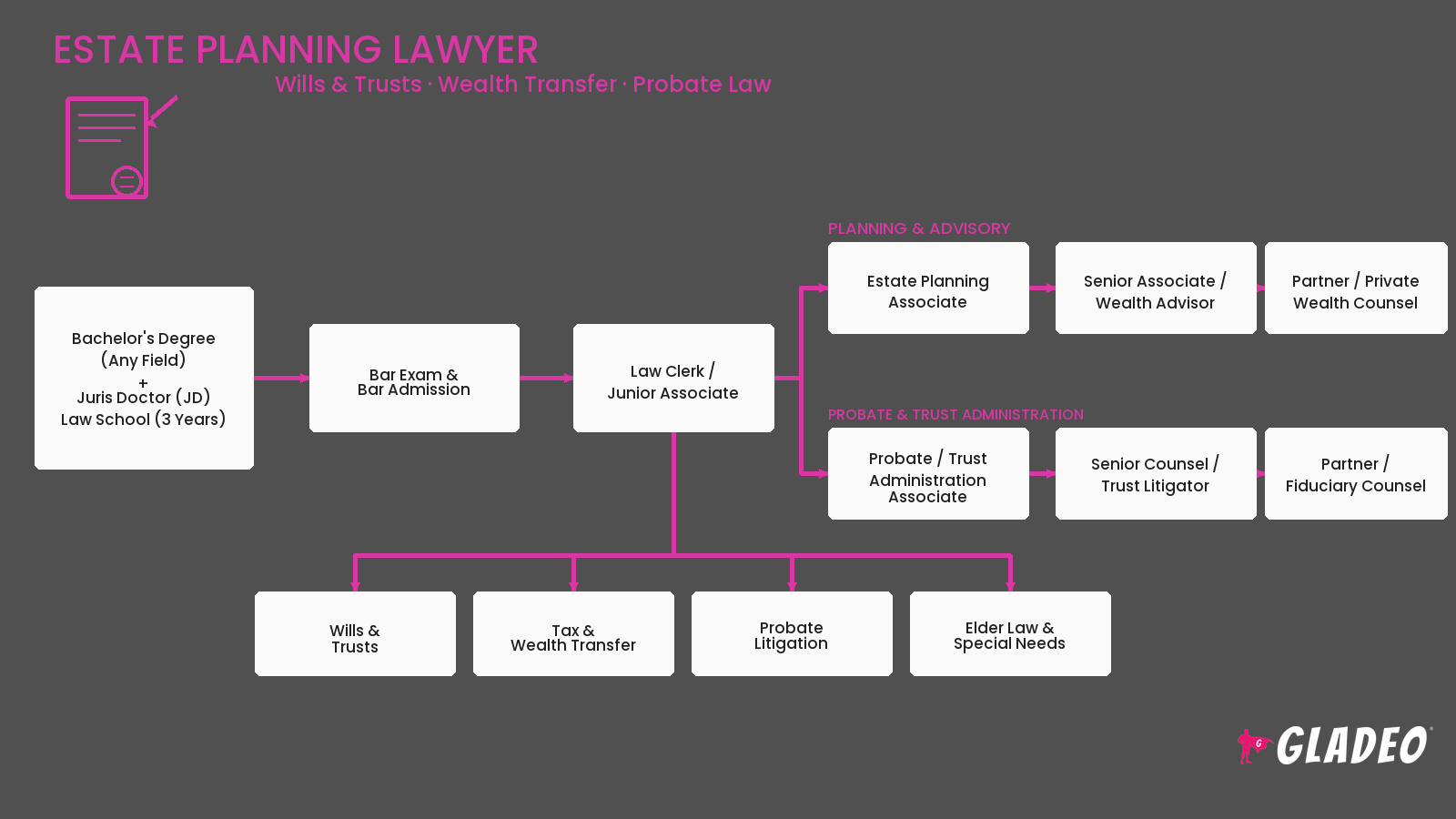
- Apply for associate positions at boutique or general practice firms with estate planning departments
- Complete an internship at a bank or trust company's fiduciary department
- Search job boards through your state bar association and estate planning sections
- Attend recruiting events hosted by firms with trusts and estates practices
- Network with alumni and attorneys working in estate planning and elder law
- Pass the bar exam and consider pursuing an LL.M. in taxation for a competitive edge
- Highlight any accounting, finance, or elder services experience on your resume
- Consider starting as a paralegal at an estate planning firm to learn the field
- Practice explaining legal concepts in plain, warm language for client-facing interviews
- Be open to smaller firms or solo practices, where new attorneys often get direct client contact faster
- Join student and early-career chapters of trusts and estates bar associations
- Volunteer for free will clinics to build experience while job searching
- Build a reputation for careful, accurate drafting that clients and colleagues trust
- Take on more complex estates involving business succession or significant tax planning
- Pursue advanced credentials, such as becoming a Fellow of the American College of Trust and Estate Counsel
- Develop a specialty, such as elder law, special needs planning, or charitable giving
- Build a strong referral network with financial advisors, accountants, and insurance agents
- Publish articles or speak at continuing legal education events on estate planning topics
- Move from associate to partner, or build your own trusted, referral-based practice
- Mentor junior attorneys and paralegals entering estate planning
Websites:
- American College of Trust and Estate Counsel - actec.org
- National Academy of Elder Law Attorneys - naela.org
- American Bar Association Real Property, Trust and Estate Law Section - americanbar.org
- WealthCounsel - wealthcounsel.com
- National Association of Estate Planners and Councils - naepc.org
- Society of Trust and Estate Practitioners - step.org
- Elder Law Answers - elderlawanswers.com
- American Bar Foundation - americanbarfoundation.org
- National Elder Law Foundation - nelf.org
- Financial Planning Association - onefpa.org
- American College of Trust and Estate Counsel Foundation - actecfoundation.org
- Trusts and Estates Magazine - wealthmanagement.com
- Estate Planning Council of your local area - naepc.org
- Uniform Law Commission - uniformlaws.org
Books:
- Plan Your Estate by Denis Clifford
- The Complete Book of Wills, Estates and Trusts by Alexander A. Bove Jr.
- Beyond the Grave by Gerald M. Condon and Jeffrey L. Condon
- Estate Planning Basics by Denis Clifford
- Loving Trust by Robert A. Esperti and Renno L. Peterson
If you find that being an Estate Planning Lawyer isn't the right fit, your skills in careful drafting, tax planning, and client relationships transfer well to many related careers.
- Financial Advisor
- Trust Officer
- Elder Care Consultant
- Paralegal specializing in trusts and estates
- Certified Public Accountant
- Insurance and Financial Planning Specialist
- Probate Court Administrator
- Nonprofit Planned Giving Officer
- Family Business Consultant
- Wealth Management Associate
Click here to download the infographic
Newsfeed

Featured Jobs
Online Courses and Tools