





Spotlights
Design Engineer, Product Designer, Mechanical Designer, Product Development Engineer, Commercial Designer, Product Developer
Nearly every product we use today was created by an Industrial Designer. They may not have held that exact title, but an Industrial Designer is responsible for the development of new products. For new items to enter the market today, there is a team of people behind the scenes ensuring that it is usable and safe, and leading that effort is an Industrial Designer.
Although not all of them perform all aspects of the job, Industrial Designers are creative individuals that spearhead the development of new products. Starting from the ground up, a concept is created with the artistic vision of an Industrial Designer via sketches, mockups, or rudimentary models or molds. These concepts then go through a team of other design professionals like engineers, manufacturers, software developers, and marketing professionals to get the product from idea to consumer readiness.
The Industrial Designer is involved through the creation process, implementing advice and specifications from engineers and manufacturers to help the product evolve into one that can be released to consumers.
- Shaping products people use every day without ever thinking about who designed them.
- Solving real problems where form, function, cost, and manufacturing all have to agree.
- Working with your hands as much as your head — sketching, modeling, and prototyping.
- Collaborating with engineers and manufacturers to turn a concept into something tangible.
- Seeing your design on a shelf, in someone's home, or in a stranger's hands.
- Watching a product survive testing, tooling, and production and come out as intended.
- Building a portfolio that shows visible growth in craft and thinking.
- Working across industries — from tech and furniture to medical devices and mobility.
Working Schedule
An Industrial Designer is responsible for helping a product go from idea to consumer-ready. They are often required to brainstorm a concept that a company has asked for directly and then provide follow-up by presenting that concept in a visual format, such as a sketch or CAD rendering. After engineering teams provide input, it is ‘back to the drawing board to implement the necessary usability requirements. As the product goes through the entire design and testing process, the Industrial Designer revisits the original product many times to make adjustments. They aid in managing the rest of a design team to fully integrate the different aspects of physical production, safety concerns, marketability, software and User Interface, etc.
Typical Duties
- Arrange production of samples
- Communicate with company leaders and customers
- Create physical models of concepts in many mediums from woodworking to 3D printing
- Include aesthetic design principles with usability requirements
- Investigate alternative uses of products that are already on the market
- Oversee assistant’s work and help manage a design team
- Prepare illustrations, blueprints, and digital renderings of design concepts
- Present ideas, design modifications, and consumer use guides to research and development teams
- Research market needs and marketing procedures
- Research production costs
- Understand and develop industry standards for design and production
Additional Responsibilities
- Aid corporate entities with their image goals
- Attend and present information at professional conferences and events
- Incorporate decorative designs
- Prepare material to ‘pitch’ ideas to companies
Mornings often start with reviewing project timelines, checking emails from clients or engineering teams, and revisiting sketches, models, or prototypes from the day before. Designers may join a cross-functional meeting with engineers, marketers, and manufacturers to align on constraints, costs, and next steps before diving into focused work.
Midday is usually the most creative stretch — sketching concepts, refining forms in CAD software, building foam or 3D-printed models, and testing how a design feels in the hand. This stage involves constant iteration, as designers balance aesthetics, usability, materials, and how a product will actually be made.
Afternoons can include prototype reviews, user testing sessions, or meetings with suppliers and manufacturers to discuss tooling, materials, and production feasibility. Designers may also present concepts to stakeholders, absorb feedback, and revise accordingly.
Evenings might involve documenting design decisions, preparing renders and presentations, researching materials and competitor products, or working on personal projects and competitions that keep their skills sharp.
Soft Skills
- Active listening
- Administrative
- Attention to Detail
- Creativity
- Mathematics
- Sales and Marketing
- Technology
- Verbal and Written Communication
Technical Skills
- Desktop Publishing
- Digital Cameras
- Internet Research/Browsing
- Video Creation and Editing
- Various types of design software such as:
- Adobe Suite
- Autodesk 3ds Max
- Dassault Systemes
- Eko
- JavaScript
- Mathworks
- QuarkXpress
- Siemens NX
- Product Designers
- Consumer Electronics Designers
- Furniture Designers
- Transportation and Automotive Designers
- Packaging Designers
- Toy and Game Designers
- Medical and Healthcare Product Designers
- Sports and Outdoor Equipment Designers
- Home Appliance Designers
- Footwear and Apparel Designers
- Lighting Designers
- Exhibit and Retail Fixture Designers
- UX and Interaction Designers
- CMF (Color, Material, Finish) Designers
- Design Researchers and Strategists
- CAD and 3D Modeling Specialists
- Prototyping and Model Makers
- Sustainable and Circular Design Specialists
- Design Consultants
- In-House Corporate Designers
- Consumer electronics companies
- Home appliance and kitchenware brands
- Furniture and home goods manufacturers
- Automotive and mobility companies
- Toy and game companies
- Sports and outdoor gear brands
- Medical device and healthcare equipment firms
- Packaging and consumer goods companies
- Design consultancies and studios
- In-house corporate design departments
- Product development and innovation labs
One of the biggest sacrifices that Industrial Designers make is sacrificing time to the job. Projects may take a lot of time that is not scheduled for because of the evolving nature of the projects and the quality control needs. They are expected to work within the timeline of other parts of the design team, which can include unexpected setbacks.
An Industrial Designer is also expected to create useful and safe products, which can be a daunting idea. They’re expected to think forward to how the designs can be used or misused, and plan ahead for those possibilities.
Industrial Design is expected to experience an average growth rate in the next few years, although the move from manufacturing inside of the U.S. could cause that to decrease slightly.
With new products going into the market every day, and innovation continues at a rapid pace in the technology sector, the need for designers is still stable and growing.
One of the main traits that Industrial Designers share is a very strong sense of imagination. As children, the designers were often involved heavily in make-believe play, and in building and constructing toys like Legos. They also likely had artistic talent, either in drawing and sculpting or in digital design. Even video games like Minecraft provide a solid foundation for the creation and construction of projects, products, and models.
Becoming an Industrial Designer typically involves a mix of formal education and hands-on making. Most designers earn a bachelor's degree in industrial design, product design, or a related field, where they learn design fundamentals, materials, manufacturing processes, and user research. Some pursue master's degrees for specialization or teaching, while others enter through adjacent paths like mechanical engineering or architecture paired with a strong portfolio.
Students can take courses in relevant subjects such as:
- Design Fundamentals and Drawing
- 3D Modeling and CAD (SolidWorks, Rhino, Fusion 360)
- Model Making and Prototyping
- Materials and Manufacturing Processes
- Ergonomics and Human Factors
- Design Research and User Testing
- Color, Material, and Finish (CMF)
- Design Thinking and Problem Solving
- Engineering and Mechanical Principles
- Sustainability and Lifecycle Design
- Presentation and Portfolio Development
- Design History and Theory
Hands-on practice is essential; building a portfolio of finished projects — showing sketches, process, prototypes, and final renders — is what employers and clients actually evaluate. Internships with manufacturers, design consultancies, or consumer brands provide valuable real-world experience. Continuous learning through workshops, design competitions, and staying current with new materials and fabrication methods keeps skills fresh and innovative.
- Draw constantly — sketch products, redesign objects around you, and keep a sketchbook
- Take art, design, woodworking, or shop classes to build making skills
- Learn basic 3D modeling and CAD software early
- Take apart old electronics or appliances to understand how things are built
- Build physical models from cardboard, foam, or 3D printing
- Enter design challenges and competitions, even local ones
- Read about materials, manufacturing, and how products get made
- Visit museums, design exhibitions, and manufacturer facilities when possible
- In college, pursue industrial or product design and complete studio projects
- Apply for internships with design firms, manufacturers, or brand studios
- Learn presentation skills — how to pitch and defend a concept
- Take engineering, psychology, or business courses to round out your thinking
- Join design clubs, portfolio reviews, and student exhibitions
- Build an online portfolio and document your process, not just final results
- Look for programs with strong hands-on studio time and real product projects
- Choose schools that offer internships or industry partnerships with manufacturers and brands
- Verify that instructors have professional experience in product or industrial design
- Ensure the curriculum covers both creative and technical skills
- Check availability of modern CAD software, workshops, and prototyping facilities
- Consider programs that teach materials, manufacturing, and how products are made
- Look for courses on design research, ergonomics, and sustainability
- Evaluate class sizes to ensure personalized instruction and critique
- Seek programs that include portfolio development and review sessions
- Find schools with active design clubs, exhibitions, or student competitions
- Consider cost and financial aid availability
- Research graduate success and job placement rates
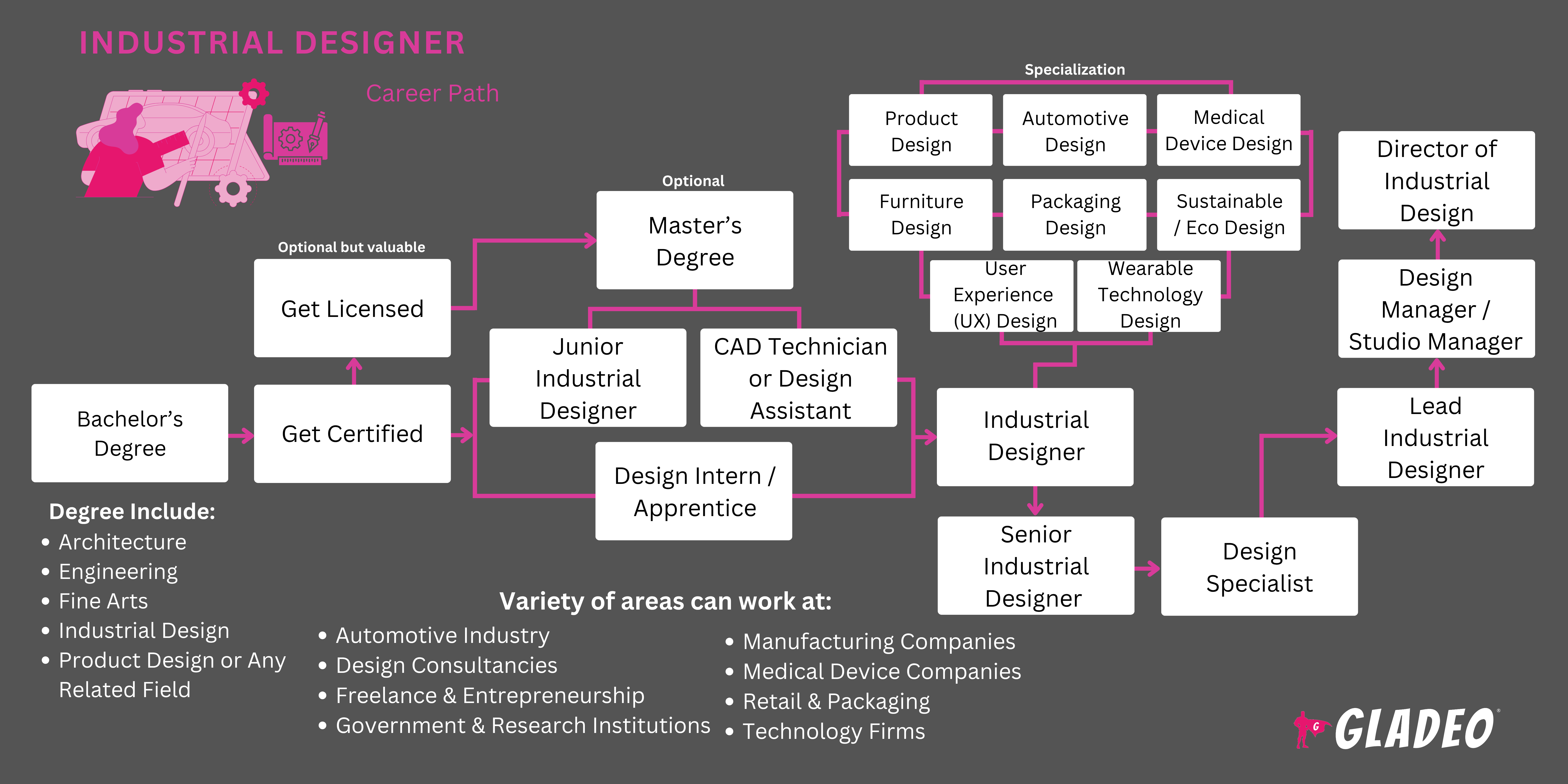
- Apply for entry-level roles such as junior industrial designer, CAD drafter, model maker, or design assistant.
- Build a portfolio of 6–10 projects showing sketches, process, prototypes, and final renders.
- Network with designers, engineers, and recruiters at design events, conferences, and online communities.
- Take on freelance or student projects for local businesses, startups, or makerspaces to build real-world samples.
- Enter design competitions and challenges to push your skills and add credibility.
- Learn the production side — materials, tooling, and manufacturing constraints — since juniors are often hired for practicality.
- Get comfortable with CAD tools: SolidWorks, Rhino, Fusion 360, and rendering software like KeyShot.
- Practice physical prototyping — foam, cardboard, 3D printing — to show you can think with your hands.
- Consider an internship with a manufacturer, consultancy, or brand studio, even short-term.
- Stay flexible on project types and locations while you build a track record.
- Develop communication and presentation skills for pitching concepts to teams and clients.
- Ask for critiques from senior designers and act on the feedback.
- Keep a log of projects, specs, and problems you solved to show growth.
- Tailor each application — a portfolio aimed at the company beats a generic one.
- Lead more complex projects from concept through production.
- Develop expertise in a specialized area like consumer electronics, transportation, or medical devices.
- Build strong relationships with engineers, manufacturers, and product managers.
- Take on leadership roles such as senior designer, design lead, or design manager.
- Expand skills into design strategy, research, and innovation management.
- Learn the business side — cost, margins, supply chain, and go-to-market.
- Mentor juniors and build a reputation within the design community.
- Stay current on new materials, fabrication methods, and design technology.
- Consider advancing education through a master's degree or specialized workshops.
Websites
- Industrial Designers Society of America (idsa.org)
- Designboom (designboom.com)
- Core77 (core77.com)
- Yanko Design (yankodesign.com)
- Dezeen (dezeen.com)
- IDEO (ideo.com)
Fast Company Design (fastcompany.com/design) - SolidWorks Blog (blogs.solidworks.com)
- KeyShot Resources (keyshot.com)
- GrabCAD (grabcad.com)
- Behance Industrial Design (behance.net)
- Material ConneXion (materialconnexion.com)
- The Dieline (thedieline.com)
- Maker communities such as Instructables (instructables.com)
Books
- Start at the End: How to Build Products That Create Change, by Matt Wallaert
- The Design of Everyday Things, by Don Norman
- The Design Thinking Playbook: Mindful Digital Transformation of Teams, Products, Services, Businesses and Ecosystems, by Michael Lewrick, Patrick Link, and Larry Leifer
- Product Design and Development by Karl Ulrich and Steven Eppinger
- Making It: Manufacturing Techniques for Product Design by Chris Lefteri
Because of the multifaceted nature of being an Industrial Designer, there are many other jobs that also utilize imagination, creativity, artistic talent, and the ability to use design software. They include careers like:
- 3D Modeler
- Architect
- Artists
- Fashion Designer
- Graphic Designer
- Industrial Engineer
- Mechanical Drafter
- Safety Engineer
- Software Developer
Newsfeed

Featured Jobs
Online Courses and Tools
Annual Salary Expectations
New workers start around $68K. Median pay is $85K per year. Highly experienced workers can earn around $107K.