







Spotlights
Landscape Cost Estimator, Landscape Project Estimator, Grounds Estimator, Landscape Construction Estimator, Outdoor Space Estimator, Hardscape Estimator, Landscape Bid Specialist, Landscape Quantity Surveyor, Landscape Cost Analyst, Site Estimator, Landscape Materials Estimator, Irrigation Estimator
Imagine walking through a stunning park, a beautiful garden, or a perfectly manicured outdoor space — the kind that makes you pause and appreciate nature’s harmony with human design. Behind the scenes, Landscape Estimators play a critical role in bringing these spaces to life by figuring out exactly what it will cost to build and maintain them, ensuring projects are both beautiful and financially sound.
Landscape Estimators spend their days analyzing project plans and blueprints to calculate the materials, labor, and equipment needed to create outdoor environments. They collaborate closely with landscape architects, contractors, suppliers, and project managers to produce detailed cost estimates that guide bids and budgets. Their work helps companies win contracts and complete projects within budget while maintaining quality and environmental standards.
Using specialized software and detailed knowledge of landscaping materials and construction processes, Landscape Estimators assess everything from soil preparation and planting to irrigation systems and hardscaping elements like patios and walls. Their careful calculations ensure that clients get the outdoor space they envision without unexpected expenses, making their role essential to successful landscaping projects.
- Knowing your estimates help create beautiful, functional outdoor spaces that people enjoy for years.
- The satisfaction of translating creative landscape designs into realistic, workable budgets.
- Collaborating with diverse teams including architects, designers, and contractors to bring projects from concept to reality.
- Playing a key role in managing resources efficiently, preventing waste, and promoting sustainability in landscaping projects.
Working Schedule
Landscape Estimators typically work full-time during regular business hours, often in office environments reviewing plans and using estimating software. However, they also spend time onsite inspecting project locations to gather measurements and assess conditions. The job may require occasional overtime to meet tight project deadlines or to adjust estimates based on client or design changes. Many work as employees of landscaping firms, construction companies, or design-build firms, but some operate as independent consultants or freelancers.
Typical Duties
- Review detailed landscape design plans, blueprints, and specifications to understand project scope.
- Calculate quantities and costs of materials such as plants, soil, mulch, stone, and irrigation components.
- Estimate labor hours and equipment needs for site preparation, planting, and construction tasks.
- Consult with suppliers and subcontractors to obtain current pricing information and availability.
- Prepare detailed cost breakdowns and written reports to support bids and proposals.
- Collaborate with landscape architects, project managers, and contractors to clarify design and construction details.
- Visit project sites to evaluate existing conditions and identify potential challenges affecting costs.
- Update estimates as project plans evolve or client requests change to maintain accurate budgeting.
- Analyze past project data and market trends to refine estimating techniques and improve accuracy.
- Ensure compliance with environmental regulations and sustainable landscaping practices in cost planning.
- Assist in preparing bids and competitive proposals for landscaping contracts.
- Maintain organized records of estimates, bids, and project cost histories for future reference.
Additional Responsibilities
- Participate in client meetings to explain cost estimates and answer questions.
- Support project managers by tracking costs during construction to prevent overruns.
- Recommend cost-saving alternatives or value engineering solutions without compromising project quality.
- Stay updated on new landscaping materials, technologies, and industry pricing trends.
- Train junior estimators or interns in estimating methods and software.
- Help develop company standards for estimating to improve consistency and efficiency.
- Coordinate with finance teams to align estimates with overall project budgets and funding.
- Assist in risk assessment related to unforeseen site conditions or supply chain issues.
In the morning, a Landscape Estimator starts by reviewing emails and messages from clients or contractors about recent plan changes or pricing updates. They examine detailed project drawings and specifications to ensure they understand every aspect before starting calculations. Sometimes they prepare for an onsite visit later in the day, gathering necessary tools such as measuring devices and cameras.
By midday, they dive into crunching numbers using estimating software and spreadsheets, calculating quantities of plants, soil, mulch, and materials needed. They contact suppliers to confirm pricing and availability, and might consult with landscape architects or project managers to clarify design details or resolve questions. Often, they update cost estimates to reflect new information or client requests.
In the afternoon or evening, the estimator might visit job sites to verify measurements and inspect ground conditions, taking notes and photos to adjust estimates accurately. Back in the office, they finalize detailed reports and cost breakdowns to submit for bids or client review. They may also attend team meetings to discuss project progress and potential budget concerns, ensuring everyone is aligned.
Soft Skills
- Attention to detail
- Strong communication
- Problem-solving
- Time management
- Team collaboration
- Critical thinking
- Adaptability
- Negotiation skills
- Customer service orientation
- Organizational skills
- Analytical mindset
- Patience and persistence
Technical Skills
- Proficiency with estimating software (e.g., RSMeans, PlanSwift)
- Blueprint and technical drawing reading
- Cost analysis and budgeting
- Quantity takeoff techniques
- Knowledge of landscaping materials and construction processes
- Familiarity with project management tools
- Ability to use measurement tools onsite
- Computer literacy (Excel, CAD basics)
- Understanding of environmental regulations
- Data research and market analysis
- Residential Landscape Estimator: Focuses on estimating costs for private homes, gardens, and small-scale outdoor spaces.
- Commercial Landscape Estimator: Works on larger projects like parks, office campuses, and retail centers requiring complex cost analysis.
- Hardscape Estimator: Specializes in estimating costs related to non-plant elements such as patios, walls, and walkways.
- Irrigation Estimator: Concentrates on the design and cost of irrigation systems for landscapes.
- Sustainable Landscape Estimator: Emphasizes eco-friendly materials and methods, integrating sustainable practices into cost estimates.
- Municipal Landscape Estimator: Works on public projects such as parks, streetscapes, and community spaces, often dealing with government regulations.
- Landscape Restoration Estimator: Focuses on rehabilitating damaged or neglected landscapes, requiring specialized cost evaluation.
- Landscape Maintenance Estimator: Estimates ongoing costs for landscape upkeep, including seasonal plantings and equipment.
- Landscaping companies
- Landscape architecture firms
- Construction and design-build firms
- Municipal parks and recreation departments
- Golf course management companies
- Nurseries and garden centers
- Environmental consulting firms
- Irrigation system companies
- Hardscape installation firms
- Real estate development companies
- Landscape maintenance service providers
- Agricultural cooperatives
Landscape Estimators often work under tight deadlines to produce accurate bids that can make or break a project’s success. This pressure means they must be precise and thorough, balancing speed with attention to detail. Mistakes can lead to costly overruns or lost contracts, so the job demands focus and resilience.
The role involves a mix of office work and field visits. While many hours are spent analyzing plans and inputting data, estimators also need to be comfortable inspecting sites in varied weather conditions. They may face fluctuating workloads, especially when multiple bids are due simultaneously, requiring flexibility and sometimes overtime.
Because landscaping projects can change rapidly due to design revisions or unexpected site issues, estimators must be ready to adapt their numbers and strategies quickly. This can mean last-minute updates and extended communication with diverse teams, requiring strong interpersonal skills and patience to handle revisions without frustration.
- Growing demand for sustainable and eco-friendly landscaping materials affecting cost estimates.
- Increased use of 3D modeling and virtual reality to visualize projects before estimating.
- Integration of drone technology for more accurate site surveys.
- Advances in estimating software with AI to improve accuracy and efficiency.
- Rising labor and material costs influencing budget planning and bidding strategies.
- Greater emphasis on water-efficient irrigation systems in estimates.
- Use of Building Information Modeling (BIM) for landscape architecture projects.
- Shift towards integrated design-build approaches requiring collaborative estimating.
- Focus on native plant species to reduce maintenance costs and environmental impact.
- Growth in urban green infrastructure projects expanding landscape estimation opportunities.
Kids who enjoy building and designing outdoor spaces, whether in a backyard garden or with model sets, often show early interest in landscape estimating. They might love measuring spaces, drawing layouts, or experimenting with plants and terrain features.
Young people fascinated by math, problem-solving, and organizing projects tend to gravitate toward this career. Early experiences like volunteering in community gardens or helping with yard work can spark a passion for understanding how outdoor environments come together practically and financially.
A career as a Landscape Estimator typically requires a combination of formal education, hands-on experience, and specialized training. Many begin with degrees or certificates in landscape design, horticulture, construction management, or related fields, which provide foundational knowledge of plants, construction processes, and project planning.
Students can take courses in relevant subjects such as:
- Landscape Design and Horticulture
- Construction Estimating
- Soil Science and Plant Biology
- Blueprint Reading and Drafting
- Project Management
- Mathematics for Construction
- Environmental Science
- Computer-Aided Design (CAD)
- Business and Contract Law
- Sustainable Landscaping Practices
Beyond coursework, aspiring Landscape Estimators benefit greatly from internships or entry-level positions where they can work alongside experienced professionals. Building a strong portfolio of completed projects and developing proficiency with estimating software are crucial steps. On-the-job training helps refine skills in cost analysis, supplier negotiation, and site assessment, which are essential for success in this role.
- Take advanced math courses such as algebra and geometry to build strong calculation skills.
- Enroll in biology or environmental science classes to understand plant and soil basics.
- Participate in vocational programs related to landscaping or construction.
- Join clubs or teams focused on gardening, environmental stewardship, or design.
- Pursue computer classes covering spreadsheets, CAD, and estimating software.
- Seek summer jobs or volunteer opportunities with landscaping companies or nurseries.
- Attend workshops or summer camps focused on landscape design or construction.
- Build a portfolio of design or estimating projects completed during school.
- Network with professionals through career fairs or mentorship programs.
- Research colleges or trade schools offering landscape architecture or construction management programs.
- Choose programs with hands-on estimating projects and internships.
- Look for curriculum that integrates both horticulture and construction principles.
- Select schools offering training in industry-standard software tools.
- Check for faculty with real-world experience in landscape estimation.
- Prioritize programs that teach sustainable landscaping methods.
- Seek opportunities for cross-disciplinary learning with architecture or engineering.
- Attend schools that have partnerships with local landscaping firms for job placements.
- Ensure the program covers business and contract law relevant to bidding.
- Opt for courses including site visits and practical fieldwork.
- Evaluate the availability of mentorship and career support services.
- Consider programs offering certification preparation for estimating.
- Choose institutions with strong alumni networks in the landscaping industry.
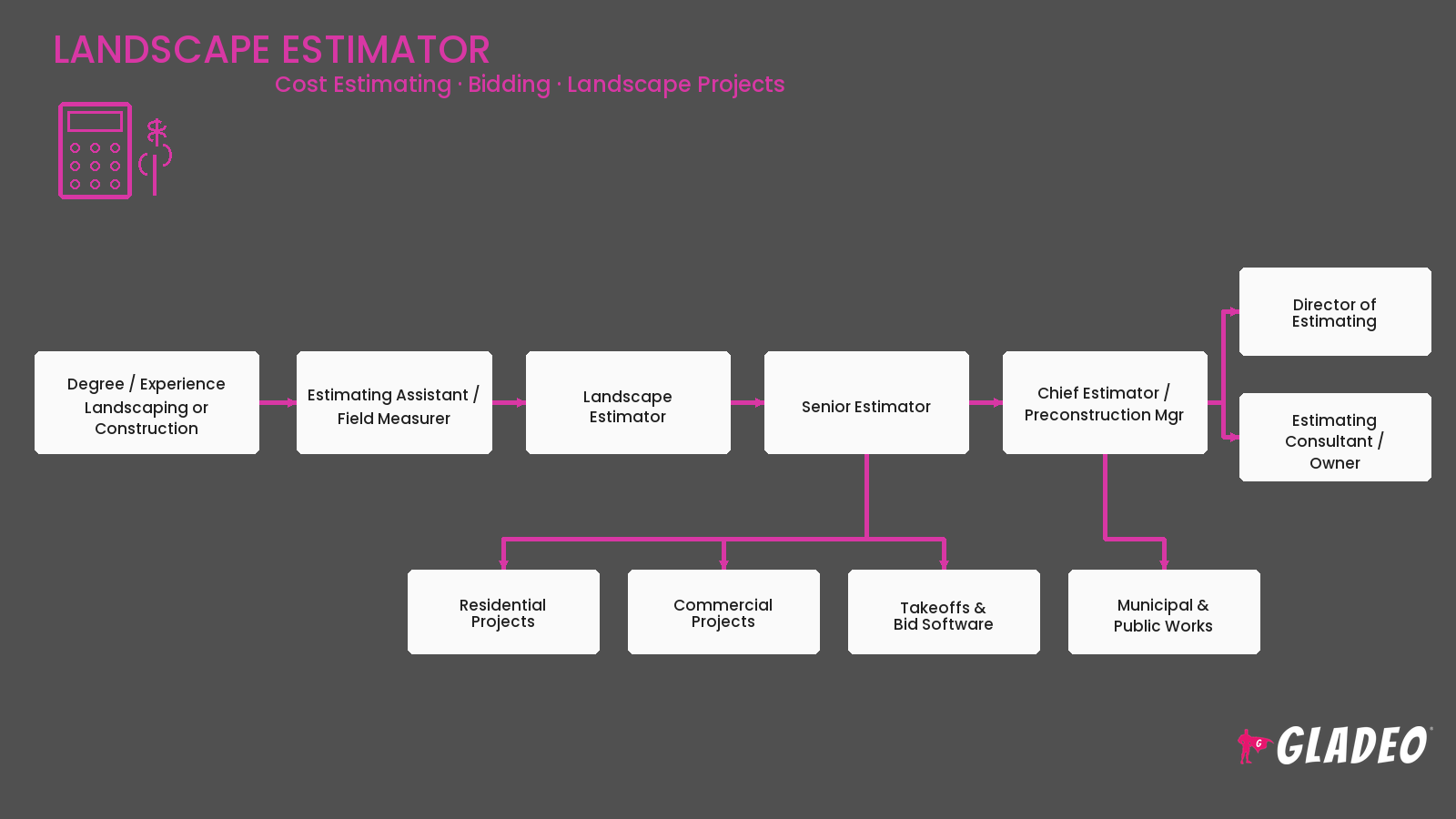
- Apply for internships or assistant estimator roles with landscaping or construction companies.
- Build a detailed portfolio showing your estimating calculations and any project involvement.
- Learn to use popular estimating software such as RSMeans or PlanSwift.
- Gain experience reading and interpreting landscape design plans and blueprints.
- Attend industry networking events to meet professionals and learn about job openings.
- Volunteer to assist with site visits to get practical knowledge of measuring and assessing land.
- Ask for opportunities to help prepare bids or cost proposals under supervision.
- Develop strong communication skills by explaining your estimates to team members.
- Stay updated on pricing trends for materials and labor in your region.
- Practice attention to detail and accuracy in all your work to build trust.
- Seek feedback from mentors to improve your estimating accuracy and efficiency.
- Join professional associations to access job listings and continuing education.
- Master advanced estimating software and data analysis techniques.
- Develop expertise in sustainable and eco-friendly landscape materials.
- Build relationships with suppliers and subcontractors to negotiate better pricing.
- Take on leadership roles in project bidding and client presentations.
- Pursue certifications in construction estimating or project management.
- Expand knowledge of related fields like landscape architecture or horticulture.
- Contribute to company standards and training programs for estimators.
- Network extensively to find opportunities for advancement or specialized projects.
Websites:
- American Society of Landscape Architects (ASLA) - asla.org
- National Association of Landscape Professionals (NALP) - landscapeprofessionals.org
- Landscape Institute - landscapeinstitute.org
- Construction Specifications Institute (CSI) - csinet.org
- Estimating Today - estimatingtoday.com
- Landscape Architect Magazine - landscapearchitect.com
- PlanSwift Estimating Software - planswift.com
- RSMeans Data Online - rsmeans.com
- Irrigation Association - irrigation.org
- Green Industry Pros - greenindustrypros.com
- Association of Professional Landscape Designers (APLD) - apld.org
- National Association of Women in Landscape Construction (NAWILC) - nawilc.org
- International Society of Arboriculture (ISA) - isa-arbor.com
- Landscape Management - landscapemanagement.net
Books:
- Landscape Estimating and Costing by David Sauter
- Construction Estimating Using RSMeans Data by Rodney D. Stewart
- The Professional Estimator's Estimating Handbook by Wayne J. Del Pico
- Landscape Construction by David Sauter
- Estimating in Building Construction by Steven J. Peterson
If you discover that landscape estimating isn’t your perfect fit, there are many related careers that use similar skills and interests, ranging from design to project management and environmental science.
- Landscape Architect
- Construction Project Manager
- Horticulturist
- Irrigation Designer
- Hardscape Installer
- Environmental Consultant
- Urban Planner
- Surveyor
- Cost Engineer
- Landscape Maintenance Supervisor
Newsfeed

Featured Jobs
Online Courses and Tools