






Spotlights
Nematode Specialist, Soil Biologist, Plant Pathologist, Agricultural Scientist, Parasitologist, Environmental Scientist, Crop Protection Scientist, Soil Health Analyst, Pest Management Specialist, Biological Researcher, Microbial Ecologist
Imagine the unseen world beneath your feet where tiny worms called nematodes either help crops thrive or cause devastating plant diseases. Nematologists are the scientists who explore this hidden realm to protect food supplies, improve soil health, and safeguard ecosystems.
Every day, nematologists study microscopic roundworms by collecting soil, plant, and water samples, then examining them under microscopes or using genetic tools. They work closely with farmers, agricultural researchers, environmental agencies, and biotech firms to identify harmful nematodes and develop ways to control or harness them for better crop yields and sustainable farming.
Using advanced laboratory equipment, microscopes, DNA sequencing technology, and computer modeling, nematologists analyze nematode behaviors and life cycles. Their research is vital for developing eco-friendly pest control methods, improving soil quality, and supporting global food security by minimizing crop losses caused by nematodes.
- Helping farmers protect crops and increase food production in sustainable ways.
- Discovering new species and understanding complex soil ecosystems.
- Contributing to environmental conservation and healthy soil management.
- Being at the forefront of scientific research with practical, real-world impact.
Working Schedule
Nematologists typically work full-time in labs, greenhouses, or field sites. Their schedule may fluctuate with planting seasons and research deadlines, sometimes requiring early mornings or extended hours during peak agricultural periods. Many work for universities, government agencies, or private companies, balancing fieldwork with lab analysis and report writing.
Typical Duties
- Collect soil and plant samples from farms, gardens, or natural areas.
- Identify nematode species using microscopes and molecular techniques.
- Conduct experiments to study nematode behavior and life cycles.
- Develop biological or chemical controls to manage harmful nematodes.
- Collaborate with agronomists and farmers to apply research findings in the field.
- Analyze data and prepare detailed reports or scientific papers.
- Monitor soil health and nematode population changes over time.
- Train students or agricultural workers on nematode identification and management.
- Stay updated on the latest scientific literature and technologies.
- Present research findings at conferences and workshops.
- Assist in securing research funding through grant writing.
- Ensure laboratory safety and proper handling of biological samples.
Additional Responsibilities
- Maintain and calibrate laboratory equipment and microscopes.
- Manage research budgets and order supplies.
- Develop educational materials for farmers and stakeholders.
- Participate in interdisciplinary research teams.
- Advise policymakers on nematode-related agricultural regulations.
- Contribute to public awareness campaigns on soil health.
- Supervise laboratory assistants or interns.
- Ensure compliance with environmental and safety regulations.
Morning often starts with reviewing lab results and planning field activities, checking weather conditions and sample collection schedules. Nematologists may analyze microscope slides or prepare soil samples for genetic testing.
Midday involves heading to farms or greenhouses to collect samples, observe nematode activity, or test soil conditions. They collaborate with farmers or research partners to discuss findings and adjust experiments.
Afternoons are dedicated to data analysis, writing reports, and meeting with research teams. They may also teach students or prepare presentations for upcoming conferences, balancing hands-on work with communication and planning.
Soft Skills
- Attention to detail
- Curiosity and passion for science
- Strong communication skills
- Problem-solving mindset
- Patience and perseverance
- Collaboration and teamwork
- Critical thinking
- Adaptability to changing field conditions
- Time management
- Teaching and mentoring ability
- Data interpretation
- Creativity in research design
Technical Skills
- Microscopy techniques
- Molecular biology methods (PCR, DNA sequencing)
- Soil sampling and analysis
- Data analysis software (e.g., R, Python)
- Experimental design
- Laboratory safety protocols
- GIS and mapping tools
- Plant pathology knowledge
- Statistical analysis
- Report writing and scientific documentation
- Agricultural Nematologist: Focuses on managing nematodes affecting crops to improve yield and quality.
- Environmental Nematologist: Studies nematodes in natural ecosystems to understand soil health and biodiversity.
- Medical Nematologist: Researches nematodes that cause diseases in humans and animals.
- Industrial Nematologist: Works on nematodes impacting products like textiles or stored goods.
- Research Scientist: Conducts fundamental studies on nematode genetics and biology.
- Extension Specialist: Trains farmers and provides practical nematode management advice.
- Biotechnologist: Develops nematode-based bio-pesticides or soil enhancers.
- Regulatory Scientist: Evaluates nematode control products for safety and effectiveness.
- Agricultural research universities
- Government agricultural departments
- Environmental protection agencies
- Biotechnology companies
- Soil and crop consultancy firms
- Nonprofit environmental organizations
- Pest management companies
- International agricultural development agencies
- Seed and agrochemical manufacturers
- Forestry research centers
- Extension service organizations
- Botanical gardens and research institutes
Nematologists often face pressure to deliver research results that can directly benefit farmers and ecosystems, sometimes under tight deadlines tied to planting seasons or grant funding cycles. Their work requires careful precision, as even small mistakes in sample handling can affect outcomes.
Work hours are generally full-time but can extend to evenings or weekends during critical fieldwork periods or when preparing reports and grant applications. Field conditions may be physically demanding, involving outdoor sample collection in varying weather.
The role demands patience and resilience due to the slow pace of biological research and the complexity of nematode ecosystems. Researchers must be comfortable with repeated experiments and revisions, balancing laboratory work with collaboration and communication.
- Increasing use of DNA sequencing and genomics for nematode identification.
- Development of eco-friendly nematode control methods reducing chemical pesticide use.
- Use of big data and AI to predict nematode outbreaks and soil health changes.
- Greater focus on sustainable agriculture and soil biodiversity.
- Integration of remote sensing and GIS in soil and nematode studies.
- Collaboration between nematologists and climate scientists to understand environmental impacts.
- Growth in biotechnological applications like bio-pesticides derived from nematodes.
- Expanding international cooperation to address global food security challenges.
- Increased public awareness of soil health importance.
- Emerging research on nematodes’ role in carbon cycling and climate mitigation.
Many nematologists developed an early fascination with nature, exploring soil and garden life, collecting insects or worms, and conducting simple experiments in backyards or school projects. A love for biology, puzzles, and problem-solving often hinted at their future path.
They enjoyed hands-on science activities, reading about plants and animals, and were curious about the microscopic world. Early exposure to farming or gardening deepened their interest in how unseen organisms impact the environment and food production.
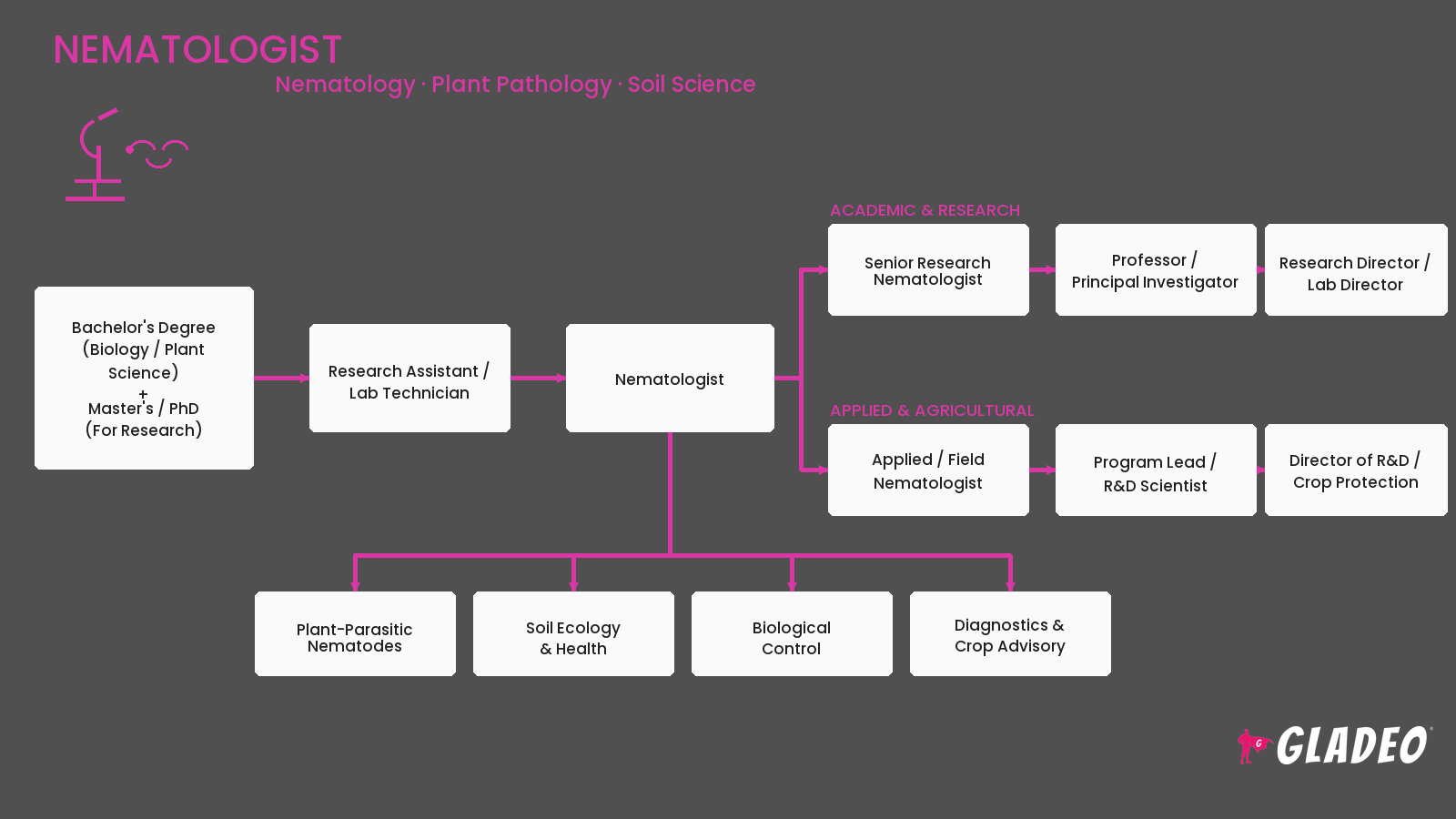
Becoming a nematologist usually requires a strong background in biology or agriculture. Most professionals earn at least a bachelor's degree in fields like biology, plant sciences, or agricultural sciences, with many pursuing graduate studies focused on nematology or related disciplines.
Students can take courses in relevant subjects such as:
- Biology and Zoology
- Soil Science
- Plant Pathology
- Microbiology
- Genetics and Molecular Biology
- Ecology and Environmental Science
- Statistics and Data Analysis
- Agronomy
- Biotechnology
- Laboratory Techniques
Hands-on laboratory and field experience is crucial, so students should seek internships or research projects during their studies. Building a portfolio of research and learning to use specialized equipment and software will prepare aspiring nematologists for the workforce.
- Take advanced science courses such as biology, chemistry, and environmental science.
- Participate in science clubs and fairs focused on biology or agriculture.
- Volunteer or intern at farms, botanical gardens, or environmental labs.
- Learn computer skills, especially data analysis and basic programming.
- Explore college programs strong in agricultural sciences or biology.
- Attend workshops or summer camps related to ecology or plant sciences.
- Develop skills in research writing and presentations.
- Seek mentorship from science teachers or local scientists.
- Join online forums or groups about nematology or soil biology.
- Prepare for college entrance exams with a focus on science and math.
- Choose programs with hands-on laboratory and fieldwork opportunities.
- Look for schools offering specialization or electives in nematology or plant pathology.
- Seek internships or research assistant positions during college.
- Prioritize programs with strong ties to agriculture or environmental agencies.
- Consider programs with access to modern genetic and molecular biology labs.
- Look for faculty actively involved in nematode research.
- Check if the program offers training in data analysis and statistical software.
- Find programs with extension services or community outreach components.
- Evaluate opportunities for interdisciplinary study combining biology, agriculture, and environmental science.
- Select schools offering career support and networking in agricultural sciences.
- Consider graduate programs for advanced research opportunities.
- Verify availability of scholarships or funding for agricultural research.
- Apply for internships or technician roles in agricultural or environmental labs.
- Volunteer for fieldwork on farms or research stations to gain practical experience.
- Build a portfolio of lab reports and research summaries.
- Attend local agricultural fairs or science events to network.
- Seek mentorship from established nematologists or biology professors.
- Develop proficiency in microscopy and basic molecular biology techniques.
- Create a resume highlighting science coursework and hands-on projects.
- Join professional organizations related to agriculture or nematology.
- Participate in community outreach or educational programs on soil health.
- Practice clear communication skills for explaining technical topics.
- Prepare for interviews by studying common nematology topics and current research.
- Look for entry-level roles such as laboratory assistant, research technician, or extension assistant.
- Pursue advanced degrees (master’s or PhD) specializing in nematology or plant pathology.
- Publish research in scientific journals to build professional reputation.
- Build strong relationships with agricultural agencies and industry partners.
- Gain experience managing research projects and teams.
- Develop expertise in bioinformatics and genetic analysis tools.
- Present at national and international conferences to expand network.
- Seek leadership roles in research institutions or extension services.
- Stay current with emerging technologies and sustainable agriculture trends.
Websites:
- Society of Nematologists (sonematologists.org)
- American Phytopathological Society (scisoc.org)
- International Federation of Nematology Societies (ifns.info)
- Agricultural Research Service (ars.usda.gov)
- Entomological Society of America (entsoc.org)
- National Sustainable Agriculture Information Service (attra.ncat.org)
- Plant Management Network (plantmanagementnetwork.org)
- Soil Science Society of America (soils.org)
- Crop Science Society of America (crops.org)
- Extension Foundation (extension.org)
- National Institute of Food and Agriculture (nifa.usda.gov)
- Biotechnology Innovation Organization (bio.org)
- ResearchGate (researchgate.net)
- Science Daily - Agriculture Section (sciencedaily.com/news/plants_animals/agriculture/)
Books:
- Introduction to Nematology by M.R. Siddiqi
- Plant Parasitic Nematodes in Subtropical and Tropical Agriculture by M.B. Luc, A.C. Sikora, J. Bridge
- Nematodes as Environmental Indicators by M. Bongers, L.F.M. van der Pol
- Biology and Management of Plant-Parasitic Nematodes by S.C. Bhatti
- Soil Microbiology, Ecology, and Biochemistry by Eldor A. Paul
If a career as a nematologist doesn’t feel like the right fit, there are plenty of related paths that tap into similar skills and interests in biology, agriculture, and environmental science.
- Agronomist
- Soil Scientist
- Plant Pathologist
- Environmental Consultant
- Microbiologist
- Biotechnologist
- Entomologist
- Forest Ecologist
- Crop Scientist
- Research Technician
Click here to download the infographic
Newsfeed

Featured Jobs
Online Courses and Tools