





Spotlights
Marine Engineer, Naval Architect, Offshore Engineer, Coastal Engineer, Subsea Engineer, Ocean Systems Engineer, Underwater Engineer, Hydraulic Engineer, Environmental Marine Engineer, Oceanographic Engineer, Marine Structural Engineer, Ocean Technology Engineer
Imagine standing on a ship or a coastal platform, knowing that the structures and systems you designed are battling the powerful forces of the ocean to protect people, the environment, and vital industries. Ocean Engineers make this possible by creating innovative solutions that keep our oceans safe, accessible, and sustainable for everyone.
Every day, Ocean Engineers dive into designing, developing, and maintaining structures and equipment that operate in marine environments. They collaborate closely with scientists, shipbuilders, environmental experts, and government agencies to build everything from offshore oil platforms and underwater vehicles to coastal defenses and renewable energy installations. Their work ensures these systems can withstand harsh ocean conditions while serving critical functions.
Using cutting-edge software, simulation tools, and hands-on testing methods, Ocean Engineers analyze waves, currents, and seabed conditions to optimize their designs. Their expertise is vital for advancing ocean exploration, protecting marine ecosystems, and supporting industries like shipping, energy, and fisheries—all while balancing safety and environmental impact.
- Seeing your designs withstand the ocean’s toughest challenges and knowing they protect lives and ecosystems.
- Contributing to innovative projects that push the boundaries of marine technology and sustainability.
- Working outdoors and underwater, combining engineering skills with a passion for the ocean.
- Collaborating with diverse teams to solve complex problems that impact global industries and communities.
Working Schedule
Ocean Engineers often work full-time in offices, labs, or directly at marine sites, including offshore platforms or shipyards. Their schedule can include irregular hours or travel to remote locations depending on project phases, weather conditions, and deadlines. Some roles require periods of fieldwork at sea, which demands flexibility and resilience.
Typical Duties
- Design and test marine structures such as offshore platforms, underwater vehicles, and coastal defenses.
- Conduct environmental impact assessments related to marine construction projects.
- Use computer-aided design (CAD) software and simulation programs to model ocean conditions and structural responses.
- Collaborate with oceanographers, environmental scientists, and regulatory bodies to ensure compliance and sustainability.
- Develop maintenance and safety protocols for marine equipment and infrastructure.
- Analyze ocean currents, tides, and wave patterns to inform engineering decisions.
- Supervise construction or installation of marine systems at shipyards or offshore sites.
- Research new materials and technologies suited for harsh marine environments.
- Prepare technical reports, project proposals, and presentations for stakeholders.
- Monitor and troubleshoot operational marine systems to enhance performance and safety.
Additional Responsibilities
- Stay updated on emerging marine technologies and industry regulations.
- Participate in interdisciplinary planning meetings and workshops.
- Manage project budgets and timelines related to marine engineering tasks.
- Train junior engineers or technicians in specialized marine engineering practices.
- Ensure environmental protection measures are integrated into engineering projects.
- Coordinate with emergency response teams for offshore incidents.
- Contribute to academic or industry publications on marine engineering topics.
- Advise policymakers or industry leaders on ocean engineering challenges and solutions.
Morning often starts by reviewing data from ocean sensors or recent field tests, followed by analyzing simulation results to refine designs or troubleshoot issues.
Midday is focused on collaborative meetings with scientists, construction teams, or clients to discuss project progress, address technical challenges, and plan next steps.
Afternoon and evening may involve drafting engineering drawings, preparing reports, or visiting offshore sites to inspect installations and ensure safety standards are met.
Soft Skills
- Problem-solving mindset
- Strong teamwork and communication
- Attention to detail
- Creative thinking for innovative design
- Adaptability to changing environments
- Patience and persistence
- Time management
- Critical thinking
- Ability to explain complex ideas simply
- Collaboration across disciplines
- Decision-making under pressure
- Passion for environmental stewardship
Technical Skills
- Proficiency with CAD software (e.g., AutoCAD, SolidWorks)
- Knowledge of marine hydrodynamics and oceanography
- Experience with structural analysis tools
- Familiarity with materials science for marine applications
- Understanding of environmental regulations
- Data analysis and simulation software skills (e.g., MATLAB, ANSYS)
- Project management software
- Ability to read and interpret blueprints
- Fieldwork and safety procedures for offshore environments
- Knowledge of underwater robotics and remote sensing technologies
- Coastal Engineer: Focuses on protecting shorelines and managing coastal erosion through design of seawalls, breakwaters, and beach nourishment.
- Offshore Engineer: Specializes in designing and maintaining platforms and infrastructure used for oil, gas, and renewable energy extraction in open waters.
- Subsea Engineer: Works on underwater equipment and systems, including pipelines, cables, and remotely operated vehicles (ROVs).
- Marine Structural Engineer: Designs structures that must endure ocean forces, like ships, docks, and underwater habitats.
- Oceanographic Engineer: Develops instruments and technology for studying ocean properties and marine life.
- Environmental Marine Engineer: Concentrates on minimizing environmental impacts of marine construction and operations.
- Naval Architect: Designs and oversees construction of ships and other marine vessels.
- Ocean Technology Engineer: Innovates new tools and devices for ocean exploration and monitoring.
- Marine engineering firms
- Oil and gas companies
- Renewable energy companies (offshore wind, tidal, wave)
- Government agencies (NOAA, U.S. Coast Guard, EPA)
- Research institutes and universities
- Shipbuilding yards
- Environmental consulting firms
- Naval and defense contractors
- Port authorities and harbor management
- International maritime organizations
- Marine technology startups
- Nonprofit ocean conservation groups
Ocean Engineering is a demanding field that often requires balancing intense project deadlines with unpredictable marine conditions. Engineers may face pressure to solve complex technical problems quickly while ensuring safety and environmental compliance.
Work hours can extend beyond the typical 9-to-5, especially during construction phases or when offshore site visits are necessary. Periods of travel, sometimes to remote or offshore locations, are common and require adaptability.
Professionals must be prepared for the physical and mental challenges of working in harsh environments, including exposure to weather, long hours away from home, and the need to stay focused for critical safety decisions.
- Increased use of autonomous underwater vehicles (AUVs) and remotely operated vehicles (ROVs) for inspection and data collection.
- Growing focus on renewable offshore energy such as wind, tidal, and wave power.
- Advancements in materials that resist corrosion and biofouling in marine environments.
- Integration of big data and AI for predictive maintenance and ocean modeling.
- Development of sustainable marine infrastructure to protect ecosystems.
- Cross-disciplinary collaboration between engineers, marine biologists, and environmental scientists.
- Digital twins and virtual reality simulations for design and training.
- Enhanced environmental regulations driving cleaner and safer engineering practices.
- Use of 3D printing for rapid prototyping of marine components.
- Expansion of offshore aquaculture systems requiring engineering innovation.
Many Ocean Engineers showed an early fascination with the ocean, spending time exploring tide pools, building model boats, or diving into marine science kits as kids. Their curiosity about how things work underwater often sparked a lifelong passion.
They also enjoyed hands-on activities like robotics, building structures, or solving puzzles, combining love for science and creativity. Field trips to aquariums, science museums, or coastal areas helped nurture their interest and understanding of marine environments.
Becoming an Ocean Engineer typically involves earning a bachelor’s degree in ocean engineering, marine engineering, naval architecture, or a related engineering field. Many pursue advanced degrees or certifications to specialize further. Hands-on experience through internships, research projects, or co-op programs is essential to develop practical skills.
Students can take courses in relevant subjects such as:
- Calculus and advanced mathematics
- Physics, especially fluid mechanics
- Computer-aided design (CAD)
- Oceanography and marine science
- Materials science for marine applications
- Environmental engineering
- Structural analysis and mechanics
- Robotics and automation
- Project management
- Data analysis and simulation software
Students should complement classroom learning with internships or cooperative education to gain real-world exposure. Building a strong portfolio of design projects and research helps prepare for entry into this competitive field. Continuous learning and professional development remain important as technology and regulations evolve.
- Take advanced math and science courses, especially physics and chemistry.
- Join robotics, engineering, or marine science clubs.
- Participate in science fairs with ocean-related projects.
- Seek summer programs or camps focused on marine technology or environmental science.
- Volunteer with local marine conservation groups or aquariums.
- Develop computer skills, especially CAD and programming basics.
- Network with professionals through internships or mentorships.
- Explore college programs with strong ocean engineering or naval architecture departments.
- Build teamwork and communication skills through group projects.
- Stay informed about current ocean and environmental issues.
- Choose accredited engineering programs with specialized ocean or marine engineering tracks.
- Look for schools offering hands-on labs, marine technology facilities, or access to research vessels.
- Prioritize programs with strong industry connections for internships and job placement.
- Verify faculty expertise in ocean engineering and related fields.
- Consider programs with interdisciplinary opportunities linking engineering and environmental science.
- Evaluate availability of co-op or internship programs in marine industries.
- Check for student organizations related to marine engineering or oceanography.
- Explore options for advanced degrees or certifications in specialized areas.
- Review curriculum for strong emphasis on computer modeling and simulation.
- Seek programs with up-to-date software and lab equipment relevant to ocean engineering.
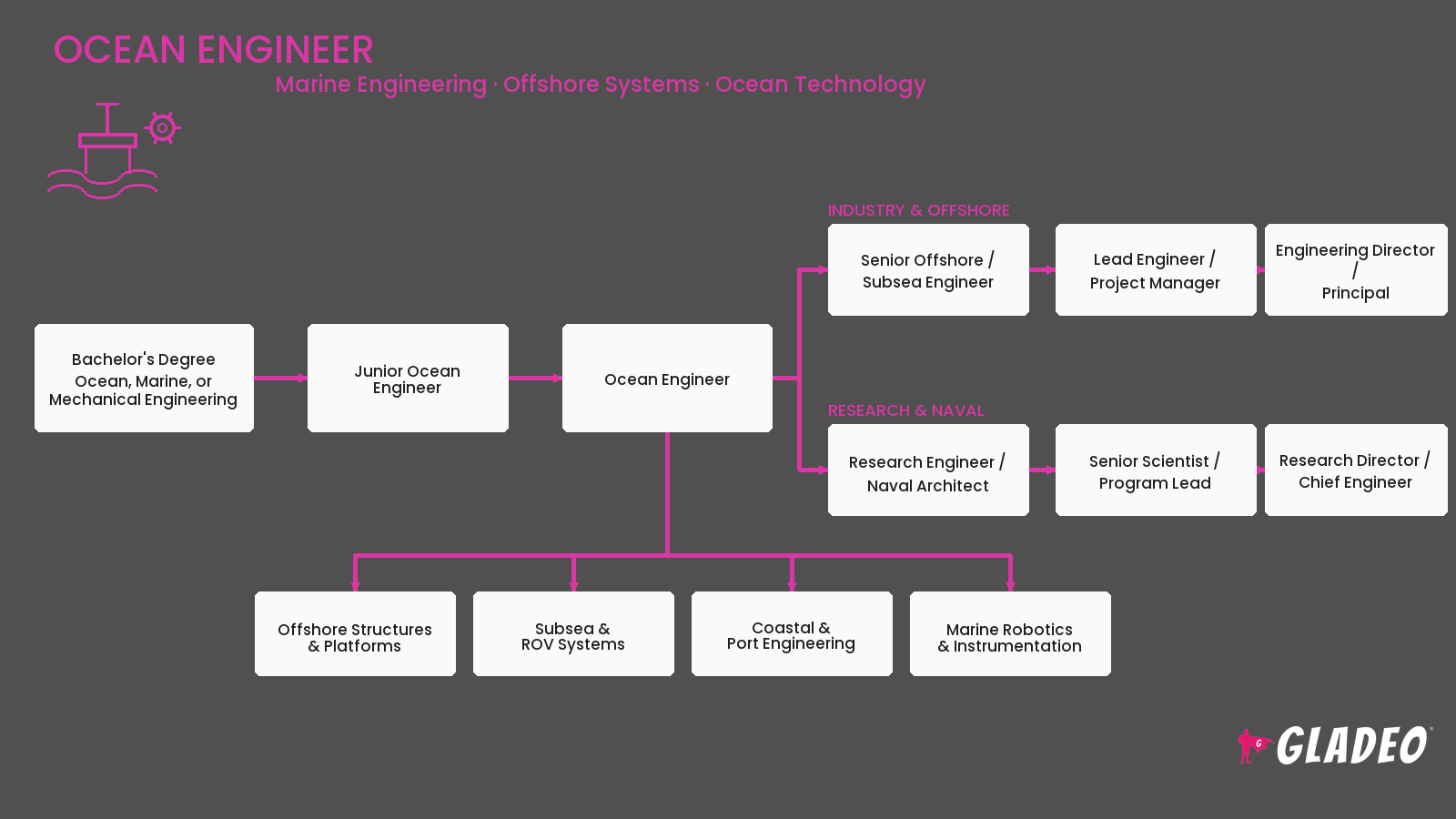
- Apply for internships or cooperative education roles with marine engineering firms or government agencies.
- Build a portfolio showcasing design projects, simulations, or research in marine environments.
- Develop a strong resume highlighting relevant coursework, software skills, and field experience.
- Network with industry professionals through conferences, workshops, or online forums.
- Seek entry-level job titles like Junior Ocean Engineer, Engineering Assistant, or Marine Engineering Technician.
- Prepare for interviews by practicing technical questions and discussing teamwork experiences.
- Gain certifications related to safety, diving, or specialized software.
- Volunteer for fieldwork opportunities to gain offshore experience.
- Stay open to relocation for job opportunities in coastal or offshore hubs.
- Continue learning industry software and marine science to stay competitive.
- Contribute to technical papers or presentations to build professional reputation.
- Join professional organizations for mentoring and job leads.
- Master advanced engineering software and simulation tools specific to ocean environments.
- Gain certifications in project management and marine safety.
- Develop leadership skills by managing small projects or teams.
- Build strong relationships with multidisciplinary teams and clients.
- Pursue graduate degrees or specialized training to deepen expertise.
- Stay involved in professional organizations to network and stay current on trends.
- Take on increasingly complex projects with higher responsibility.
- Mentor junior engineers and contribute to industry knowledge sharing.
Websites:
- Marine Technology Society (mtsociety.org)
- Society of Naval Architects and Marine Engineers (sname.org)
- International Marine Contractors Association (imca-int.com)
- Ocean Engineering Society (oceanengineering.org)
- National Oceanic and Atmospheric Administration (noaa.gov)
- American Society of Civil Engineers — Ocean, Coastal, and Arctic Engineering Institute (asce.org)
- Marine Advanced Technology Education Center (marine-ate.org)
- Offshore Technology Conference (otcnet.org)
- Society for Underwater Technology (sut.org)
- The Oceanography Society (tos.org)
- International Association of Marine Science and Technology (iamsa.org)
- IEEE Oceanic Engineering Society (ieeeoes.org)
- Marine Conservation Institute (marine-conservation.org)
- Renewable Energy Marine Alliance (renewablemarine.org)
Books:
- Introduction to Ocean Engineering by Robert C. Spindel and James S. Allen
- Marine Structural Design by Yong Bai
- Fundamentals of Ocean Engineering by Xavier Lurton
- Offshore Engineering by K. K. Phoon
- Principles of Naval Architecture Series by the Society of Naval Architects and Marine Engineers
If you love the ocean and engineering but want to explore other paths, many related careers can tap your skills and passion in new ways.
- Civil Engineer focusing on coastal infrastructure
- Environmental Engineer working on water quality and habitat restoration
- Mechanical Engineer designing marine machinery or robotics
- Marine Biologist studying ocean ecosystems and marine life
- Renewable Energy Engineer specializing in offshore wind or tidal power
- Naval Architect designing ships and marine vessels
- Geotechnical Engineer analyzing seabed conditions for construction
- Hydraulic Engineer working on water flow and coastal management
Click here to download the infographic
Newsfeed

Featured Jobs
Online Courses and Tools