






Spotlights
Fruit Grower, Pomologist, Orchard Manager, Tree Fruit Specialist, Horticulturist, Agricultural Technician, Crop Scientist, Nursery Manager, Plant Scientist, Agricultural Consultant, Crop Production Specialist, Agricultural Researcher
Imagine biting into a crisp apple or savoring a juicy peach, both bursting with flavor thanks to the care and science behind their growth. Olericulturists are the experts who make sure the fruits and vegetables we enjoy are healthy, abundant, and delicious.
Olericulturists specialize in growing and managing vegetable crops and sometimes fruits, focusing on the best practices for planting, nurturing, and harvesting. They spend their days testing soil, monitoring plant health, managing pests, and working alongside farmers, agronomists, and agricultural scientists to maximize crop yield and quality.
Using tools like soil testers, irrigation systems, and data analysis software, olericulturists apply scientific methods to improve crop production sustainably. Their work is essential because it helps feed communities, supports local economies, and promotes environmental stewardship through responsible farming techniques.
- Watching crops grow from seedlings to harvest-ready produce and knowing your efforts contributed to healthy food supplies.
- Solving problems related to plant diseases, pests, and environmental challenges with innovative solutions.
- Collaborating with farmers and scientists to improve agricultural practices that benefit people and the planet.
- Being outdoors and hands-on with plants, combining science and nature in a meaningful way.
Working Schedule
Olericulturists often work full-time hours that can vary seasonally, with longer days during planting and harvest seasons. Work typically involves a mix of fieldwork outdoors and time in labs or offices analyzing data. Many work for farms, research institutions, or government agencies, and while some have regular schedules, others may need to respond to urgent crop issues or weather events, making flexibility important.
Typical Duties
- Conduct soil and plant tissue tests to assess nutrient needs.
- Develop and implement planting schedules for various crops.
- Monitor crops for signs of pests, diseases, and nutrient deficiencies.
- Advise farmers on irrigation, fertilization, and pest control techniques.
- Collect data on crop growth and yields to improve practices.
- Manage and supervise harvesting operations to ensure quality.
- Research and test new crop varieties or cultivation methods.
- Maintain records of crop treatments and environmental conditions.
- Collaborate with agricultural scientists and extension agents.
- Evaluate environmental impacts and promote sustainable farming methods.
Additional Responsibilities
- Stay updated on agricultural regulations and safety standards.
- Train farm workers on best practices for crop care and safety.
- Assist in budgeting and resource planning for crop production.
- Participate in community outreach or educational programs about agriculture.
- Help develop marketing strategies for farm products.
- Coordinate with suppliers for seeds, fertilizers, and equipment.
- Contribute to research publications or reports on crop production.
- Manage pest and disease outbreaks with integrated pest management approaches.
Mornings usually start with reviewing crop conditions and weather forecasts, followed by soil and plant inspections to detect any early problems.
Midday involves fieldwork tasks like adjusting irrigation systems, applying fertilizers or treatments, and collecting data samples. Collaboration with farm crews happens frequently to ensure everyone is aligned on daily goals.
Afternoons are often spent analyzing data, planning upcoming planting or harvesting schedules, and communicating findings with agricultural teams or stakeholders to optimize production strategies.
Soft Skills
- Attention to detail
- Problem-solving mindset
- Effective communication
- Team collaboration
- Patience and perseverance
- Adaptability to changing conditions
- Critical thinking
- Organizational skills
- Time management
- Curiosity and willingness to learn
- Physical stamina
- Responsibility and reliability
Technical Skills
- Soil and plant tissue analysis
- Use of irrigation and fertilization systems
- Pest and disease identification
- Data collection and analysis
- Crop management software
- Knowledge of agricultural machinery
- Understanding of plant biology and physiology
- Sustainable farming practices
- Record-keeping and reporting
- Application of integrated pest management
- Vegetable Olericulturist: Focuses on the production and management of vegetable crops specifically.
- Fruit Olericulturist: Specializes in cultivating fruits alongside vegetables, often working in orchards.
- Research Olericulturist: Works in labs or field experiments to develop new crop varieties or cultivation techniques.
- Extension Olericulturist: Provides training and advice to farmers and the public on best practices.
- Organic Olericulturist: Concentrates on growing crops using organic methods and sustainable practices.
- Urban Olericulturist: Focuses on small-scale vegetable production in urban or community garden settings.
- Commercial farms and orchards
- Agricultural research centers
- University agricultural departments
- Government agricultural agencies
- Agricultural extension services
- Nurseries and greenhouses
- Food production companies
- Environmental and sustainability organizations
- Agricultural equipment suppliers
- Organic farming cooperatives
- Community garden programs
- Agrochemical companies
Olericulturists often face high-pressure situations, especially during planting and harvest seasons when timing and crop health are critical. Weather events, pest outbreaks, and equipment failures can add urgency and stress to the job.
Work hours can extend beyond the typical 9-to-5, including early mornings, weekends, or holidays during peak growing periods. Fieldwork can be physically demanding, involving bending, lifting, and exposure to the elements.
This career requires a strong commitment to continuous learning and adaptation, as agricultural science and environmental regulations evolve. Olericulturists must balance productivity goals with sustainable practices, which can sometimes create complex challenges to navigate.
- Increased use of precision agriculture technologies like drones and sensors.
- Growth of organic and sustainable farming practices.
- Development of drought-resistant and pest-resistant crop varieties.
- Integration of data analytics and AI for crop management.
- Expansion of urban and vertical farming techniques.
- Greater emphasis on reducing environmental impact and carbon footprint.
- Use of biotechnology in crop improvement.
- Rising demand for locally grown and specialty produce.
- Advances in soil health and microbiome research.
- Collaboration between farmers and scientists through digital platforms.
Many olericulturists showed early interest in gardening, farming, or nature exploration, often enjoying hands-on activities like planting seeds or caring for home gardens.
They tended to be curious about how plants grow and thrive, eager to understand the science behind healthy crops and fascinated by the connection between farming and feeding people.
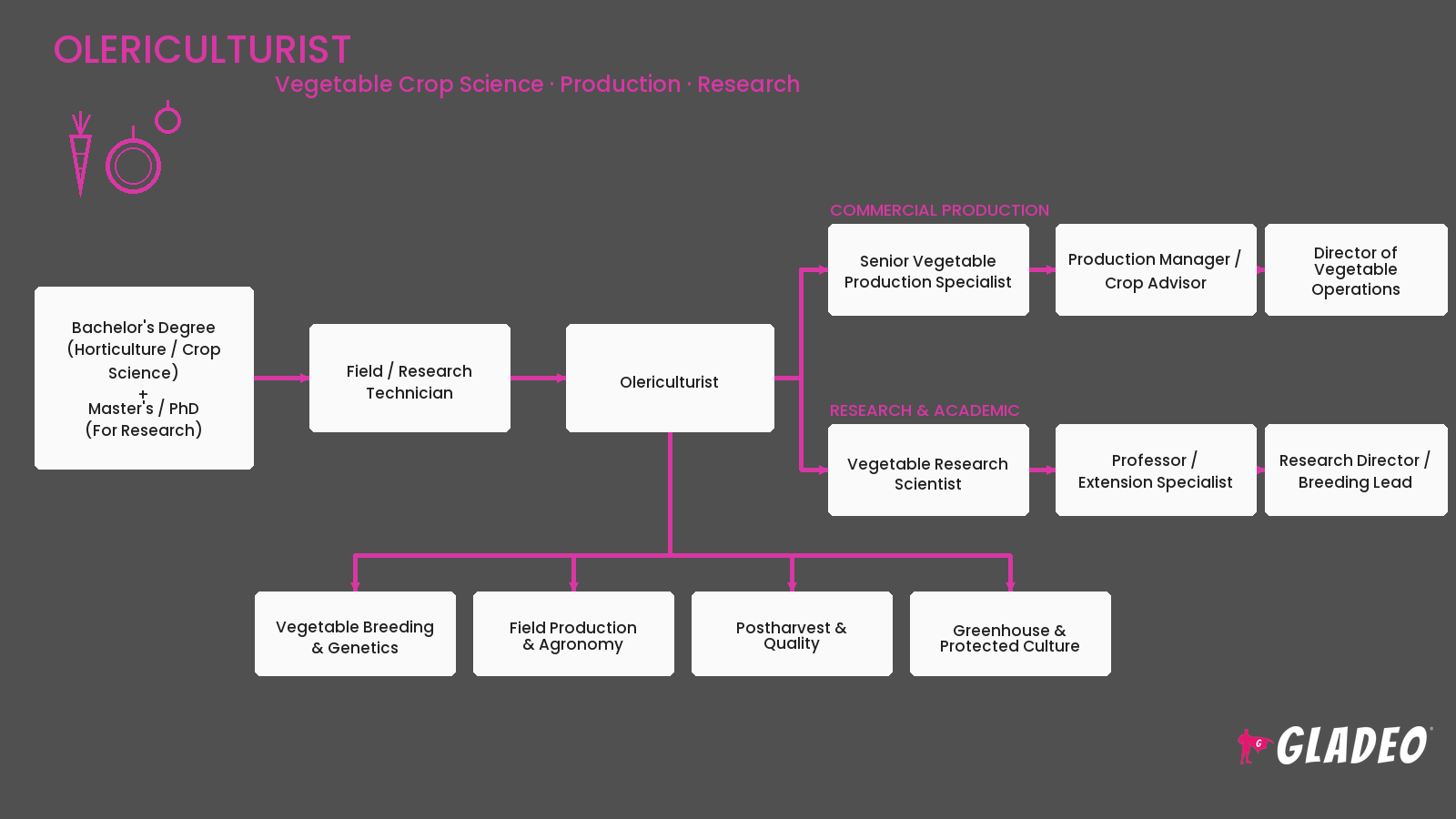
Becoming an olericulturist typically involves studying agricultural sciences, horticulture, or plant biology. Many professionals earn associate or bachelor's degrees in these fields, combined with practical experience on farms or research projects.
Students can take courses in relevant subjects such as:
- Plant Science
- Soil Science
- Agronomy
- Pest Management
- Horticulture
- Crop Production
- Plant Pathology
- Sustainable Agriculture
- Irrigation and Water Management
- Data Analysis for Agriculture
Hands-on experience through internships, cooperative education, or volunteering on farms is essential for developing practical skills. Building a strong portfolio of projects and understanding local crop conditions enhances job prospects. Many olericulturists continue learning on the job and may pursue certifications in specialized areas.
- Take biology and chemistry courses to build a foundation in plant and soil science.
- Enroll in environmental science and agriculture classes if available.
- Join school gardening clubs or 4-H programs to gain hands-on experience.
- Volunteer at local farms or community gardens.
- Learn to use basic computer software for data tracking.
- Attend agricultural fairs and workshops.
- Develop strong math skills for data analysis.
- Explore internships at agricultural research centers.
- Participate in science fairs focusing on plant or environmental topics.
- Seek mentors in agriculture or horticulture fields.
- Choose programs with strong practical training and fieldwork opportunities.
- Look for schools with connections to local farms or research institutions.
- Ensure courses cover both plant biology and modern agricultural technology.
- Select programs that offer internships or cooperative education.
- Check for faculty expertise in olericulture or horticulture.
- Consider programs emphasizing sustainable and organic farming methods.
- Verify availability of labs and greenhouses for hands-on learning.
- Look for curriculum that includes data analysis and crop management software.
- Find programs that teach integrated pest management.
- Evaluate opportunities for community outreach or extension work.
- Apply for internships or assistant roles on farms or nurseries.
- Volunteer in community gardens or agricultural research projects.
- Build a resume highlighting hands-on experience and relevant coursework.
- Create a portfolio documenting plant care, experiments, or projects.
- Network with local farmers, agricultural extension agents, and professors.
- Attend agricultural job fairs and industry events.
- Develop basic skills in operating farm equipment and software.
- Be willing to start in entry-level positions to gain experience.
- Prepare for interviews by learning about local crops and farming challenges.
- Stay open to seasonal or temporary work to build connections.
- Gain certifications in specialized areas like pest management or sustainable agriculture.
- Pursue advanced degrees in horticulture or plant sciences.
- Build relationships with agricultural researchers and industry leaders.
- Develop leadership skills by managing teams or projects.
- Stay current with emerging technologies and farming practices.
- Publish research or case studies to establish expertise.
- Seek roles in farm management or agricultural consulting.
- Expand your network through professional organizations and conferences.
Websites:
- American Society for Horticultural Science (ashs.org)
- USDA Agricultural Research Service (ars.usda.gov)
- National Sustainable Agriculture Coalition (sustainableagriculture.net)
- Extension Foundation (extension.org)
- International Society for Horticultural Science (ishs.org)
- The Xerces Society for Invertebrate Conservation (xerces.org)
- AgriLife Extension at Texas A&M (agrilifeextension.tamu.edu)
- National Organic Coalition (organicadvocacy.org)
- CropLife America (croplifeamerica.org)
- Farm Journal (farmjournal.com)
- Modern Farmer (modernfarmer.com)
- Growers Network (growersnetwork.org)
- Horticulture Magazine (hortmag.com)
- Agricultural Research Magazine (agresearchmag.ars.usda.gov)
Books:
- The Vegetable Gardener's Bible by Edward C. Smith
- Principles of Vegetable Crop Production by K.L. Chadha
- Introduction to Horticulture by Charles B. Heiser Jr.
- Plant Pathology by George N. Agrios
- Sustainable Agriculture by John Mason
If you love working with plants and agriculture but want to explore other career paths, there are many related options that still let you impact food production and environmental health.
- Agricultural Technician
- Soil Scientist
- Plant Pathologist
- Environmental Scientist
- Greenhouse Manager
- Agricultural Sales Representative
- Farm Manager
- Landscape Designer
- Food Scientist
- Forestry Technician
Click here to download the infographic
Newsfeed

Featured Jobs
Online Courses and Tools