





Spotlights
Plant Scientist, Botanical Physiologist, Crop Physiologist, Plant Biologist, Agronomic Researcher, Plant Ecologist, Plant Development Specialist, Agricultural Biologist, Environmental Botanist, Plant Growth Analyst, Crop Science Researcher, Plant Stress Physiologist
Imagine walking through vast fields of crops, knowing that the health and productivity of every leaf and root were studied and enhanced by experts behind the scenes—Plant Physiologists make this possible by unlocking how plants grow, respond to stress, and thrive in their environments.
Plant Physiologists spend their days investigating how plants function—from how they absorb water and nutrients to how they react to light, heat, and pests. They conduct experiments in greenhouses and labs, collaborate with agronomists, geneticists, and environmental scientists, and analyze data to develop ways to improve crop yields, fight plant diseases, and help plants adapt to climate change.
Using tools like microscopes, chromatography, and molecular biology techniques, Plant Physiologists uncover the secrets of plant life. Their work is crucial for agriculture, forestry, and environmental conservation because it directly influences food security, sustainable farming, and ecosystem health.
- Contributing to solutions that help feed the world and ensure sustainable agriculture.
- Discovering new insights into plant biology that can lead to groundbreaking innovations.
- Collaborating with diverse teams of scientists and farmers to apply research in real-world settings.
- Seeing the tangible impact of your work in healthier plants and improved crop production.
Working Schedule
Plant Physiologists typically work full-time in laboratories, greenhouses, or outdoor field sites. Their schedule can fluctuate with the seasons, often requiring more hours during planting or growing seasons to monitor experiments and collect data. Many work standard daytime hours, but some fieldwork or lab tasks may require early mornings, evenings, or weekend work. Jobs can be found in government research centers, universities, private companies, or agricultural settings, with a mix of office, lab, and outdoor environments.
Typical Duties
- Design and conduct experiments to study plant functions like photosynthesis, respiration, and nutrient uptake.
- Analyze how environmental factors such as drought, temperature, and soil conditions affect plant growth.
- Use biochemical and molecular techniques to investigate plant responses to stresses like pests and diseases.
- Collaborate with geneticists to develop crops that are more resilient and productive.
- Collect and interpret data using statistical and computer modeling tools.
- Prepare reports, research papers, and presentations to communicate findings.
- Monitor and maintain plant specimens in greenhouses or growth chambers.
- Test the effects of fertilizers, pesticides, or growth regulators on plants.
- Work with agricultural engineers to implement research findings in farming practices.
- Stay updated on scientific literature and emerging plant research methodologies.
Additional Responsibilities
- Train and supervise laboratory or field assistants and interns.
- Apply for research grants and funding to support projects.
- Attend scientific conferences and workshops to share research and learn from peers.
- Ensure compliance with safety protocols and environmental regulations.
- Collaborate with extension agents or farmers to translate research into practical advice.
- Maintain detailed laboratory notebooks and databases of experimental results.
- Participate in interdisciplinary teams focused on climate change or sustainability initiatives.
- Contribute to educational outreach or public awareness programs about plant science.
Morning often begins by reviewing data collected from overnight experiments and planning the day's activities, including setting up new experiments or adjusting ongoing ones based on preliminary results.
Midday is spent in the lab or greenhouse conducting hands-on work such as measuring plant growth, analyzing samples, or running molecular assays. Time is also allocated for meetings with colleagues to discuss project progress and brainstorm solutions to challenges.
Afternoons and evenings may involve data analysis, writing research reports, or preparing presentations. Field visits to agricultural sites or forests can occur to monitor plants in their natural environment, especially during critical growth phases or environmental stress events.
Soft Skills
- Curiosity and a strong desire to understand complex biological processes.
- Attention to detail to accurately observe and document plant behaviors.
- Critical thinking to design experiments and interpret results effectively.
- Problem-solving skills to address challenges in plant growth or research obstacles.
- Communication skills to explain research findings to scientists, farmers, and the public.
- Collaboration and teamwork to work with diverse experts and stakeholders.
- Patience and perseverance for long-term experiments and data collection.
- Adaptability to changing environmental conditions and research needs.
- Organizational skills to manage multiple experiments and data sets.
- Creativity in developing innovative approaches to plant science problems.
- Time management to balance lab work, field studies, and administrative tasks.
- Ethical responsibility in conducting research and environmental stewardship.
Technical Skills
- Proficiency in laboratory techniques like chromatography, spectrophotometry, and microscopy.
- Knowledge of molecular biology methods such as DNA/RNA extraction and PCR.
- Experience with data analysis software and statistical tools like R or SAS.
- Ability to use plant growth chambers and environmental control systems.
- Familiarity with soil testing and nutrient analysis methods.
- Skill in using imaging technologies for plant phenotyping.
- Competence in designing and conducting controlled experiments.
- Understanding of plant taxonomy and physiology principles.
- Ability to operate greenhouse and field equipment safely.
- Knowledge of research documentation and scientific writing standards.
- Agricultural Plant Physiologist: Focuses on improving crop production and resistance to stresses in farm plants.
- Forest Plant Physiologist: Studies trees and forest ecosystems to promote health and regeneration.
- Plant Stress Physiologist: Investigates how plants cope with drought, salinity, temperature extremes, and pests.
- Molecular Plant Physiologist: Uses genetic and molecular tools to understand plant functions at the cellular level.
- Environmental Plant Physiologist: Examines plant interactions with their ecosystems and responses to environmental changes.
- Crop Scientist: Integrates physiology with breeding to develop improved crop varieties.
- Plant Biochemist: Focuses on the chemical processes within plants and their impact on growth and development.
- Plant Ecologist: Studies plant relationships with their habitats and other organisms in natural settings.
- Agricultural research institutes
- Universities and academic research centers
- Government agencies like USDA or EPA
- Biotechnology companies
- Environmental conservation organizations
- Agricultural extension services
- Seed and agrochemical companies
- Forestry services and commissions
- Nonprofit research foundations
- Private agricultural consultancies
- International agricultural development programs
- Greenhouse and botanical gardens
Plant Physiologists often face pressure to produce reliable, reproducible data that can influence agricultural policies or commercial products. Research funding can be competitive, requiring strong grant-writing skills and perseverance.
Work hours can be demanding during planting and growing seasons, with additional time needed for detailed data analysis and report writing. Fieldwork may involve exposure to harsh outdoor conditions and physically demanding tasks.
This career requires dedication to continuous learning and adaptability as new technologies and environmental challenges emerge. Researchers may need to balance long-term projects with the urgency of addressing immediate agricultural or environmental problems.
- Increased use of genetic engineering and CRISPR technology to develop stress-tolerant crops.
- Advances in remote sensing and drone technology for monitoring plant health in real time.
- Greater emphasis on sustainable agriculture and reducing chemical inputs.
- Integration of big data and AI to model plant growth and predict responses to environmental changes.
- Development of indoor farming and controlled environment agriculture techniques.
- Focus on understanding plant microbiomes and their role in plant health.
- Climate change research driving studies on plant adaptation and resilience.
- Collaborations across disciplines to tackle global food security challenges.
- Use of automation and robotics in laboratory and field experiments.
- Expansion of open-access databases for plant genetics and physiology information.
Many Plant Physiologists discovered their passion early by exploring nature, gardening, or caring for plants at home or school. They often showed curiosity about how plants grow and survive in different conditions.
They enjoyed science fairs, biology classes, and outdoor activities like hiking or volunteering in botanical gardens, which helped build a foundation in plant biology and ecology.
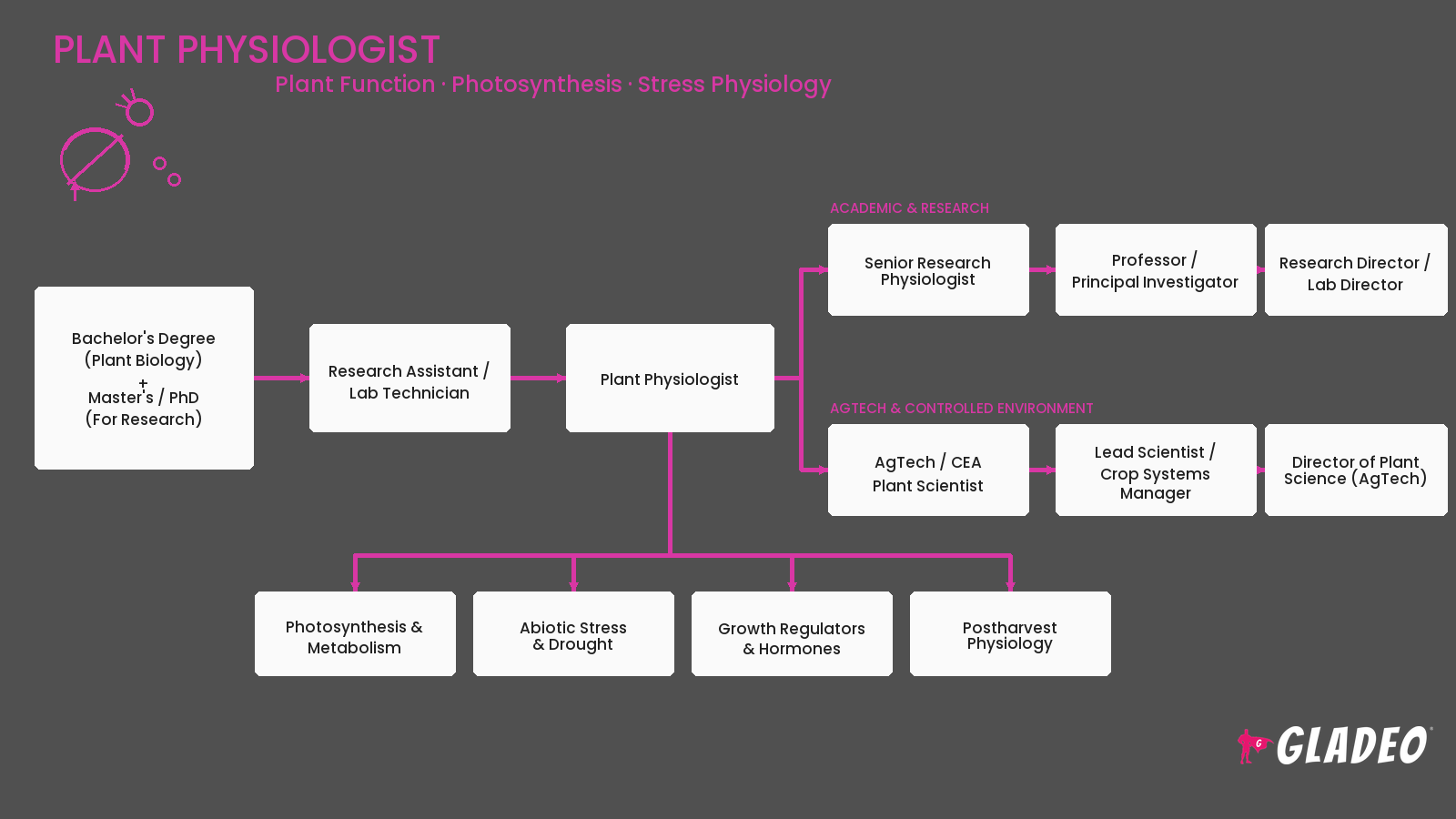
Becoming a Plant Physiologist typically requires a strong background in biology, plant sciences, or related fields. Most professionals hold at least a bachelor's degree in plant biology, botany, agriculture, or environmental science, with many pursuing advanced degrees for research and leadership roles.
Students can take courses in relevant subjects such as:
- Biology and Botany
- Plant Physiology
- Genetics and Molecular Biology
- Soil Science
- Environmental Science
- Chemistry
- Statistics and Data Analysis
- Agronomy
- Biotechnology
- Ecology and Ecosystem Science
Hands-on experience through internships, research projects, and lab work is vital for developing practical skills. Building a portfolio of research and publications can enhance opportunities, while on-the-job training continues to sharpen expertise in this evolving field.
- Take advanced science courses, especially biology and chemistry.
- Participate in science clubs and fairs focused on plant or environmental topics.
- Volunteer or intern at botanical gardens, farms, or environmental centers.
- Learn computer skills, including data analysis and basic programming.
- Attend workshops or summer camps related to agriculture or biology.
- Develop strong math skills to handle data and statistics.
- Explore college programs with strong plant science or agricultural research departments.
- Seek mentors among biology teachers or local scientists.
- Engage in field trips to farms, greenhouses, or research labs.
- Consider studying environmental issues and sustainability topics.
- Choose programs with hands-on lab and fieldwork opportunities.
- Look for faculty actively involved in plant science research.
- Check if programs offer internships or cooperative education with industry partners.
- Ensure access to modern laboratory equipment and greenhouses.
- Consider schools with collaborations in agriculture and environmental science.
- Review curriculum for courses in molecular biology and data analysis.
- Seek programs that encourage interdisciplinary learning and teamwork.
- Find out about funding or scholarships for plant science students.
- Assess opportunities to participate in scientific conferences or clubs.
- Evaluate the program’s focus on sustainable and applied plant science research.
- Apply for internships or technician positions in agricultural research labs or universities.
- Build a portfolio showcasing your research projects and lab skills.
- Network with professors, researchers, and industry professionals at events and online.
- Gain experience with laboratory equipment and plant growth monitoring tools.
- Volunteer for fieldwork during growing seasons to learn practical skills.
- Attend workshops or certification courses to enhance your expertise.
- Create a strong resume highlighting scientific coursework and hands-on experience.
- Practice explaining complex plant science concepts in simple terms for interviews.
- Seek out entry-level roles like research assistant or lab technician.
- Stay updated on current research trends and technologies in plant physiology.
- Join professional organizations related to plant science for job leads and networking.
- Develop good record-keeping and data management habits for research roles.
- Pursue a master’s or doctoral degree to advance in research or academic roles.
- Publish research findings in scientific journals to build credibility.
- Develop expertise in specialized areas such as plant genetics or stress physiology.
- Build strong collaborations with interdisciplinary teams and industry partners.
- Take leadership roles in research projects or laboratory management.
- Stay engaged in continuing education and professional development.
- Mentor junior researchers and interns to develop leadership skills.
- Seek positions in government agencies or private companies to influence policy or product development.
Websites:
- American Society of Plant Biologists (aspb.org)
- Crop Science Society of America (sciencesocieties.org)
- Plant Physiology Journal (plphys.org)
- Society for Experimental Biology (seb.org.uk)
- International Society for Plant Molecular Biology (ispmbl.org)
- National Institute of Food and Agriculture (nifa.usda.gov)
- Plant Science Research Network (plantsciences.org)
- Botanical Society of America (botany.org)
- Agricultural Research Service (ars.usda.gov)
- Environmental Protection Agency - Plant Research (epa.gov/plant-research)
- Science Daily - Plant Science Section (sciencedaily.com/news/plants_animals/plant_science)
- Nature Plants Journal (nature.com/nplants)
- Plant Biology Conferences and Workshops (plantbiology.org)
- ResearchGate - Plant Physiology Groups (researchgate.net)
Books:
- Plant Physiology by Lincoln Taiz and Eduardo Zeiger
- Biochemistry and Molecular Biology of Plants by Bob B. Buchanan, Wilhelm Gruissem, and Russell L. Jones
- Introduction to Plant Physiology by William G. Hopkins
- Plant Stress Physiology by Sergey Shabala
- The Physiology of Crop Yield by David P. S. Verma
If a career as a Plant Physiologist doesn’t work out or you want to explore other options, your skills and interests can lead to many related fields in science and agriculture.
- Agronomist
- Soil Scientist
- Environmental Scientist
- Horticulturist
- Biotechnologist
- Ecologist
- Plant Pathologist
- Agricultural Engineer
- Science Educator
- Laboratory Technician
Click here to download the infographic
Newsfeed

Featured Jobs
Online Courses and Tools