






Spotlights
Predictive Modeler, Forecasting Analyst, Predictive Analytics Consultant, Quantitative Analyst, Risk Modeling Analyst, Demand Forecasting Analyst, Predictive Data Scientist, Statistical Analyst, Predictive Analytics Engineer, Business Analytics Specialist, Forecasting Specialist, Predictive Insights Analyst
Long before a store knows it needs more inventory for the holidays, before a bank flags a suspicious transaction, or before a factory replaces a machine part just before it breaks, a Predictive Analytics Specialist already saw it coming. By studying years of historical data and building statistical and machine learning models, they give companies something incredibly valuable: a genuine head start on the future.
Predictive Analytics Specialists dig into massive datasets to find patterns that hint at what is likely to happen next, whether that is customer demand, equipment failure, financial risk, or the chance a customer will cancel a subscription. They build, test, and refine forecasting models, then work closely with business leaders, data engineers, and IT teams to make sure those predictions actually get used to guide real decisions, not just sit in a report nobody reads. Their job is not to explore data out of curiosity; it is to build models specifically trusted enough to inform what a business does next.
Using statistical software, machine learning frameworks, and large-scale data platforms, Predictive Analytics Specialists turn raw historical numbers into forecasts that companies can act on with confidence. Their models help businesses stock the right products, catch fraud before it spreads, keep factory equipment running, and avoid losing valuable customers, making their work quietly essential to how modern companies plan ahead.
- Building models that give companies a real, measurable head start on future problems
- Solving genuinely interesting puzzles hidden inside years of historical data
- Seeing a forecast you built directly shape a major business decision
- Watching your predictions get proven right, and learning just as much when they are wrong
Working Schedule
Predictive Analytics Specialists typically work full-time, standard business hours, usually as part of a data science, analytics, or business intelligence team. The role is largely computer-based, split between building and testing models independently and meeting with business stakeholders to understand what decisions the forecasts need to support. Most are employed directly by companies in finance, retail, healthcare, insurance, or technology, though some work as consultants supporting multiple client organizations.
Typical Duties
- Gathering and cleaning historical data from company databases and outside sources
- Building statistical and machine learning models to forecast future outcomes
- Testing and validating models to check their accuracy before deployment
- Selecting the right forecasting approach for a given business problem, such as regression, time series, or classification models
- Working with business leaders to understand what decisions a forecast needs to support
- Monitoring deployed models over time to catch when predictions start drifting off target
- Presenting forecasts and model results in clear, actionable reports and dashboards
- Collaborating with data engineers to ensure clean, reliable data feeds the models
- Documenting model assumptions, limitations, and methodology for future reference
- Running "what-if" scenarios to show how forecasts change under different conditions
- Identifying which variables most strongly predict a particular outcome
- Retraining and updating models as new data becomes available
Additional Responsibilities
- Educating non-technical teams on how to interpret and use predictive forecasts responsibly
- Auditing models for bias or unfair outcomes across different customer groups
- Building automated pipelines that refresh forecasts on a regular schedule
- Researching new statistical and machine learning techniques to improve accuracy
- Collaborating with IT and security teams on data privacy and governance
- Supporting budget and planning cycles with updated demand or risk forecasts
- Mentoring junior analysts on statistical methods and modeling best practices
A Predictive Analytics Specialist's morning often starts with checking dashboards that track how recent forecasts performed against actual results, looking for any signs that a model's accuracy is slipping. They might spend the first hour cleaning a new batch of data or investigating why a forecast missed the mark on a particular product line.
Midday is often spent deep in model-building, testing different statistical approaches to see which one best predicts an outcome like customer churn or equipment failure. They might run a series of experiments, compare accuracy scores, and dig into which variables are driving the predictions. A meeting with a business stakeholder might follow, translating technical model results into a clear recommendation about inventory levels, staffing, or risk exposure.
Afternoons often involve presenting findings, walking a team through a new forecast and answering questions about how confident they should be in it. The specialist might also update documentation, retrain a model with fresh data, or collaborate with a data engineer to fix an issue in the data pipeline feeding their models. Before the day wraps up, they typically log their progress and flag any forecasts that need closer monitoring.
Soft Skills
- Strong analytical and critical thinking skills
- Clear communication of complex results to non-technical audiences
- Curiosity about patterns and root causes hidden in data
- Attention to detail when validating and testing models
- Patience through repeated testing and refinement cycles
- Comfort with uncertainty and probabilistic thinking
- Collaboration with business, engineering, and leadership teams
- Organizational skills for managing multiple ongoing models
- Honesty about a model's limitations and potential for error
- Problem-solving when forecasts do not match reality
- Time management to balance long-term projects with urgent requests
- Adaptability as business needs and data availability change
Technical Skills
- Statistical modeling techniques including regression and time series analysis
- Machine learning methods for classification and prediction
- Programming languages such as Python or R for data analysis
- SQL and database querying for gathering and organizing data
- Data visualization tools such as Tableau or Power BI
- Big data platforms such as Spark or Hadoop for large datasets
- Model validation and performance evaluation techniques
- Understanding of business metrics relevant to the industry, such as churn or risk
- Cloud-based analytics platforms such as AWS, Azure, or Google Cloud
- Data cleaning and preparation methods
- Demand Forecasting Analyst: Predicts future customer demand for retail or supply chain planning
- Risk Modeling Analyst: Builds models predicting financial or credit risk for banks and insurers
- Fraud Detection Analyst: Focuses on forecasting and flagging likely fraudulent activity
- Churn Modeling Specialist: Predicts which customers are likely to cancel a service or subscription
- Predictive Maintenance Analyst: Forecasts when equipment or machinery is likely to fail
- Healthcare Predictive Analyst: Forecasts patient outcomes, readmissions, or resource needs
- Marketing Analytics Specialist: Predicts customer response to campaigns and promotions
- Banks and financial services firms
- Insurance companies
- Retail and e-commerce companies
- Healthcare systems and health insurance providers
- Manufacturing and logistics companies
- Technology companies
- Consulting and analytics firms
- Government agencies and public policy organizations
- Telecommunications companies
- Energy and utility companies
- Transportation and supply chain companies
- Sports and entertainment organizations
Predictive Analytics Specialists are expected to be honest about uncertainty, even when business leaders want a confident, simple answer. A forecast that is presented as more certain than it really is can lead to costly business decisions, so resisting pressure to oversimplify results is a constant part of the job.
The work requires patience through long cycles of testing, validating, and refining models before they are trusted enough to guide real decisions. Models that seemed accurate in testing can behave differently once real-world conditions shift, requiring ongoing monitoring and a willingness to admit when a forecast missed the mark.
There is also pressure tied to how directly this work touches business outcomes. When a demand forecast is off, a company might overstock or understock products; when a risk model misses something, financial losses can follow. This weight of responsibility, combined with the technical rigor the job demands, can make the role mentally demanding, especially during high-stakes planning periods.
- Growing use of machine learning models alongside traditional statistical forecasting
- Increased demand for real-time predictive analytics rather than periodic reports
- Rising use of automated machine learning (AutoML) tools to speed up model building
- Greater focus on explainable models so business leaders understand how predictions are made
- Expansion of predictive analytics into new areas like employee retention and sustainability
- Growing importance of model monitoring to catch performance drift after deployment
- Increased attention to fairness and bias testing in predictive models
- Rising use of cloud-based analytics platforms for handling massive datasets
- More companies embedding predictive analytics directly into everyday business software
- Growing collaboration between predictive analytics teams and generative AI tools
Many Predictive Analytics Specialists were the kids who loved puzzles, strategy games, and spotting patterns other people missed, whether in sports statistics, card games, or figuring out the best way to beat a video game level. They often enjoyed math class more than most, especially when it involved real numbers instead of abstract problems.
Many also gravitated toward tracking things over time, like keeping stats on a favorite sports team, predicting outcomes for fun, or organizing data for a school project just because it was satisfying to do. A natural love of numbers, combined with curiosity about what happens next, often pointed toward this career.
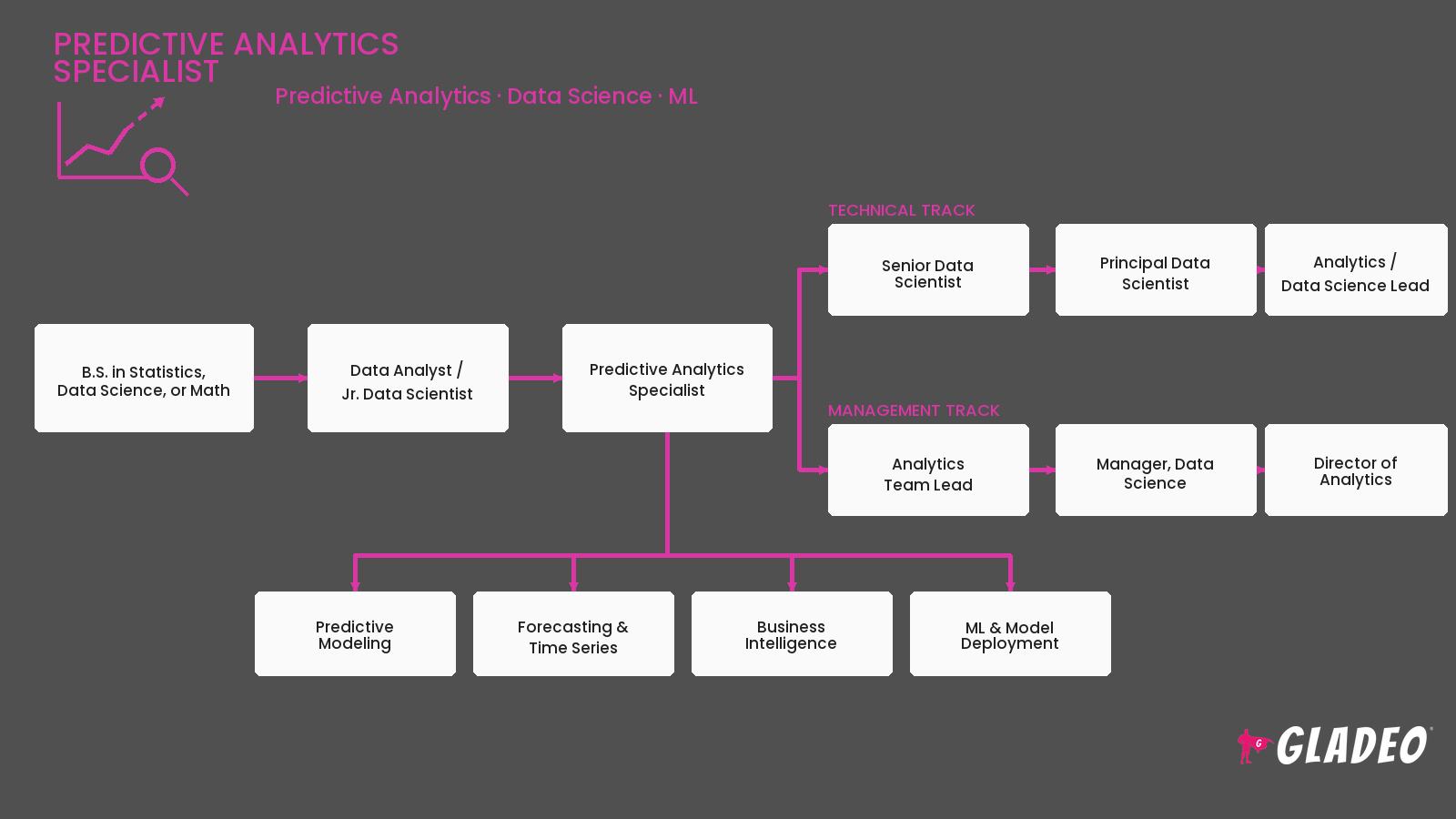
Most Predictive Analytics Specialists hold a bachelor's degree in statistics, mathematics, data science, computer science, economics, or a related quantitative field, and many pursue a master's degree in data science, analytics, or statistics to strengthen their modeling skills and stand out for more advanced roles. Strong programming and statistics skills matter just as much as the specific degree title.
Students can take courses in relevant subjects such as:
- Statistics and Probability
- Calculus and Linear Algebra
- Machine Learning and Predictive Modeling
- Database Management and SQL
- Programming in Python or R
- Time Series Analysis and Forecasting
- Data Visualization and Business Reporting
- Business Analytics and Decision Science
- Economics or Finance Fundamentals
- Big Data Technologies
Hands-on experience is critical in this field. Working with real datasets, whether through internships, class projects, or public data competitions, helps build the intuition needed to know which modeling approach fits a given problem. Many specialists also earn certifications such as the Certified Analytics Professional (CAP) credential, and continued learning is essential as new statistical and machine learning techniques emerge regularly.
- Take statistics, calculus, and as much advanced math as your school offers
- Learn a programming language like Python or R through free online courses
- Practice analyzing real datasets from sources like sports statistics or public data portals
- Join a math club, statistics club, or data science competition team
- Take economics or business classes to understand how companies use data to make decisions
- Participate in data science competitions on platforms like Kaggle
- Build a small forecasting project, like predicting sports outcomes or local weather patterns
- Learn the basics of a spreadsheet program and a data visualization tool
- Seek internships or part-time roles involving data analysis
- Read case studies about how companies use predictive analytics to make decisions
- Practice explaining a data finding clearly to someone without a technical background
- Talk to data analysts or scientists about what their day-to-day work actually looks like
- Strong statistics and mathematics curriculum with real applied projects
- Coursework covering both traditional statistics and modern machine learning
- Hands-on projects using real, messy datasets rather than only clean textbook examples
- Access to programming languages and tools like Python, R, and SQL
- Faculty with industry experience in analytics, data science, or forecasting
- Opportunities for internships with companies that use predictive analytics
- Coursework in business context, not just technical modeling skills
- Preparation for certifications like the Certified Analytics Professional (CAP) credential
- Capstone projects that involve building and presenting a real predictive model
- Strong career services connecting students with analytics and data employers
- Access to cloud computing resources or big data platforms for practice
- Flexible programs for working professionals pursuing a graduate analytics degree
- Build a portfolio of two or three predictive modeling projects using real datasets
- Compete in data science competitions on platforms like Kaggle to build credibility
- Apply for entry-level titles like Data Analyst, Junior Data Scientist, or Business Analyst
- Search job boards such as LinkedIn, Indeed, and analytics-focused job boards
- Learn to clearly explain your modeling choices and results in interviews
- Highlight programming, statistics, and specific tools on your resume with real project examples
- Attend analytics and data science meetups or conferences to build your network
- Earn a certification such as the Certified Analytics Professional (CAP) credential
- Practice presenting a technical project to a non-technical audience
- Seek internships specifically focused on forecasting, risk, or business analytics
- Contribute to open datasets or open-source analytics projects to build visibility
- Be ready to discuss a time a model you built was wrong and what you learned from it
- Take ownership of higher-stakes forecasting projects with direct business impact
- Build a track record of models that measurably improved business decisions
- Develop deeper expertise in machine learning and big data tools
- Learn to communicate directly with executives about forecasts and business risk
- Mentor junior analysts and data scientists on statistical best practices
- Pursue advanced certifications or a graduate degree in analytics or statistics
- Build cross-functional relationships with finance, operations, and product teams
- Move into roles like Senior Predictive Analytics Specialist, Lead Data Scientist, or Director of Analytics
Websites:
- Institute for Operations Research and the Management Sciences (INFORMS) - informs.org
- American Statistical Association (ASA) - amstat.org
- Association for Computing Machinery Special Interest Group on Knowledge Discovery (ACM SIGKDD) - kdd.org
- KDnuggets - kdnuggets.com
- Kaggle - kaggle.com
- Towards Data Science - towardsdatascience.com
- DataCamp - datacamp.com
- Institute for Advanced Analytics - analytics.ncsu.edu
- Certified Analytics Professional (CAP) - certifiedanalytics.org
- Data Science Central - datasciencecentral.com
- Coursera Data Science Courses - coursera.org
- edX Data Science Courses - edx.org
- Analytics Vidhya - analyticsvidhya.com
- Google Cloud Skills Boost - cloudskillsboost.google
Books:
- Prediction Machines: The Simple Economics of Artificial Intelligence by Ajay Agrawal, Joshua Gans, and Avi Goldfarb
- Data Science for Business by Foster Provost and Tom Fawcett
- The Signal and the Noise by Nate Silver
- Predictive Analytics by Eric Siegel
- Weapons of Math Destruction by Cathy O'Neil
If you find that being a Predictive Analytics Specialist isn't the right fit, your skills in statistics, modeling, and data-driven problem solving transfer well to many related careers.
- Data Scientist
- Business Intelligence Analyst
- Data Analyst
- Risk Analyst
- Actuary
- Market Research Analyst
- Operations Research Analyst
- Financial Analyst
- Machine Learning Engineer
- Quantitative Researcher
Newsfeed

Featured Jobs
Online Courses and Tools