







Spotlights
Quality Control Technician, Quality Assurance Inspector, QA/QC Technician (Quality Assurance/Quality Control Technician), Quality Analyst, Quality Technician, Inspection Technician, Compliance Technician, Quality Testing Technician, Product Quality Technician, Manufacturing Quality Technician
In one form or another, all businesses sell either products, services, or both. To become successful, these businesses must ensure their products and services meet certain quality standards. That’s why companies rely on Quality Assurance Technicians at various times throughout their activities.
For example, companies that make their own products need quality assurance (QA) reviews during the design and development phases. Models and prototypes of products are then made for further testing before they go into mass production.
Quality Assurance Technicians test products for safety and functionality, identify defects, and suggest improvements. QA checks can apply to every type of product imaginable including shoes, software programs, smartphones, vehicles, processed foods, medicines, and countless other items!
They can also provide quality control for services by developing Standard Operating Procedures, assessing training programs, gathering consumer feedback, doing audits and inspections, and analyzing performance metrics.
- Ensuring products are safe and reliable for consumers
- Playing a key role in maintaining and improving quality standards
- Opportunities to work with cutting-edge technologies and methodologies
- Collaborating with a variety of teams across different departments
Working Schedule
Quality Assurance Technicians typically work full-time, with the potential for overtime during busy periods. They may work in manufacturing plants, laboratories, or offices.
Typical Duties
- Develop Standard Operating Procedures (SOPs) for quality control
- Provide training and support to production teams. Verify workers are following standards
- Conduct quality assurance reviews during the design and development phases
- Ensure compliance with applicable laws and regulations
- Test models and prototypes before mass production
- Identify defects and areas for improvement. Conduct root cause analysis for defects and implement corrective measures
- Evaluate the safety and functionality of products
- Run audits and inspections of service-related processes
- Gather and analyze consumer and employee feedback to assess service quality
- Analyze performance metrics to identify areas for improvement
- Document and report quality issues and actions taken to fix them. Share reports with managers, as needed
- Monitor worker task performance and cross-check their work against applicable policies and procedural guidelines to ensure compliance
- Input data into quality management systems
- Inspect raw materials, chemical products, and other goods
- Help with applicable customer complaint investigations
Additional Responsibilities
- Assess training programs for effectiveness
- Calibrate testing equipment and tools. Perform routine maintenance
- Stay up-to-date with industry trends, Good Manufacturing Practices, and advancements in quality assurance techniques
- Maintain subject matter expertise by reviewing technical manuals, regulations, in-house policies, and other applicable guidance
- Wear required personal protective equipment and follow safety protocols
A Quality Assurance Technician typically starts the day by reviewing the production schedule, checking inspection plans, and preparing the tools and equipment needed for testing. Depending on the industry, they may work in a factory, laboratory, warehouse, food-processing facility, or manufacturing plant. They check whether measuring instruments are properly calibrated, review quality standards, and go over any issues reported during the previous shift. Before production gets underway, they may inspect raw materials, components, or product samples to make sure they meet company specifications and safety requirements.
Throughout the day, Quality Assurance Technicians monitor products and processes to catch problems before defective items reach customers. They collect samples from production lines, perform visual inspections, take measurements, and conduct tests using specialized equipment. For example, a technician in a food-processing plant might check product temperature, weight, packaging, and cleanliness, while someone in electronics manufacturing might test circuit boards and inspect components for defects. They record results, compare them with established standards, and report any irregularities to supervisors or production teams. If a product fails inspection, they may help identify the cause, document the issue, and recommend corrective actions.
Toward the end of the shift, Quality Assurance Technicians complete inspection reports, update quality records, and communicate any unresolved problems to supervisors or the next shift. They may review trends in defects, help investigate customer complaints, or participate in meetings about improving production quality. Some days involve repetitive testing and detailed documentation, while others require troubleshooting unexpected problems or working closely with engineers and production staff. Although much of the work requires careful attention to detail, it can be rewarding to know that their efforts help ensure products are reliable, safe, and meet customer expectations.
Soft Skills
- Analytical thinking
- Attention to detail
- Communication skills
- Compliance orientation
- Integrity
- Observation
- Organization
- Problem-solving
- Teamwork
- Time management
- Visualization
Technical Skills
- Auditing procedures
- Data and statistical analysis
- International Organization for Standardization requirements
- Knowledge of industry-specific regulations and standards
- Manufacturing processes and materials
- Quality control software and documentation
- Risk management activities
- Six Sigma
- Standard operating procedures (SOPs)
- Technical writing skills
- Testing and validation methods
- Manufacturing Quality Assurance Technician: Inspects products and production processes to make sure manufactured goods meet company specifications and quality standards.
- Food Quality Assurance Technician: Tests food products, ingredients, and processing conditions to ensure they meet food safety, hygiene, and quality requirements.
- Pharmaceutical Quality Assurance Technician: Checks medications, ingredients, packaging, and production records to ensure products follow quality and regulatory standards.
- Medical Device Quality Assurance Technician: Inspects and tests medical devices and components to verify their safety, reliability, and compliance with industry requirements.
- Automotive Quality Assurance Technician: Examines vehicle parts and assemblies for defects, proper measurements, and compliance with automotive manufacturing standards.
- Electronics Quality Assurance Technician: Tests electronic components, circuit boards, and finished devices to identify defects and performance problems.
- Software Quality Assurance (QA) Technician: Tests software applications, websites, and digital systems to identify bugs, verify functionality, and document issues before release.
- Textile Quality Assurance Technician: Inspects fabrics, garments, and other textile products for defects, color consistency, durability, and proper construction.
- Chemical Quality Assurance Technician: Tests chemical materials and finished products to verify their composition, purity, and compliance with required specifications.
- Agricultural companies
- Automotive industry
- Food and beverage producers
- Manufacturing companies
- Medical device manufacturers
- Pharmaceutical companies
- Restaurants
- Software companies
Quality Assurance Technicians are expected to find and resolve all quality-related issues with products or services. Their work is critical to ensuring that products are safe and comply with regulatory standards, and that services are meeting customer expectations.
The role requires a high level of integrity, precision, and attention to detail as even small mistakes can lead to serious problems – and potential lawsuits – if a flawed product gets mass-produced and sent to market.
Tight deadlines and production schedules can sometimes require working extra hours. Technicians may have to deal with pushback from manufacturing team members, but they must maintain their adherence to standards. They can’t ignore problems or let them slide, even if it means being the bearer of bad news!
Quality assurance is improving thanks to digital solutions like automation and AI. These advancements help to streamline inspections, increase precision, and reduce human error. In fact, AI-driven analytics can predict potential issues, allowing for preventative actions to be taken.
Technologies like blockchain enhance transparency and traceability, ensuring better real-time monitoring and consistent quality across global suppliers.
Another trend is the focus on sustainable practices and compliance with environmental regulations. Companies are adopting green quality assurance methods to reduce waste and meet the expectations of eco-conscious consumers.
Quality Assurance Technicians are often rule followers with a knack for problem-solving and a keen eye for detail. Growing up they might have enjoyed puzzles, science experiments, or activities that required precision and accuracy.
Quality Assurance Technicians typically need a high school diploma or GED, although some employers prefer candidates with an associate degree, vocational certificate, or technical training in quality control, manufacturing, laboratory technology, or a related field. The exact requirements depend on the industry and the products being inspected. For entry-level positions, employers may provide on-the-job training in inspection procedures, testing equipment, documentation, and company quality standards. However, jobs in pharmaceuticals, medical devices, food production, and other regulated industries may require additional knowledge of safety procedures and government regulations.
Students can take courses in relevant subjects such as:
- Introduction to Quality Assurance and Quality Control
- Manufacturing Processes and Production Systems
- Applied Mathematics and Statistics
- Industrial Technology
- Materials Science
- Measurement and Inspection Techniques
- Technical Drawing and Blueprint Reading
- Laboratory Methods and Testing Procedures
- Microbiology and Food Safety
- Computer Applications and Data Management
- Workplace Health and Safety
- Lean Manufacturing and Process Improvement
Training programs teach the practical skills needed to inspect products, identify defects, perform tests, use measuring instruments, and maintain accurate quality records. Depending on the industry, students may learn to use calipers, micrometers, gauges, testing machines, microscopes, and computer-based inspection systems. They may also study statistical process control (SPC), which uses data to monitor production and identify variations that could affect product quality.
Quality Assurance Technicians can strengthen their qualifications through professional certifications. The American Society for Quality (ASQ) offers credentials such as the Certified Quality Improvement Associate (CQIA) and Certified Quality Technician (CQT). The CQT is generally intended for people with relevant work experience, so students may first pursue entry-level training or gain practical experience. Other useful training may include ISO 9001 quality management systems, Good Manufacturing Practices (GMP), Hazard Analysis and Critical Control Points (HACCP) for food-related work, and industry-specific quality standards. Software QA Technicians may instead pursue training in software testing, programming fundamentals, test automation, and bug-tracking tools.
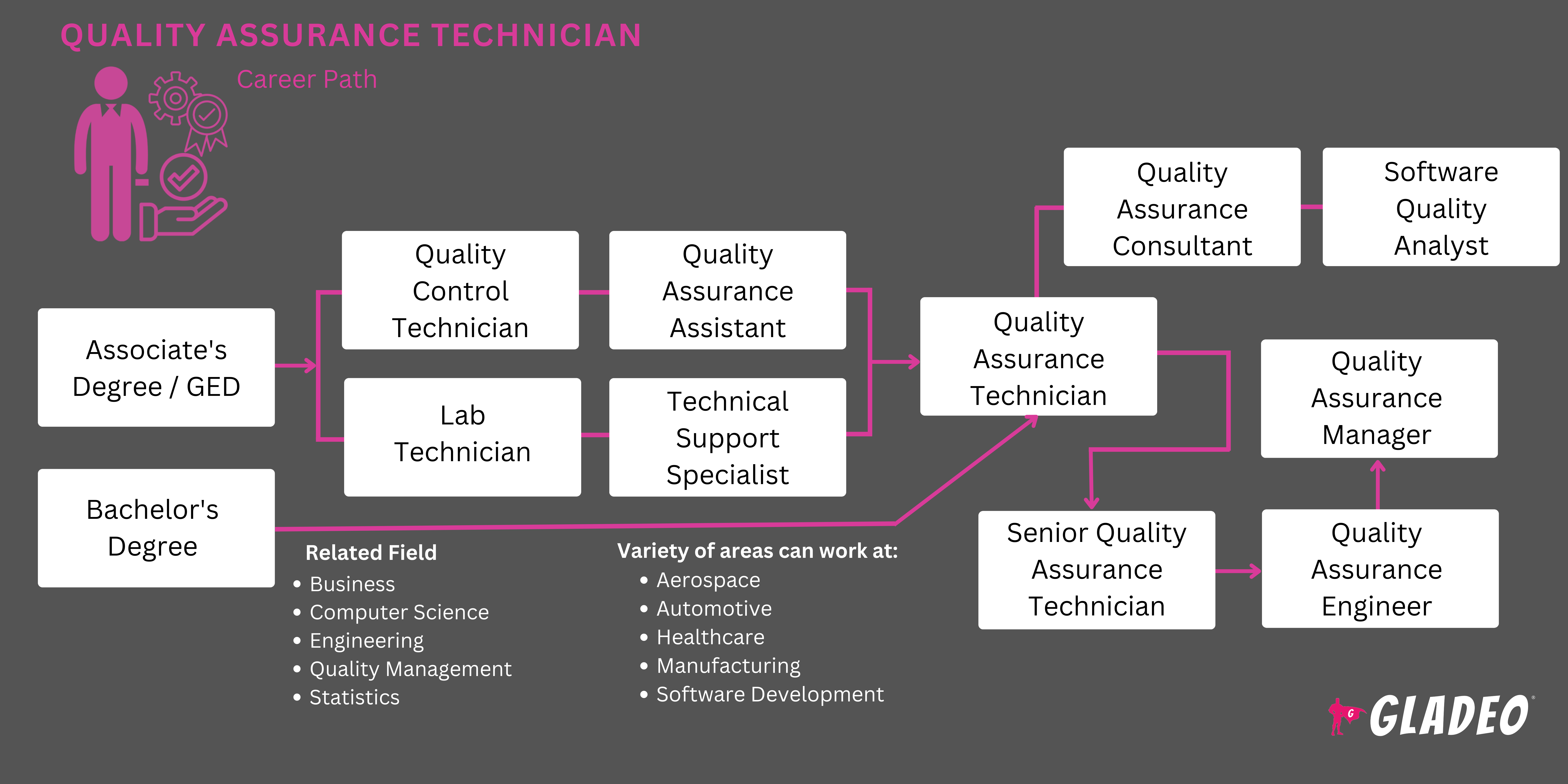
Getting started often involves completing an educational program, gaining hands-on experience through an internship or entry-level manufacturing or laboratory position, and learning the quality standards used in the target industry. Once hired, new technicians typically receive training on company procedures, inspection methods, testing equipment, and documentation systems. With experience and additional certifications, they may advance into roles such as Quality Control Inspector, Quality Engineer, Quality Assurance Specialist, or Quality Manager.
- Take courses in mathematics, statistics, chemistry, biology, physics, and computer science
- Develop strong observation and problem-solving skills by participating in science fairs and laboratory projects
- Learn to use spreadsheets and other computer applications to organize data and track results
- Explore manufacturing, engineering, laboratory science, or information technology clubs and activities
- Visit manufacturing plants, food-processing facilities, or laboratories to learn how quality inspections are performed
- Look for internships, summer jobs, or volunteer opportunities in laboratories, production facilities, or technical workplaces
- Practice measuring objects accurately and recording results using basic measuring tools
- Learn how to read technical documents, instructions, charts, and product specifications
- Consider an associate degree or vocational certificate in quality technology, manufacturing technology, industrial engineering technology, or laboratory science
- Explore software testing courses if you are interested in becoming a Software Quality Assurance Technician
- Research industry certifications offered by the American Society for Quality (ASQ)
- Build communication and teamwork skills by participating in group projects and presenting your findings
- Learn about workplace safety, quality standards, and continuous improvement methods
- Programs accredited by recognized educational or technical accrediting organizations
- A curriculum covering quality assurance, quality control, inspection methods, and manufacturing processes
- Courses in statistics, measurement, data analysis, and problem-solving
- Hands-on training with inspection instruments, testing equipment, and laboratory tools
- Instruction in quality management systems, including ISO 9001 principles
- Opportunities to learn statistical process control (SPC), root cause analysis, and corrective action procedures
- Industry-specific training in food safety, pharmaceutical quality, medical devices, automotive manufacturing, or software testing, depending on your interests
- Access to modern laboratories, manufacturing equipment, testing facilities, or software testing tools
- Internship opportunities or partnerships with manufacturing companies, laboratories, and other employers
- Preparation for relevant professional certifications, such as those offered by the American Society for Quality
- Instructors with professional experience in quality assurance, manufacturing, engineering, or laboratory testing
- Training in technical writing, inspection reports, recordkeeping, and quality documentation
- Clear information about tuition, equipment costs, certification fees, and available financial aid
- Check out job portals such as Indeed, Simply Hired, Glassdoor, and Craigslist
- Look for part-time jobs, internships, apprenticeships, or anything to get your foot in the door so you can start racking up experience
- Ask working QA Technicians for job-seeking tips. Most jobs are still found through networking!
- Connect with your school’s career center for help with resumes, mock interviewing, and finding job fairs
- Check out online Quality Assurance Technician resume templates and review potential job interview questions, such as, “Can you describe a time when you identified a major defect in a product or process? How did you handle it, and what was the outcome?”
- Brush up on terminology and news about the field before heading into interviews. Be ready to discuss your insights about trends and advancements
- Know how to dress for interview success!
- Be diligent about catching issues that need to be fixed before a product goes into full production
- Talk to your supervisor about ways you can boost your knowledge and skills to serve the company better. Show your willingness to knock out extra courses or certifications like Certified Quality Technician or Six Sigma Certification
- Study manufacturer and software guides and specifications so you can be the expert on the things you’re quality control checking
- Set an example for others to follow. Mentor new workers thoroughly and make sure they understand the importance of their tasks
- Always wear appropriate personal protective equipment to avoid mishaps and hazards
- Publish articles related to your field of quality assurance to establish yourself as an industry leader
- Branch out into different types of quality assurance to expand your horizons
- Consider relocating or switching employers if necessary to advance your career!
Websites
- American Society for Quality
- Association for Software Testing
- AT*SQA
- International Organization for Standardization
- International Software Testing Qualifications Board
- National Committee for Quality Assurance
- National Quality Assurance
- QAI Global Institute
- Society of Quality Assurance
- Quality Assurance Association
- Quality Assurance International
- Quality Assurance Magazine
- Quality Digest
- Quality Magazine
Books
- Six Sigma for Dummies, by Craig Gygi
- The Certified Quality Technician Handbook, by Donald W. Benbow
- The Future of Software Quality Assurance, by Stephan Goericke
Virtually every organization needs quality assurance professionals to ensure processes are being done correctly. However, a career in QA can often involve telling other team members or stakeholders things they don’t want to hear! If you’re curious about other options, consider careers such as:
- Aircraft Structure Assembler
- Calibration Technologist
- Electrical and Electronic Equipment Assembler
- Engine Assembler
- Fire Inspector
- Industrial Engineering Technician
- Industrial Machinery Mechanic
- Logistician
- Machine Feeder
- Manufacturing Technician
- Multiple Machine Tool Setter
- Process Improvement Specialist
- Production Supervisor
- Regulatory Affairs Specialist
Newsfeed

Featured Jobs
Online Courses and Tools
Annual Salary Expectations
New workers start around $83K. Median pay is $116K per year. Highly experienced workers can earn around $139K.