







Spotlights
Real Estate Attorney, Property Lawyer, Real Estate Transactional Attorney, Title Attorney, Closing Attorney, Land Use Attorney, Landlord-Tenant Attorney, Real Estate Litigation Attorney, Commercial Real Estate Counsel, Zoning Attorney, Real Property Attorney, Real Estate Closing Counsel
Buying a home is one of the biggest financial decisions most people ever make, and behind every smooth closing, every resolved boundary dispute, and every successful commercial development is a Real Estate Lawyer making sure the deal is airtight. They turn stacks of paperwork and legal risk into keys handed over with confidence, protecting one of the most significant investments a person or business will ever make.
Real Estate Lawyers handle the legal side of buying, selling, leasing, and developing property. They review and draft purchase agreements, examine property titles for hidden liens or ownership disputes, negotiate terms between buyers and sellers, and guide clients through the closing process where ownership officially changes hands. Beyond individual home sales, they also handle zoning issues, help landlords and tenants resolve lease disputes, and represent developers navigating the maze of permits and regulations required to build anything from an apartment complex to a shopping center. Most of the work is transactional and document-heavy, though disputes over property lines, contract breaches, or construction defects sometimes lead to litigation.
Using tools like title search databases, closing software, zoning codes, and property survey records, Real Estate Lawyers catch the problems that could derail a deal or cost a client money for years to come. Their work matters because property is rarely simple: liens, easements, zoning restrictions, and contract fine print can turn a dream home or a promising development into a legal headache without someone experienced watching every detail.
- Helping first-time homebuyers close on a house and start a new chapter of their lives
- Untangling complicated title issues that could otherwise derail a family's biggest purchase
- Guiding developers through the process of turning empty land into thriving communities
- Combining careful, detail-oriented work with the satisfaction of a clean, completed deal
Working Schedule
Most Real Estate Lawyers work full-time, with workload often tied to the local real estate market, busier during peak buying and selling seasons and around commercial development deadlines. The job is largely office-based, reviewing contracts and title reports, though closings often happen in person at a title company, bank, or law office. Some travel to properties for site visits or to attend zoning board meetings. Real Estate Lawyers work at real estate-focused law firms, title companies, general practice firms with a real estate department, corporate real estate development teams, or as solo practitioners handling residential closings.
Typical Duties
- Drafting and reviewing purchase agreements, leases, and other real estate contracts
- Conducting title searches to identify liens, easements, or ownership disputes
- Coordinating and conducting property closings for buyers, sellers, and lenders
- Advising clients on zoning laws and land use restrictions
- Negotiating terms between buyers, sellers, landlords, and tenants
- Resolving boundary disputes and easement disagreements between property owners
- Representing developers in permitting and regulatory approval processes
- Reviewing mortgage and financing documents for accuracy and compliance
- Advising landlords and tenants on lease terms and eviction procedures
- Handling foreclosure proceedings on behalf of lenders or homeowners
- Drafting homeowners association documents and covenants
- Representing clients in real estate litigation over contract breaches or construction defects
Additional Responsibilities
- Staying current on state and local real estate law and zoning regulations
- Managing escrow accounts and closing funds accurately
- Coordinating with real estate agents, lenders, surveyors, and title companies
- Training or supervising paralegals and closing coordinators
- Reviewing environmental assessments for commercial property transactions
- Advising on 1031 exchanges and other tax-related real estate strategies
- Participating in continuing legal education on real estate law updates
- Managing a high volume of simultaneous transactions and closing deadlines
A Real Estate Lawyer's morning often starts with reviewing a title report for an upcoming closing, checking for any liens or unresolved claims that could hold up the sale. They might spend an hour on the phone with a lender, confirming that financing documents are ready for a closing scheduled later that week.
Midday often includes a closing itself, sitting down with a buyer, seller, and their agents to review and sign the final paperwork that transfers ownership. Between closings, they draft or revise purchase agreements, working through negotiations over repair credits, contingencies, or closing dates. They may also field a call from a commercial client asking whether a proposed development complies with local zoning.
Afternoons can bring research into a boundary dispute between two neighboring property owners, or a meeting with a developer's team to review permitting requirements for a new project. Real Estate Lawyers often end the day organizing files for the next round of closings, since the job depends on juggling multiple transactions moving through the pipeline at once.
Soft Skills
- Attention to detail
- Strong organizational skills for managing multiple transactions
- Clear written and verbal communication
- Negotiation skills
- Patience explaining legal steps to clients unfamiliar with real estate law
- Problem-solving when title issues or disputes arise
- Time management and ability to meet closing deadlines
- Professionalism under pressure during high-stakes transactions
- Collaboration with agents, lenders, and title companies
- Trustworthiness, since clients rely on you to protect major financial decisions
- Composure during contentious landlord-tenant or boundary disputes
- Persuasive advocacy when litigation becomes necessary
Technical Skills
- Deep knowledge of property, contract, and real estate law
- Title search and examination
- Contract and lease drafting and review
- Closing and escrow procedures
- Zoning and land use regulation knowledge
- Mortgage and financing document review
- Legal research and case law analysis
- Familiarity with construction and development permitting processes
- Real estate transaction and closing management software
- Basic understanding of property surveys and easements
- Residential Real Estate Attorney: Handles home purchases, sales, and closings
- Commercial Real Estate Attorney: Focuses on office, retail, and industrial property transactions
- Title Attorney: Specializes in researching and resolving title and ownership issues
- Land Use and Zoning Attorney: Advises developers on permitting and regulatory approval
- Landlord-Tenant Attorney: Handles lease disputes and eviction proceedings
- Real Estate Litigation Attorney: Represents clients in property-related lawsuits
- Foreclosure and Real Estate Finance Attorney: Handles mortgage default and lender representation
- Construction Law Attorney: Focuses on disputes over building defects and contractor agreements
- Real estate-focused law firms
- Title insurance companies
- General practice law firms with a real estate department
- Real estate development companies
- Commercial and residential brokerages with in-house counsel
- Banks and mortgage lenders
- Property management companies
- Homeowners associations and management firms
- Government planning and zoning departments
- Real estate investment trusts (REITs)
- Solo private practice specializing in closings
- Construction and general contracting firms
Real estate transactions run on tight, unmovable deadlines. Closings are scheduled around financing timelines, moving dates, and multiple parties' calendars, so Real Estate Lawyers must work efficiently under constant time pressure with little room for delay. A missed deadline can cost a client their financing or even the deal itself.
The work requires extreme attention to detail. A single overlooked lien, an incorrectly recorded easement, or a clause buried in a hundred-page commercial lease can cause serious financial harm to a client years down the road, so there is little tolerance for careless mistakes. This level of precision, transaction after transaction, requires real mental stamina.
Because much of the work is transactional and volume-driven, especially in residential practice, Real Estate Lawyers can end up managing many deals simultaneously, which demands strong organizational systems and the ability to switch between very different clients and property types throughout a single day without losing track of critical details.
- Growth of e-closings and remote online notarization for real estate transactions
- Increasing use of blockchain and digital title records in some markets
- Rising demand for real estate attorneys amid housing affordability and zoning reform debates
- Greater use of automated title search and document review technology
- Growth of build-to-rent and mixed-use developments creating new zoning challenges
- Increased scrutiny of short-term rental regulations affecting property owners
- Rising interest in sustainable building codes and green development incentives
- Expansion of commercial real estate work in logistics and warehouse space
- Growing complexity in landlord-tenant law amid rent control and eviction moratorium changes
- More use of legal tech platforms to manage high-volume residential closings
Many Real Estate Lawyers were naturally organized as kids, the ones who kept careful notes, managed group projects well, and enjoyed puzzles or detail-oriented tasks. Some grew up around family members in real estate, construction, or property management and developed an early interest in how homes and buildings get bought, sold, and built.
Others were drawn to negotiation and problem-solving, enjoying activities like debate, business clubs, or even running a small entrepreneurial venture. A combination of strong organizational instincts, comfort with detailed paperwork, and an interest in property and business often points students toward this steady, in-demand specialty.
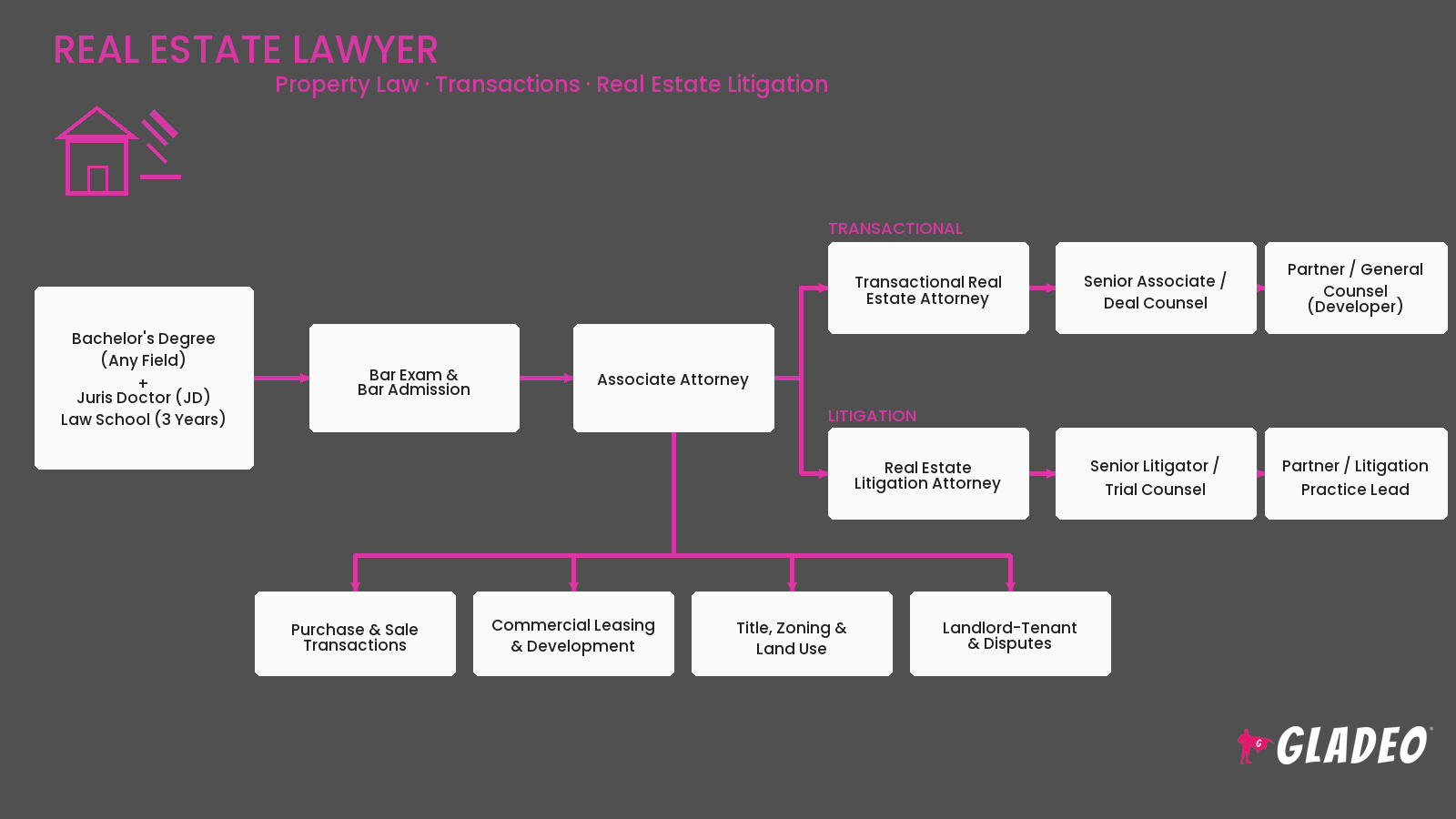
Becoming a Real Estate Lawyer starts with a four-year bachelor's degree in any field, though business, finance, economics, and urban planning are useful choices. Law school follows, a three-year program leading to a Juris Doctor (JD) degree, ideally with electives in property law, real estate transactions, and land use. After graduation, passing the state bar exam is required to practice, and many Real Estate Lawyers gain early experience through internships at real estate firms or title companies.
Students can take courses in relevant subjects such as:
- Property Law
- Real Estate Transactions
- Contracts
- Land Use and Zoning Law
- Real Estate Finance
- Landlord-Tenant Law
- Business Associations
- Legal Writing and Research
- Construction Law
- Tax Law as it relates to real estate
Hands-on experience is highly valuable in this field. Internships or clerkships at real estate law firms, title companies, or developers give students real exposure to closings, title review, and contract negotiation. Many Real Estate Lawyers start their careers as closing coordinators or title examiners before becoming full attorneys, building practical skills that classroom study cannot fully replicate. Continuing legal education keeps practicing attorneys current on changing zoning, financing, and real estate regulations.
- Take business, economics, and finance courses to understand real estate markets
- Join debate team or a business club to build negotiation and communication skills
- Volunteer or work part-time with a real estate agency, title company, or property management firm
- Shadow a real estate attorney or attend a home closing if a family member allows it
- Practice organizational skills through activities that require managing multiple deadlines
- Research pre-law tracks and law schools with strong real estate law programs
- Talk to real estate attorneys, agents, or title examiners about their day-to-day work
- Take a personal finance or math class to build comfort with mortgage and financing concepts
- Explore internships or part-time work at law firms during summers
- Study local government and civics to understand how zoning and permitting work
- Build attention to detail through activities like editing, accounting, or precise craft work
- Practice reading and summarizing lengthy documents accurately
- Law schools with a real estate law clinic or transactional law program
- Faculty with real experience in real estate transactions or land use law
- Strong bar passage rates in the state where you plan to practice
- Opportunities for externships with real estate firms, title companies, or developers
- Coursework in property law, real estate finance, and zoning
- Access to transactional skills training, not just litigation-focused courses
- Career services with connections to real estate law firms and title companies
- Programs offering joint degrees in law and business or urban planning
- Strong alumni network in real estate and property law
- Location near active real estate markets for internship opportunities
- Opportunities to shadow or assist with real closings during school
- Flexible scheduling if you plan to work while attending law school
- Complete an internship or clerkship at a real estate law firm or title company
- Seek entry-level roles such as Associate Attorney, Closing Coordinator, or Title Examiner
- Build relationships with real estate agents, lenders, and title companies during law school
- Volunteer for legal aid clinics that handle landlord-tenant or housing cases
- Network through your state bar's real property section
- Highlight any experience with contracts, closings, or property transactions on your resume
- Pass the bar exam and consider joining the American Bar Association's real property section
- Practice reviewing a sample purchase agreement and explaining key terms clearly in interviews
- Consider starting at a title company or general practice firm to build broad real estate experience
- Attend real estate law conferences and CLE seminars to meet practicing attorneys
- Offer to assist senior attorneys with title searches to prove your attention to detail
- Show genuine reliability and organization in interviews, since clients trust you with major transactions
- Take on increasingly complex commercial or development transactions
- Build a reputation for smooth, error-free closings and thorough title work
- Pursue certification in real estate law where offered by your state bar
- Develop a steady referral network among real estate agents and lenders
- Publish articles or speak at CLE events to establish expertise in a subspecialty
- Move from associate to partner, or open your own real estate law practice
- Mentor junior attorneys and closing coordinators on transaction management
- Get involved in real estate bar sections or local real estate industry associations for leadership opportunities
Websites:
- American Bar Association Section of Real Property, Trust and Estate Law - americanbar.org
- American Land Title Association - alta.org
- National Association of Realtors - nar.realtor
- Urban Land Institute - uli.org
- American College of Real Estate Lawyers - acrel.org
- Justia Real Estate Law Center - justia.com/real-estate
- FindLaw Real Estate Law Center - findlaw.com/realestate
- National Association of Real Estate Brokers - nareb.com
- Mortgage Bankers Association - mba.org
- American Planning Association - planning.org
- International Council of Shopping Centers - icsc.com
- Law School Admission Council (LSAC) - lsac.org
- Commercial Real Estate Development Association (NAIOP) - naiop.org
- National Apartment Association - naahq.org
Books:
- Real Estate Law by Marianne M. Jennings
- The Complete Guide to Real Estate Law by Denise Evans
- Property by Jesse Dukeminier and James E. Krier
- Real Estate Transactions: Problems, Cases, and Materials by Robin Paul Malloy
- How Real Estate Developers Think by Peter Hendee Brown
If you find that being a Real Estate Lawyer isn't the right path for you, your skills in contracts, negotiation, and property knowledge transfer well to related careers.
- Real Estate Agent or Broker
- Title Examiner
- Property Manager
- Mortgage Loan Officer
- Real Estate Developer
- Land Use Planner
- Escrow Officer
- Commercial Leasing Agent
- Real Estate Investment Analyst
- Zoning and Permitting Specialist
Click here to download the infographic
Newsfeed

Featured Jobs
Online Courses and Tools